
The conditions shaping commercial economics
Macroeconomics & Monetary Policy — Rates, currencies, growth and inflation.
Capital Markets & Trade Finance — Funding, liquidity and investment flows.
Energy — Fuel, power and feedstock economics.
The forces shaping global trade do not operate independently. Neither should the intelligence used to understand them.
Energy influences industrial inputs. Policy changes capital allocation. Demographics reshape consumption. Technology transforms production and logistics. Each development can create consequences across markets, industries, and enterprises.
Meridian connects twelve interdependent domains to identify relationships, transmission mechanisms, and emerging developments that conventional analysis can overlook.
Explore the Methodology →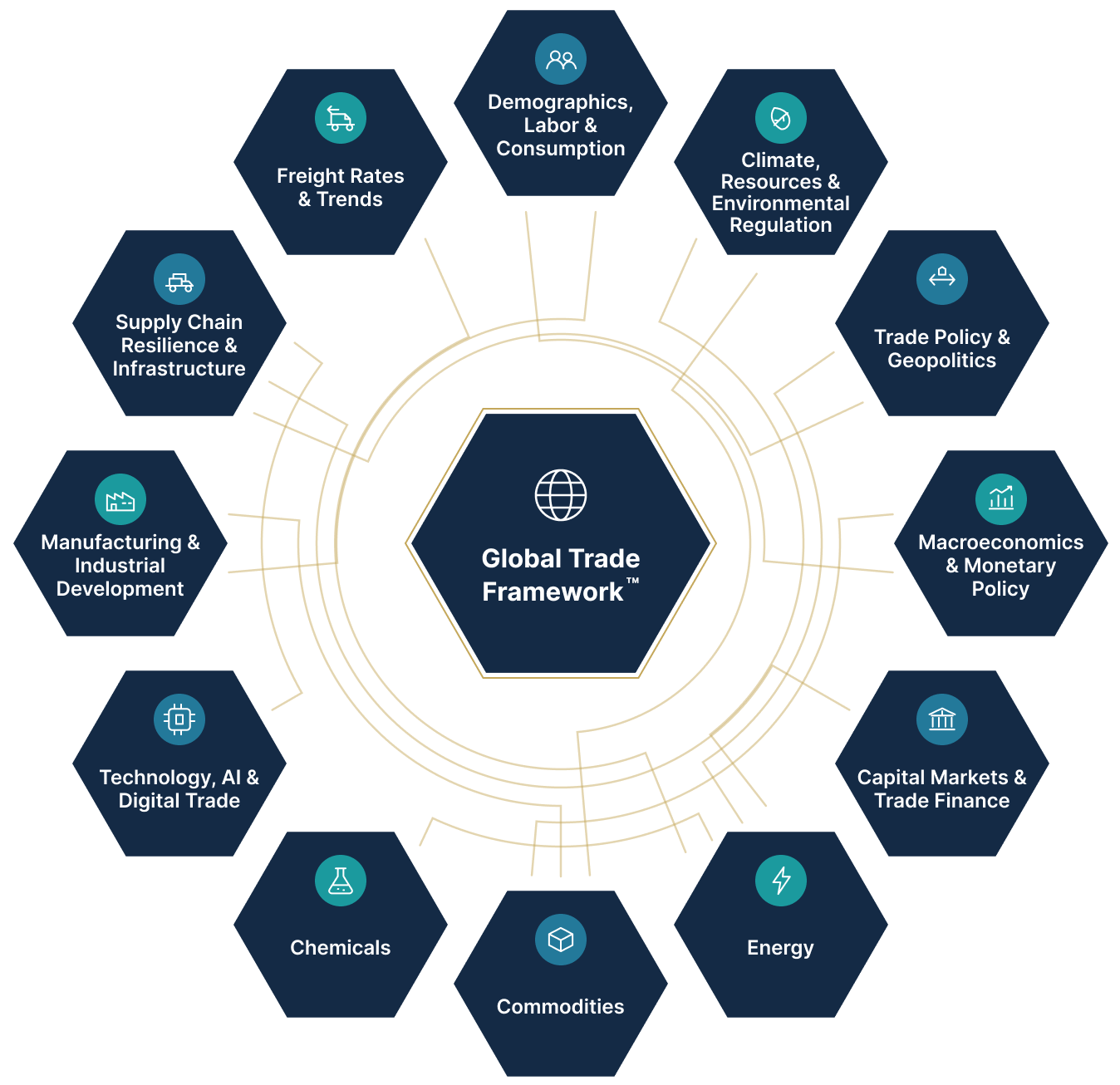
A change in energy costs can alter chemical production economics, influence manufacturing locations, shift freight demand, and ultimately change competitiveness thousands of miles away. The Framework examines these relationships instead of treating every market signal as an isolated headline.
Illustrative transmission pathway; outcomes depend on market conditions and are not deterministic.
The twelve domains form one analytical system. The groupings below help explain their coverage; they do not replace the Framework's official domain structure.
Macroeconomics & Monetary Policy — Rates, currencies, growth and inflation.
Capital Markets & Trade Finance — Funding, liquidity and investment flows.
Energy — Fuel, power and feedstock economics.
Chemicals — Industrial intermediates and process economics.
Commodities — Resource availability, prices and flows.
Manufacturing & Industrial Development — Capacity, location and production shifts.
Trade Policy & Geopolitics — Tariffs, restrictions and geopolitical exposure.
Freight Rates & Trends — Capacity, routing and transport economics.
Supply Chain Resilience & Infrastructure — Network constraints and continuity.
Technology, AI & Digital Trade — Automation and digital market change.
Demographics, Labor & Consumption — Workforce and demand patterns.
Climate, Resources & Environmental Regulation — Resource constraints and regulatory shifts.
Meridian's six-stage analytical discipline tests evidence, traces indirect consequences, develops forward-looking scenarios, and turns connected intelligence into strategic options.
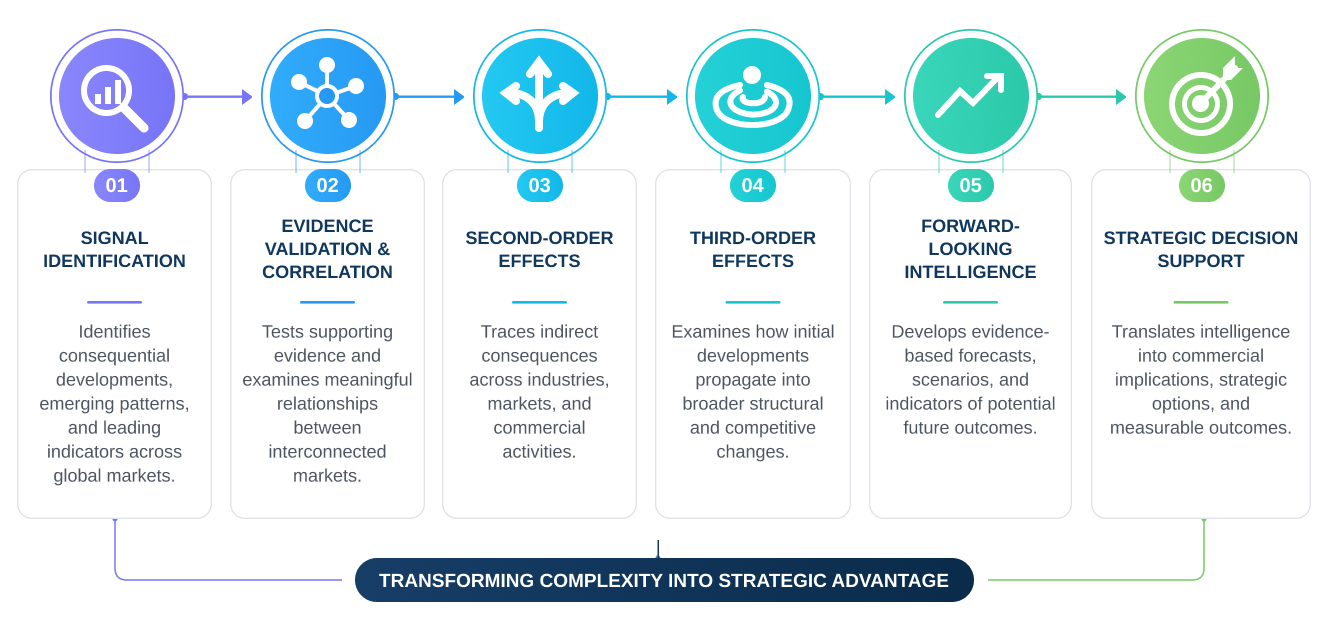
01 Signal identification. Find emerging developments and leading indicators.
02 Evidence validation & correlation. Test sources and meaningful relationships.
03 Second-order effects. Trace indirect market and commercial consequences.
04 Third-order effects. Examine structural and competitive propagation.
05 Forward-looking intelligence. Develop scenarios and indicators to monitor.
06 Strategic decision support. Connect findings to choices and measurable outcomes.
Daily intelligence connects consequential developments across the twelve domains.
Proprietary analytical measures translate external forces into enterprise exposure, opportunity and decision latitude.
Executive guidance and practical implementation informed by a connected view of global markets.
Global trade is interconnected. Your intelligence should be, too.
Discuss Your Priorities →