
Britain's Carbon Border Charge Will Be Set by 2027 Supplier Records, Long Before Registration Opens
HMRC's October 16 default values put a product-by-product number on missing emissions data, and its guidance bars an importer from replacing a default-based return with actual data later.

HMRC's October 16 default values put a product-by-product number on missing emissions data, and its guidance bars an importer from replacing a default-based return with actual data later. Elsewhere in the layer, this week's water and waterway evidence describes constraints that are local and quick to reverse, which calls for operating triggers rather than national headlines.
Executive Takeaway
The most consequential development this week is administrative. On October 16, HM Revenue & Customs published product-level default emission values for the UK Carbon Border Adjustment Mechanism, together with a draft notice that would give those defaults legal force for 2027 and 20281,2,3. They sit on a calendar set out in HMRC's policy guidance: the mechanism commences on January 1, 2027, the first accounting period is calendar 2027, registration opens on January 1, 2028, and the first return and payment are due on May 31, 20284. Seventeen months separate the first taxable import from the first payment, which invites deferral. HMRC's guidance removes most of the room for it. Records are required from the first import5, and a return completed with default values cannot later be amended to use actual emissions data2,3. For an importer of specified aluminum, cement, fertilizer, hydrogen or iron and steel goods, whether its 2027 liability rests on a supplier's verified emissions or on a marked-up default will largely be settled by what it secures from suppliers before and during 2027, not by anything it does when registration opens.
The Meridian's reading is that supplier data, not the tax rate, is the binding constraint for most affected importers over the next ten weeks. The research did not establish the 2027 rates that will apply, so no cash liability is calculated here. Defaults are not always the worse outcome: where verification costs more than it saves, or where a supplier's actual intensity is no lower than the default, filing on defaults is rational. What the October publications change is that the trade-off now carries published numbers, that the number depends on the exact commodity code, and that the guidance treats a default filing as final. This edition's single Call to Audit tests whether the default regime enters into force for 2027 imports with that substitution bar intact.
The physical-resource evidence argues against treating national or seasonal headlines as operating conditions. The government declared severe drought in parts of six southern and south-western English counties on October 15, and the number of reservoirs or groups classed as exceptionally low rose from 8 to 11, yet formal abstraction-license restrictions fell from 536 to 449 and national storage held at 54%6,7. On the Boven-IJssel, Rijkswaterstaat reinstated one-way navigation on October 14, two days after it had expected to lift it, because less rain fell than forecast8; Maersk had announced Dutch low-water surcharges and a €178-per-container contingency charge for affected inland services the day before9,10. On the Mississippi, recommended barge drafts are restricted between river miles 869 and 303 while the lower river reports 50-foot deep-draft access to mile 18011,12. In each case the exposure turns on a specific reach, reservoir or license, and on how quickly the condition reverses.
Regulatory deadlines elsewhere are approaching without the disruption sometimes attached to them. The EU ban on exporting plastic waste for recovery to countries outside the OECD applies from November 21 under a regulation adopted in 2024, and its transitional provisions mean the date is neither a universal stop nor a general exemption13. On rounded 2025 figures, roughly 670,000 tons went to destinations outside the OECD, a measure of historical exposure rather than volume already displaced14. Three broader narratives did not survive the evidence. Broker data show commercial property rates falling at double-digit rates in the second quarter, which contradicts a market-wide insurance retreat15,16. The World Bank's new mineral compacts are plans whose own documents list unmet power and regulatory prerequisites17,18,19. And Kawasaki's 50-tonne-per-day hydrogen liquefaction plant has started construction, with completion scheduled for the end of 202820, which is a milestone, not supply.
This is the first Climate, Resources & Environmental Regulation edition with a Meridian forecast record, so there are no earlier positions in this layer to reaffirm or revise.
Editorial Analysis
HMRC's Default Values Turn Missing Supplier Data Into a Fixed Tax Choice
On October 16, HMRC published the numbers that will stand in for missing emissions data under the UK Carbon Border Adjustment Mechanism (CBAM). Guidance pages for hydrogen and for iron and steel list a default intensity for each eight-digit commodity code2,3, and a draft Default Values Force of Law Notice sets out the values and the period they would cover1. The same day HMRC updated its policy summary, which states that the mechanism will commence on January 1, 2027, will apply across the whole of the UK including Northern Ireland, and covers specified goods in the aluminum, cement, fertilizer, hydrogen, and iron and steel sectors4.
The defaults are not yet law. HMRC labels the default-values notice a draft, and its publication page for the force-of-law notices states that the draft notices have not commenced and do not currently have the force of law, with commencement intended for January 1, 20271,21. The draft cites Schedule 17 to the Finance Act 2026 as the source of its legal effect and is written in operative language; that wording does not override the draft label1. Every value discussed below is HMRC's published proposal for 2027 and 2028, not a figure in force.
The calendar is older than the October publications and is the part most easily misread. According to the policy summary, the first accounting period runs from January 1 to December 31, 2027; registration opens on January 1, 2028, with first-year registrants given until January 31, 2028; and the first return and payment are due on May 31, 20284. Registration is an administrative step that follows a year of liability, not a precondition for it. HMRC's records guidance requires importers to keep records for CBAM goods from January 1, 2027: the eight-digit commodity code and description, the date the goods passed the tax point, value, net mass in kilograms excluding packaging, and evidence for any exemption; proof of origin for goods on a return; and, where actual emissions are reported, the verification reports that support them5. Records must be kept for six years, and HMRC says a fixed penalty of £500 may apply for failing to keep them5.
Exhibit 1. UK CBAM: liability and records start a year before registration and seventeen months before payment
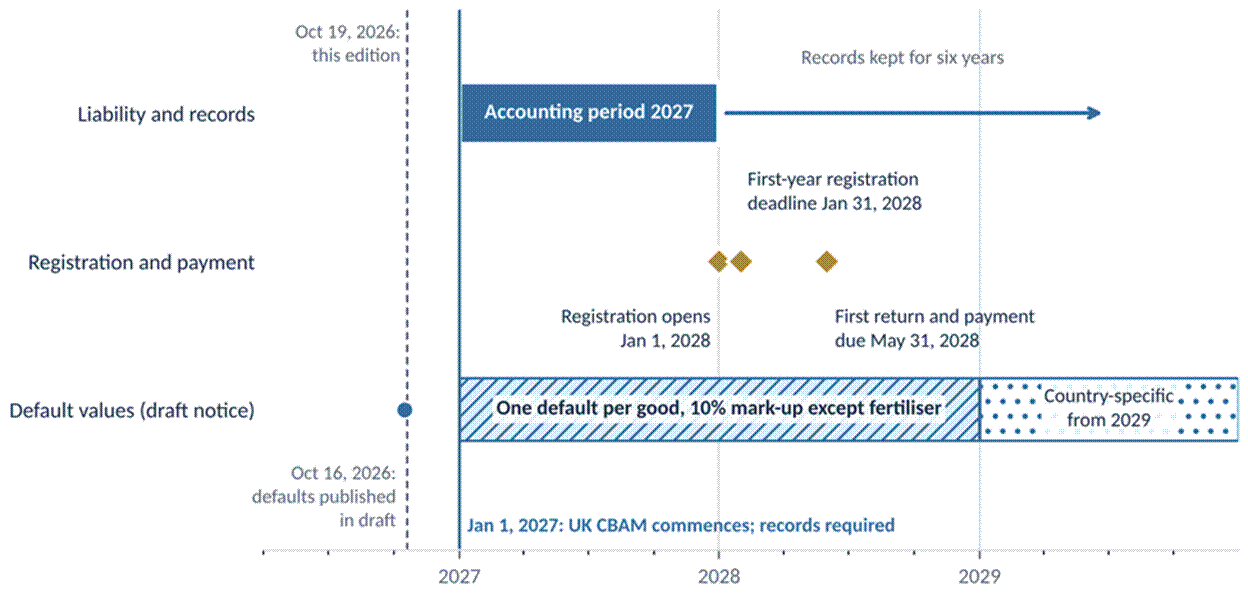
Note: Milestones from HMRC's policy summary (updated October 16, 2026) and records guidance. Default-value period and design from HMRC's Default Values Force of Law Notice (Draft), first published October 16, 2026, which has not commenced and does not have force of law. Hatched and dotted bars denote draft provisions. The six-year retention period runs from the later of record creation or the end of the related accounting period; the arrow is schematic.
Sources: [1] [4] [5] (see Sources).
The rule that makes the choice permanent
The most consequential sentence in the October 16 material is short. On both the hydrogen and the iron and steel pages, HMRC states that if a CBAM return uses default values, the importer cannot amend it later with actual emissions data2,3. The guidance also limits how the two methods may be mixed: default values may be used for precursor goods when actual data cover the processes that turn them into the final good, but actual precursor data may not be paired with a default for the final good2. The rule concerns substituting actual emissions for defaults. It is not a general bar on correcting a return, and HMRC's records guidance separately anticipates repayment claims for errors5.
Read with the calendar, the rule moves the practical decision forward by more than a year. An importer files its first return in May 2028, but whether that return can use actual emissions depends on whether, for goods that crossed the tax point during 2027, it holds emissions data from the producing installation that an accredited verifier has checked. That evidence has to come from the foreign supplier, and the cleanest opportunity to require it is in the purchase contracts now being negotiated for 2027 delivery. An importer that reaches 2028 without it will find that its options depend on monitoring its supplier needed to have carried out during 2027. Once it files on defaults, the choice is closed for that return.
The window is narrower than the calendar suggests because parts of the actual-emissions rulebook have not yet been published. As of October 19, HMRC's records page says verification details will be published before January 1, 2027, and that guidance on monitoring, verifying and reporting actual emissions will follow later this year. The same page still says default values will be set later in the year, although they appeared on October 165. Guidance pages updated on different dates are a practical hazard in themselves; compliance teams should record which version of each page they relied on.
What the defaults look like
The draft notice provides one default per good for 2027 and 2028, applies a 10% mark-up in every sector except fertilizer, where no mark-up is applied, and states that the UK will move to country-specific defaults from 20291. Where a supplier's verified intensity sits at the average underlying the default, the mark-up alone makes a default-based figure about a tenth higher. The draft notice describes its values as including the mark-up. The Meridian has not confirmed line by line that the guidance tables reproduce the notice's tables, so no further mark-up should be layered onto the published guidance values.
The values are specific to the commodity code, and the differences matter. Hydrogen under CN 28041000 carries 28.378 tons of CO2-equivalent per ton of product. Among the iron and steel codes, hot-rolled flat coil at least 600 mm wide with patterns in relief (CN 72081000) carries 2.722; pickled hot-rolled coil at least 4.75 mm thick without patterns in relief (CN 72082500) carries 2.823; and a specified non-alloy pig iron (CN 72011011) carries 1.3312,3. The two hot-rolled coil codes differ by about 3.7%. Classification, which already determines duty, will also determine the emissions figure on any default-based return.
Exhibit 2. Selected UK CBAM default values and embedded emissions for a hypothetical 1,000-tonne import
|
CN code |
Product (abridged) |
Default value (tCO2e per tonne) |
Embedded emissions, 1,000 t (tCO2e, Meridian
calculation) |
|
28041000 |
Hydrogen |
28.378 |
28,378 |
|
72081000 |
Hot-rolled flat steel in coils, width 600 mm
or more, with patterns in relief |
2.722 |
2,722 |
|
72082500 |
Hot-rolled flat steel in coils, width 600 mm
or more, thickness 4.75 mm or more, pickled, without patterns in relief |
2.823 |
2,823 |
|
72011011 |
Non-alloy pig iron of specified phosphorus,
manganese and silicon content |
1.331 |
1,331 |
Note: Default values as published in HMRC guidance on October 16, 2026; selected codes only, not a full table audit. Values are prospective defaults under a draft notice that has not commenced; they are not measured supplier intensities. The draft notice states that a 10% mark-up has been applied in all sectors except fertilizer; no further mark-up is applied here. The 1,000-tonne quantity is hypothetical; emissions = default value × 1,000. These are emissions quantities, not tax: no UK CBAM rate or carbon price relief is applied.
Sources: [1] [2] [3] (see Sources).
Exhibit 2 converts the selected defaults into embedded emissions for a hypothetical 1,000-tonne import. These are emissions quantities, not tax. The research did not establish the 2027 rates that will apply to each sector, the treatment of a carbon price paid abroad for a specific good, or an actual shipment, so The Meridian does not convert them into a sterling liability4,5.
Who is exposed, and where the exposure sits
The registration threshold is a value test, not a weight test. On any given day, a person must consider whether imports expected to pass the tax point over the next 30 days will reach £50,000; on the first day of each month, whether imports over the preceding 12 months have done so, with the 2027 look-back starting on January 1, 20274. This is a different test from the EU's 50-tonne exemption and should not be treated as equivalent to it22. Coverage is limited to specified goods within the five sectors; a sector name on its own does not establish that a particular product is in scope4.
Inside an importing business, the exposure falls in three places. Procurement holds the only lever that produces verified actual data: a contractual obligation on the supplier to provide installation-level emissions and to give an accredited verifier access, written into contracts for 2027 deliveries that are being priced now. Customs and compliance teams own classification and the records listed above, and a code error now changes the emissions figure as well as the duty. Finance carries a liability that accrues through 2027 but is paid in May 2028, a full year of exposure to estimate and accrue before any cash leaves. These are inferences from the calendar and the substitution rule. The research found no evidence that importers have already incurred losses or that the market as a whole is unprepared.
Two boundaries need care. HMRC's scope includes Northern Ireland4, but that does not settle how the EU's own CBAM treats goods moving through Northern Ireland, where October changes to the Commission's guidance remain under legal review (Section 04). And the policy summary states that no jurisdiction is currently exempt and that no international arrangements are in place4, so EU-origin goods are within scope today. Any UK–EU arrangement that changed that would need to be traced to an operative instrument before it informs a sourcing decision.
The case for defaults, and what would prove this view wrong
The strongest counterargument is that defaults will be a sound choice for many importers. Verification costs money and requires supplier cooperation, and for an importer with modest volumes, or a supplier whose actual intensity is at or above the default, filing on defaults may be cheaper and simpler. Because the 2027–2028 defaults are a single value per good rather than country-specific1, the default can also work as a ceiling for an importer whose supplier's verified emissions would exceed it; that protection narrows when country-specific values arrive in 2029. The Meridian's argument is narrower than "always use actual data": the choice should be made deliberately and early, because the guidance treats it as final for a filed return, and the importer that discovers in 2028 that it wanted actual data will depend on monitoring that had to happen in 2027.
This assessment would weaken materially if the final notices or guidance allowed a default-based return to be amended to actual emissions, if commencement were delayed, if a lawful exemption or relief removed specific goods from scope, or if verified supplier data proved to be widely available already. It would be supported by commencement on the published calendar with the substitution bar intact, which is the subject of this edition's Call to Audit. The nearer catalysts are HMRC's promised verification details and actual-emissions guidance, both due before January 1, 2027 on the records page's own timetable5.
CLIMATE, RESOURCES & ENVIRONMENTAL REGULATION — FIXED INTELLIGENCE COVERAGE
01. Climate Conditions, Extreme Weather & Physical Risk
Lower Mississippi: drought worsens, navigation limits stay reach-specific
The US Drought Monitor released on October 15, valid for October 13, shows drought worsening across the Lower Mississippi region and exceptional drought expanding in parts of Arkansas and northern Louisiana23. NOAA's seasonal outlook issued the same day favors improvement across much of the South from November through January, while noting long-term impacts and limited winter precipitation in northern areas24. The outlook is a probability statement about the coming season. It does not describe the draft a barge can carry this week.
The navigation constraint is defined by reach. The Coast Guard's October 16 compilation of notices to mariners carries a low-water safety advisory for river miles 869 to 303, recommending southbound drafts of 11.6 feet between miles 869 and 585 and 12.6 feet between miles 585 and 303, a northbound draft of 10.6 feet, and limits on tow width and length11. The document does not establish that these recommendations tightened during the week. On the lower river, an October 16 port bulletin reports 50-foot deep-draft access to mile 18012, and the USGS gauge at Baton Rouge read a provisional 324,000 cubic feet per second at 11:15 CDT on October 1925; neither downstream observation clears the shallow upstream reaches. The same Coast Guard compilation separates a Vicksburg bridge span affected by low water from a construction closure of the I-55 Arkansas span scheduled for October 19 to November 211. Counting both as drought losses would confuse weather with works.
The commercial chain is plausible but unmeasured. A restricted reach reduces loading or forces a different tow configuration, which can mean more voyages, waiting time and changes to inventory timing for grain, fertilizer and chemicals moving by barge. The research found no barge counts, tonnage, transit records or matched freight series with which to size that effect, and no claim of a river-wide closure is supported. The next Drought Monitor release is due October 22.
Netherlands: a two-day reversal
Rijkswaterstaat had indicated that one-way navigation on the Boven-IJssel, in place since September 25, could be lifted on October 12 once the water level reached 1.45 meters. On October 14 at 09:00 it reinstated the restriction between IJsselkop and Zutphen because less rain fell than expected and the level dropped back below that threshold8. The commercial consequences are covered in Section 10.
England and Asia
In south-west England, a BBC account attributed to meteorological records gives 49 mm of rain at Exeter between September 1 and October 15 against a 106 mm average for the same period, about 54% below26. It is secondary corroboration of a dry autumn, not a national anomaly. Maersk's October 7 Asia-Pacific update described improving port productivity and no significant further disruption from a late-September typhoon, without naming affected ports or quantifying delays27; older Asian disruption reports have not been carried forward as current closures. Coverage incomplete: the research obtained no current insured-loss estimate and no operator-confirmed Asian port observations for the week.
02. Water Availability, Scarcity & Industrial Competition
England: stable national storage, deteriorating local reservoirs
The Environment Agency's report for October 9 to 15 records that the government declared severe drought on October 15 in parts of Cornwall, Devon, Dorset, Somerset, East Sussex and West Sussex, after Yorkshire moved into drought on October 96. National reservoir storage for the week ending October 13 was 54%, unchanged at the reported precision and, on the Agency's description, about 21% below the long-term average. Beneath that stable aggregate, the number of reservoirs or groups classed as exceptionally low rose from 8 to 11, while the number below half full fell from 19 to 186,7.
Restrictions on abstractors moved the other way. Formal restrictions on abstraction licenses fell from 536 to 449, a decline of 87 or 16.2%; voluntary restrictions cutting abstraction by half held at 1,383, and flexible-abstraction requests from agriculture held at 426,7. River flows improved on balance: on the Agency's category counts, 40 of 55 reported sites were below normal or worse, down from 44. In the north-west, United Utilities' Strategic Resource Zone moved out of drought level 1 on October 136.
Exhibit 3. England's drought indicators moved in opposite directions in the latest week
|
Indicator |
Report for Oct 2–8 (reservoirs: week ending Oct 6) |
Report for Oct 9–15 (reservoirs: week ending Oct 13) |
Change |
|
National reservoir storage |
54% |
54% |
0 pp at reported precision |
|
Reservoirs or groups classed exceptionally
low |
8 |
11 |
+3 |
|
Reservoirs or groups below 50% full |
19 |
18 |
−1 |
|
Formal abstraction-license restrictions |
536 |
449 |
−87 (−16.2%) |
|
Voluntary restrictions (50% reduction) |
1,383 |
1,383 |
0 |
|
Flexible-abstraction requests (agriculture) |
42 |
42 |
0 |
|
River sites below normal or worse |
44 of 55 |
40 of 55 |
−4 (derived) |
Note: Counts are of reservoirs, restrictions, requests and monitoring sites; they are not facilities, volumes withheld or output lost. River-site figures are derived from the Agency's category counts. Percentage change is a Meridian calculation.
Sources: [6] [7] (see Sources).
The divergence is the finding. Rain that lifted river flows, and with them many of the license conditions tied to those flows, has not refilled the reservoirs that supply particular zones in the south and south-west. Exposure therefore depends on which reservoir or river a supply zone or license draws on, and the counts cannot be translated into facilities affected, water withheld or output lost. Reservoir levels also reflect outages, maintenance and flood-storage rules, and companies can protect supply with transfers and demand restraint6.
The instruments that would reach businesses are pending rather than in force. South East Water applied on October 2 and South West Water on October 6 for drought orders that would permit non-essential use bans, and Southern Water's July 31 applications for a River Test drought order and a non-essential use order await a decision by the Secretary of State6. Non-essential use orders are the step that can extend restrictions beyond households to specified commercial uses; an application is not an order, and no compulsory curtailment of a named industrial site was found. Drought permits granted in late September and early October to South East Water at Ardingly, Thames Water at Farmoor and South West Water at Wimbleball allow abstraction beyond normal license terms, which protects public supply but can shift pressure onto river ecology6. Ardingly itself illustrates the need for precise figures: an operator statement that it was below 17% full was corrected to 19.4%28. The Agency also reports that some farmers are considering smaller plantings of irrigated high-value vegetables for 20276; these are intentions, not planted area.
Ontario: water as a condition of mine access
A different kind of water dependency appeared in Ontario, where a proposed amendment to Vale's Copper Cliff mine-dewatering permit was posted on October 15 for comment until November 1429. It covers three wells for ten years, with proposed daily maxima of 2.2, 8.0 and 6.7 million liters for 175 Pit, North Mine Shaft and South Mine Shaft. Their 16.9-million-litre sum is a sum of ceilings, not measured pumping, and the notice's per-minute limits do not reconcile with its daily maxima: 1,420 liters a minute over 24 hours is 2.04 million liters against a 2.2 million daily cap29. The proposal shows that access to ore can depend on water permission even where the water is removed rather than consumed. It does not show any change in output.
03. Land Use, Agricultural Resources & Ecosystem Pressures
Monitoring continues. The UN biodiversity conference, COP17, opened in Yerevan on October 19 and runs to October 30, conducting the first global review under the 2022 Kunming-Montreal Global Biodiversity Framework30. The Secretariat reports that nearly 90% of parties have national targets, more than 70% have submitted national reports and fewer than half of national targets are self-assessed as on track; its release gives no raw denominators, so these are not audited progress rates30. The European Commission's October 16 statement of its negotiating position refers to a nature-credit initiative planned for October 27 and to discussions on digital sequence information and the Cali Fund, naming pharmaceutical, agrifood and biotechnology users as relevant31. Its 2028–2034 budget figures are proposals. No binding corporate levy or nature-credit obligation has been adopted; final decisions are due on October 30.
The Commission's guidance on the EU Deforestation Regulation lists application from December 30, 2026 for large and medium operators and for small firms already covered by the EU Timber Regulation, and from June 30, 2027 for most micro and small operators. It also flags December 30, 2027 for newly added products, under a delegated act that was not separately reviewed32. No legal change within the research window was identified. Importers of covered commodities face traceability obligations in about ten weeks; that is a standing deadline rather than news this week.
Agricultural land use connects to Section 02 through English growers' stated intention to plant less irrigated high-value produce in 20276. Coverage incomplete: the research obtained no current acreage data and did not review the full COP17 documentation. The next checkpoints are adopted COP17 decisions on October 30 and the EUDR legal text; a conference declaration alone would not meet the materiality threshold.
04. Carbon Pricing, Border Adjustments & Emissions Compliance
United Kingdom
The UK developments are analysed in the editorial above. HMRC's October 16 publications place product-level default values and a draft default-values notice alongside a calendar that starts liability and record-keeping on January 1, 2027 and defers registration to January 2028 and first payment to May 31, 2028. The notices are drafts without current legal force, and the guidance bars replacing a default-based return with actual data later1,2,3,4,5,21.
European Union: narrow guidance changes, not new obligations
The Commission's CBAM questions and answers carry an internal update date of October 15. A question-by-question comparison against the May 27 version found narrow changes rather than new obligations33,34. The substantive differences concern Northern Ireland. Q7.12 adopts Windsor Framework terminology; Q7.13 changes its customs-code references to Articles 5(3), 5(4), 13(1) and Annex 2; Q7.14 widens to UK and third-country goods transiting via Northern Ireland and adds a sentence excluding goods produced in or released for free circulation there; and the former Q7.15, on Northern Ireland companies' use of indirect customs representatives, has been removed. Core dates are unchanged from May: 2026 is the first import year, the first declaration and certificate surrender are due on September 30, 2027, and certificate sales begin on February 1, 202733,34.
Two cautions apply. Deleting an answer does not repeal the representation requirement it described, and a guidance document cannot create an exemption, so the new Q7.14 wording needs a competent-authority interpretation before anyone restructures a route around it. The October text also contains an unedited drafting note in Q1.7, "Should we mention our proposal on downstream?", which is evidence of unfinished editing, not of extended product coverage33. Verification outstanding: the comparison relies on a third-party copy of the May version and cannot show whether other versions were published in between.
Exhibit 4. EU and UK carbon border mechanisms: different tests, different calendars
|
Feature |
EU CBAM |
UK CBAM |
|
First period covered |
Imports from 2026 (definitive period) |
Imports from January 1, 2027; first
accounting period is calendar 2027 |
|
Threshold |
50-tonne exemption (a mass test) |
£50,000 value test: 30-day forward and
12-month backward look; not equivalent to the EU test |
|
First filing |
First declaration and certificate surrender
due September 30, 2027 |
Registration opens January 1, 2028
(first-year deadline January 31, 2028); first return and payment due May 31,
2028 |
|
Price or rate |
Certificates on sale from February 1, 2027;
Q3 2026 administrative price €82.32 |
2027 rates not established in this edition's
research |
|
Default values |
Not reviewed in this edition's research |
Draft notice: one default per good for
2027–2028, 10% mark-up except fertilizer; country-specific from 2029 |
|
Northern Ireland |
October FAQ wording changed; legal
interpretation pending |
Applies across the UK, including Northern
Ireland |
|
Status of this week's documents |
October 15 FAQ is guidance, not an amending
act |
Default-values and other notices are drafts
that have not commenced |
Note: Compiled from Commission guidance and HMRC publications. The two thresholds measure different things and should not be read as equivalent. EU certificate prices are quarterly auction-weighted administrative prices, not spot EU ETS allowance prices and not UK rates.
Sources: [1] [4] [22] [33] [35] (see Sources).
United States and reference values
USTR's October 8 request for comments on the effect of the EU CBAM and its proposed expansion on US trade, docket USTR-2026-0661, closes at 23:59 ET on November 9; the SBA's Office of Advocacy publicized it on October 1336,37. It asks about current coverage, proposed downstream coverage and possible responses. It is evidence-gathering, not an investigation or a retaliatory measure.
The Commission's quarterly CBAM certificate prices were €75.36 for the first quarter of 2026, €75.28 for the second and €82.32 for the third, the last published on October 5; the third-quarter price was €7.04, or 9.35%, above the second35. These are auction-weighted administrative prices applying to imports in each quarter, not spot allowance prices and not UK rates; the fourth-quarter figure is scheduled for January 4, 2027. The Commission's September 30 assessment found that the 50-tonne exemption covered 0.87% of embedded emissions between April 1, 2025 and March 31, 2026, below its 1% ceiling; that is a share of emissions, not of importers22.
05. Environmental Regulation, Permitting & Enforcement
The week's US permitting actions were procedural. EPA Region 9 proposes modifying San Joaquin Refining's Class I wastewater-injection permit at Bakersfield so that a fracture-gradient test from either of two wells, WD1 or WD2, can establish the maximum allowable surface injection pressure for both, with further testing where needed; comments close on November 1840. It is a draft change to a testing method, not an increase in operating capacity. The October 19 final rule approving revisions to Arizona's cleaner-burning gasoline, winter oxygenated fuel and gasoline set-aside programs takes federal effect on November 18, but EPA states that it imposes no requirements beyond state law already adopted and implemented41. It is not a new refinery specification.
In Ontario, a decision posted on October 16 raised the annual removal ceiling under Amrize's aggregate license 3719 from 136,050 to 650,000 tons, an increase of 513,950 tons or about 378%, approved on October 642. The posting places the site in the Township of North Dumfries in its summary but near Wasaga Beach, in Clearview/Sunnidale, in its location details. Until that is corrected, the additional ceiling cannot be attributed to a regional construction market, and in any case a ceiling is not shipments. Consultation concerns centered on truck traffic, mixed agricultural and heavy-equipment use and haul routes42.
The Environment Agency's first-quarter scorecard, published on October 14, reports permit-determination timeliness of 93%, 72%, 75% and 59% across categories 1 to 4, against targets of 95%, 85%, 80% and 75%43. The Meridian does not treat these figures as a trend. The release labels its quarter as running from July 1 to "31 September", reports water-site compliance as 166% in a table whose narrative gives 52 of 100, and describes the category 4 change differently in its table and commentary. Category 3 also removes a legacy backlog from reporting, so an apparent improvement need not mean faster decisions for a comparable applicant. Verification outstanding pending a corrected release.
06. Industrial Decarbonization & Clean Production Technologies
Kawasaki Heavy Industries began construction on October 19 of a hydrogen liquefaction plant at Ogishima with a capacity of 50 tons a day, which the company compares with 15 tons a day for the largest previously announced Japanese plant; completion is scheduled for the end of 2028 and a commercialization demonstration from 203020. Argus independently reported the construction start and schedule44. Liquefaction capacity is not hydrogen production. The research established neither the carbon intensity of the hydrogen to be liquefied nor the plant's electricity use, utilization, offtake or cost per kilogram, and the company's efficiency and cost claims are expectations. What the project can test is whether larger cold boxes and transfer equipment perform as designed, which bears on the cost of moving hydrogen by sea. The relevant horizon is 2028 to 2030.
In Europe, the Innovation Fund's IF26 heat auction is in its information phase. Final terms are dated September 24, a Germany–Austria webinar was held on October 13 and a Benelux session is scheduled for October 20, ahead of a planned December opening with a €1 billion budget45. Eligible technologies include electrified heat, direct renewable heat and nuclear, some supplying heat from 80°C, with premiums linked to direct CO2 abatement for up to five years. A budget is not awarded funding, and eligibility does not supply a grid connection, a permit or an offtake agreement.
Eni's announcement that the Douglas platform for the Liverpool Bay carbon capture and storage network had been installed is dated October 8, before this research window, and the company puts the wider network at about 50% complete46. Installed platform steel is not CO2 injection. No new operating abatement tonnage was identified this week.
07. Resource Security, Access & Strategic Dependencies
Mineral compacts: prerequisites before supply
The World Bank launched metals and minerals compacts with eight countries on October 16, with an ambition to raise its support fivefold to US$19 billion over fiscal years 2026 to 2030, combining its own financing with private capital it expects to mobilise17. That is a plan, not disbursed money. The Zambia and Malawi compacts, which the research examined in detail, are more informative for the prerequisites they list than for their targets.
Zambia's compact records about 890,346 tons of copper production in 2025 and a government objective of 3 million tons by 2031, about 3.4 times the 2025 level18. A separate roadmap table uses 2040 scenarios of 2.5 million tons under business as usual and 3 million tons unconstrained; the dates and premises differ, and the two should not be merged. The compact cites 3,811 MW of installed generating capacity, 83% of it hydropower, describes staffing and laboratory gaps at the environmental regulator, proposes stronger controls on closure, tailings and licensing, and calls its signing a non-binding statement of intention. Its financing is staged: a requested US$80 million IDA operation and an approved US$2.5 million preparation grant18.
Malawi's compact cites 551 MW of capacity, about 80% hydropower with 23% technical losses, and 120 to 160 MW of additional mining demand by 2032, equivalent to 22% to 29% of the installed base19. That ratio compares demand with nameplate capacity, not with firm supply, and the compact proposes a 140 MW grid addition by 2029 rather than showing adequate delivered power today. Resourcing baselines and targets for the environmental and mining regulators are marked "TBD", and narrative scenarios differ from the results matrix. A prospective operation of roughly US$70 million and possible IFC investment are not secured project finance19.
The path from compact to supply runs through funded regulators, credible environmental and water assessments, enforceable approvals and closure assurance, reliable power and logistics, and then finance and construction. The evidence supports tracking those milestones over the next 90 to 180 days. It does not support any change to near-term copper supply expectations, and The Meridian's existing Commodities forecasts on copper stocks and treatment charges are unaffected.
Permits that set ceilings, not output
Closer to market, Ontario's Amrize aggregate decision (Section 05) and the Copper Cliff dewatering proposal (Section 02) show resource access running through permits that set legal ceilings. Neither establishes additional supply: actual output depends on demand, processing capacity, haulage and, for the mine, hydrogeological conditions that the published notices do not describe.
08. Circular Economy, Recycling & Waste Regulation
EU plastic-waste exports: a consent-and-capacity problem
The EU's prohibition on exporting plastic waste for recovery to countries outside the OECD decision applies from November 21, 2026, under Article 39(1)(d) read with Article 86(3)(c) of Regulation (EU) 2024/1157, adopted in April 2024; the date is not new13. Since May 21, 2026, according to the Commission, all EU plastic-waste exports have required prior written notification and consent47.
Two features make the deadline less binary than it is often described. Article 85(3) continues the old rules for notifications submitted and acknowledged by the destination authority before May 21, 2026, and paragraphs 5 and 6 set completion deadlines for specified older consents13. Whether a given shipment is protected depends on its own notification and consent history. Neither "every shipment stops on November 21" nor "everything already notified is exempt" is supported by the text.
The Commission's September assessment reports that the EU exported about 1.4 million tons of plastic waste in 2025, of which 730,000 tons went to OECD countries and 510,000 tons to Türkiye alone14. Subtraction gives roughly 670,000 tons, close to half the total, sent to destinations outside the OECD. Because the inputs are rounded, that is an approximate envelope of historical exposure, not a forecast of displaced tonnage and not a volume that must find a new home in November.
Exhibit 5. Where EU plastic-waste exports went in 2025: about half left the OECD
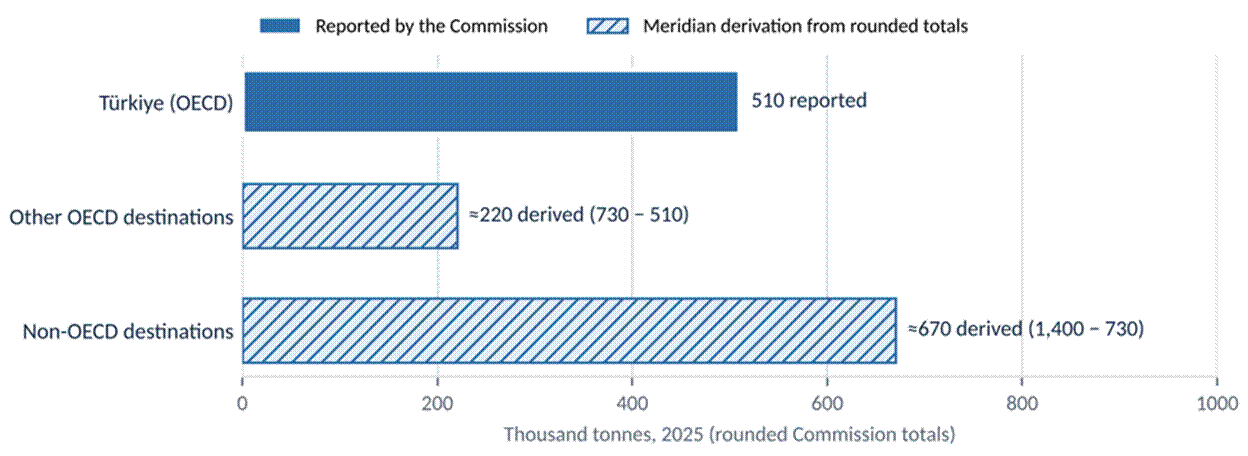
Note: Commission figures are rounded: about 1.4 million tons in total, 730,000 tons to OECD countries, 510,000 tons to Türkiye. Other-OECD and non-OECD values are Meridian derivations by subtraction and are approximate. The non-OECD figure is historical exposure, not a forecast of tonnage displaced on November 21, 2026; transitional rights and compatible receiving capacity cannot be inferred from it.
Sources: [14] (see Sources).
Türkiye, the largest OECD outlet, is not unlimited capacity. Its import quota is set at 50% of certified annual processing capacity, released in four quarterly tranches, and collection, sorting, pressing and crushing capacity do not count toward the quota base14. Compatible licensed capacity for a given polymer and contamination level, and quota remaining in the relevant quarter, have to be checked shipment by shipment.
No commercial response is yet documented. Maersk's waste-cargo policy, dated September 9, requires route-wide classification and documentation48. It is an acceptance rule, not evidence of rejected bookings, rising stocks, rerouting or price pressure, none of which the research established. Weaker demand, cleaner feedstock, growth in domestic processing and valid transitional permissions could each absorb the change without a bottleneck. Later milestones are May 21, 2027, for a broader export and audit stage, and May 21, 2029, the earliest date on which qualifying non-OECD countries may request access; that is a request date, not an automatic reopening13,49.
E-waste and enforcement
E-waste exports to non-OECD destinations have been prohibited since January 1, 2025, and OECD shipments require prior consent, with an intra-EU exception for non-hazardous e-waste that runs to the end of 202649. In England, the Environment Agency's scorecard reports 43 high-risk illegal waste sites stopped in its labelled first quarter, against 24 a year earlier and a target of 17, but the invalid reporting period described in Section 05 prevents a certified comparison43. Agencies in the Liverpool City Region agreed on October 16 to share intelligence and coordinate enforcement50; that is a commitment, not an enforcement outcome.
09. Climate Adaptation, Infrastructure Resilience & Insurance
Insurance: a warning without a denominator
An October 14 memo titled "Sounding the Alarm" collects anonymized concerns from current and recent insurance and reinsurance executives about repricing, withdrawal and the limits of climate models51. It gives no sample size, names no industrial policy and shows no before-and-after terms. Broker data point the other way for the average account. Willis reports average rate declines of 14.5% in the second quarter of 2026 for North American large and complex property programs, against 8.4% a year earlier, and of 23.41% for shared and layered placements, against 14.57%15. Aon reports an average US property rate change of minus 14.9% in the second quarter after minus 15.1% in the first16.
These are different broker samples, not two readings of one series, and The Meridian has not averaged them. Together they contradict a claim that the property market as a whole is retreating now. They do not rule out the loss of flood cover, tighter sublimits or higher deductibles at a particular exposed site, which can coexist with falling average rates and would matter to lenders and collateral. The research found no named site, peril, renewal or lender response that would establish such a case.
Adaptation: completed works, untested performance
The Environment Agency has replaced the corroded Avon Water tidal outfall at Keyhaven Harbour, which it says protects around 40 properties52. Redbridge Council reports three recently completed underground storage projects and says the schemes installed this year can temporarily hold around 426,000 liters, within an installed borough total of more than 2.2 million litres53. Both are verified physical milestones; neither reports performance in a storm, avoided losses or any change in insurance terms. An insurer or lender is likely to want location-specific engineering and residual-risk evidence before treating such works as grounds to change terms. The Agency's scorecard figure for high-consequence flood assets at target condition, 92.6% against 93.0% in the previous labelled quarter, is subject to the period error noted in Section 05, and a change of metric from "properties better protected" to "properties benefitting" prevents a historical comparison43.
10. Cross-Layer Climate, Resources & Environmental Implications
Dutch waterways: from water level to invoice
The clearest cross-layer transmission this week runs from Dutch river levels to container charges. On October 13, Maersk announced a low-water surcharge for inland waterway transport in the Netherlands, tiered by terminal, container size and water level; for 40-foot containers through Nijmegen it is €50, €80 or €120 at stated levels of 2.0 m or less, 1.75 m or less and 1.50 m or less9. The notice says the charge is effective October 13 but applies to inland movements from October 6, a point that contracts and invoices will need to settle. A separate notice the same day reported disruption to Hengelo, Doesburg and Almelo services, rerouting via Nijmegen and a €178-per-container contingency charge on imports and exports, with the low-water surcharge remaining separately applicable10. The next day Rijkswaterstaat reinstated one-way traffic on the Boven-IJssel (Section 01)8.
Exhibit 6. Dutch inland waterways: published charges and the authority's operating threshold
|
Item |
Charge or threshold |
Trigger and timing |
|
Maersk low-water surcharge, Hengelo/Almelo,
20-ft |
€25 per container |
Carrier table: IJsselkop–Twentekanaal at 2.0
m or less; announced Oct 13, applies to movements from Oct 6 |
|
Maersk low-water surcharge, Hengelo/Almelo,
40-ft |
€50 per container |
As above |
|
Maersk low-water surcharge, Nijmegen, 40-ft |
€50 / €80 / €120 per container |
Waal at 2.0 m / 1.75 m / 1.50 m or less;
tiers are alternatives, not cumulative |
|
Maersk contingency surcharge, affected
Hengelo, Doesburg and Almelo imports and exports |
€178 per container |
Immediate from Oct 13 until further notice;
low-water surcharge separately applicable |
|
Rijkswaterstaat, Boven-IJssel |
1.45 m operating threshold |
One-way traffic reinstated Oct 14, 09:00,
after the level fell back below the threshold |
Note: Carrier figures are announced terms, not observed invoices. Neither the carrier nor the authority notice specifies the gauge datum, so carrier and authority thresholds are not interchangeable. Whether a contingency charge and a low-water tier combine on one invoice depends on contract and route. Amounts are shown in the original currency; no conversion is made.
Sources: [8] [9] [10] (see Sources).
The mechanism is documented end to end: a water level falls below an operating threshold, the navigation authority restricts traffic, the carrier reroutes through another terminal, and published charges attach to the changed route. Three points keep it from being overstated. The carrier's "Twentekanaal closure" description is not the same thing as the authority's one-way restriction or the partial obstruction at Eefde lock, which Rijkswaterstaat reports has applied since July 258,10; no current official navigation order, terminal gate record or invoice was obtained, and the carrier's thresholds and the authority's 1.45 m limit refer to gauges that the notices do not specify. The low-water tiers are alternatives at different water levels, not cumulative charges. And whether the €178 charge and a low-water tier both appear on one invoice depends on the contract and the route. When The Meridian checked on the evening of October 19, Rijkswaterstaat's page showed no update after October 148.
The decision-relevant lesson concerns triggers. A restriction lifted and reimposed within two days makes a seasonal improvement forecast a poor basis for booking; the authority's operating notices and the carrier's service status, checked before each affected booking, are the inputs that matter. If navigation normalizes and the charges remain in place, the question becomes contractual lag rather than hydrology.
Strongest connections across the framework
Trade Policy & Geopolitics. Carbon border rules in the UK and EU, and the EU's waste-destination controls, change the documentation requirements and legal eligibility of particular imports and exports; USTR's docket is the formal US channel for contesting the EU's version4,13,36. These are dated rules rather than tariffs, and whether they shift sourcing depends on supplier data and destination capacity.
Chemicals and Commodities. Fertilizer and hydrogen are CBAM goods, with fertilizer defaults carrying no mark-up, and plastic-waste eligibility rules govern where recovery feedstock can go1,4,13. Water permissions condition copper and aggregate supply, but a national target or a higher legal ceiling is not tonnage18,29,42.
Manufacturing & Industrial Development. For steel-consuming manufacturers that import directly, UK CBAM exposure depends on the exact product code and the supplier's data3. Site water rights and inland route access can alter production schedules, although no named plant was affected this week.
Capital Markets & Trade Finance. UK CBAM liability accrues through 2027 for payment in May 2028, which creates an accrual and working-capital question a year before any cash moves4. Loss of site-specific insurance cover could affect collateral terms, but average property pricing is softening15,16.
Energy. Heavily hydro-dependent power systems condition mineral expansion in Zambia and Malawi, and hydrogen liquefaction and industrial heat electrification both depend on power availability18,19,20,45.
Supply Chain Resilience & Infrastructure and Freight Rates & Trends. The Dutch and Mississippi restrictions alter execution options and, in the Dutch case, published freight charges. Recovery and alternative routes limit the effect, and the two are separate events that should not be added into a single global disruption figure9,10,11.
Not retained. No pathway to Macroeconomics & Monetary Policy is supported: route surcharges are verified announcements, but the research has no evidence on economy-wide pass-through. Flood-protection property counts do not translate into effects on Demographics, Labor & Consumption. Technology, AI & Digital Trade enters only through the data-control demands of verified emissions records.
Signals to Watch
1. Commencement of HMRC's draft notices and any change to the default rules. This tests the Call to Audit and the editorial thesis. Commencement on January 1, 2027 with the substitution bar unchanged supports the base case; a published amendment permitting later substitution, or a later start date, weakens it and lowers the urgency of supplier-data clauses. Source: HMRC and HM Treasury publications on GOV.UK. Review weekly until January 1, 2027.
2. HMRC's verification details and actual-emissions guidance. The records page promises verification details before January 1, 2027 and monitoring, verification and reporting guidance later this year5. Publication late in December, or demanding verifier requirements, would make defaults the method of necessity for more 2027 imports; early, workable guidance would widen the actual-data route. Importers should revisit supplier contract terms when it appears.
3. Exceptionally low reservoirs versus abstraction restrictions in England. The Environment Agency's weekly report shows 11 reservoirs or groups exceptionally low and 449 formal abstraction restrictions for the latest week6. A further rise in the first while the second keeps falling widens the local divergence; a fall in both, with storage moving above 54%, signals broad relief. Decisions on the pending non-essential use drought-order applications from South East Water, South West Water and Southern Water are the step that would reach commercial users. Review weekly.
4. Dutch inland navigation status and carrier charges. Rijkswaterstaat's Boven-IJssel restriction and Eefde lock status, measured against the 1.45 m threshold, and Maersk's €178 contingency and low-water surcharge notices8,9,10. Restoration with charges withdrawn ends the episode; restoration with charges still applied shifts the question to contractual lag. Review before each affected booking.
5. EU plastic-waste transition on November 21. Competent-authority guidance on Article 85 transitional notifications, Türkiye's quarterly quota release, and carrier booking cutoffs13,14,48. Documented rejections, rising stocks or rerouting for specific waste codes would confirm a capacity bottleneck; accepted transitional shipments and contracted processing would refute it. Review weekly through December.
6. Reach-specific Mississippi drafts. Coast Guard amendments to the low-water advisory for miles 869 to 303 and the Drought Monitor release on October 2211,23. A rise in recommended drafts on the same reaches is the evidence of relief; an improvement observed only downstream is not. NOAA's next seasonal outlook is due November 1924.
7. USTR comments on the EU CBAM. Docket USTR-2026-0661 closes at 23:59 ET on November 936. Any formal action after the comment period, such as an investigation, would move the issue from evidence-gathering to trade measures; none is assumed.
8. Commission clarification of the Northern Ireland answers. A corrected FAQ or competent-authority ruling on Q7.14 and the removed indirect-representation answer33. Until one appears, no Northern Ireland routing advantage should be built into sourcing or logistics plans.
Sources
Numbered in order of first citation. † Re-checked by The Meridian against the live page on October 19, 2026; other sources were reviewed through this edition's research dossier, and mutable web pages may have changed since retrieval.
1. HM Treasury and HM Revenue & Customs. The Carbon Border Adjustment Mechanism (Default Values) Force of Law Notice (Draft). First published 16 October 2026. https://www.gov.uk/government/publications/carbon-border-adjustment-mechanism-force-of-law-notice-and-reference-document/the-carbon-border-adjustment-mechanism-default-values-force-of-law-notice-draft--4 †
2. HM Revenue & Customs. Hydrogen default values. Published 16 October 2026. https://www.gov.uk/government/publications/check-the-default-values-for-the-carbon-border-adjustment-mechanism-cbam/hydrogen-default-values †
3. HM Revenue & Customs. Iron and steel default values. Published 16 October 2026. https://www.gov.uk/government/publications/check-the-default-values-for-the-carbon-border-adjustment-mechanism-cbam/iron-and-steel-default-values †
4. HM Revenue & Customs. Carbon Border Adjustment Mechanism (CBAM): Policy summary. First published 10 February 2026; updated 16 October 2026. https://www.gov.uk/government/publications/carbon-border-adjustment-mechanism-cbam-policy-summary/carbon-border-adjustment-mechanism-cbam-policy-summary †
5. HM Revenue & Customs. Keeping records for Carbon Border Adjustment Mechanism (CBAM). First published 16 July 2026. https://www.gov.uk/guidance/keeping-records-for-carbon-border-adjustment-mechanism-cbam †
6. Environment Agency. Dry weather and drought in England: 9 to 15 October 2026. Published 16 October 2026. https://www.gov.uk/government/publications/dry-weather-and-drought-in-england-2026-summary-reports/dry-weather-and-drought-in-england-9-to-15-october-2026 †
7. Environment Agency. Dry weather and drought in England: 2 to 8 October 2026. Published 9 October 2026. https://www.gov.uk/government/publications/dry-weather-and-drought-in-england-2026-summary-reports/dry-weather-and-drought-in-england-2-to-8-october-2026
8. Rijkswaterstaat. Eenrichtingsverkeer voor scheepvaart op de Boven-IJssel mogelijk maandag 12 oktober 2026 opgeheven, Sluis Eefde volledig bediend [One-way shipping traffic on the Boven-IJssel possibly lifted Monday 12 October 2026; Eefde lock fully operated]. 9 October 2026, 15:51; updated 14 October 2026, 09:37. https://www.rijkswaterstaat.nl/nieuws/archief/2026/10/eenrichtingsverkeer-voor-scheepvaart-op-de-boven-ijssel-mogelijk-maandag-12-oktober-2026-opgeheven-sluis-eefde-volledig-bediend †
9. Maersk. Introduction of Low Water Surcharge (LWS) for Inland Waterway Transportation in the Netherlands. 13 October 2026. https://www.maersk.com/news/articles/2026/10/13/netherlands-inland-waterway-low-water-surcharge
10. Maersk. Twentekanaal Closure Impacting Inland Barge Services in the Netherlands. 13 October 2026. https://www.maersk.com/news/articles/2026/10/13/twentekanaal-closure-inland-barge-disruption-netherlands
11. U.S. Coast Guard, Eighth District. Local Notice to Mariners, Week 41/2026 / Maritime Safety Information Products. 16 October 2026. https://navcen.uscg.gov/sites/default/files/pdf/lnms/lnm0841r2026.pdf
12. Moran Shipping Agencies (New Orleans Board of Trade bulletin). Port Update - New Orleans, LA / Mississippi River. 16 October 2026, 06:55. https://www.moranshipping.com/news/bulletins/port-update-new-orleans-la-slash-mississippi-river-2026-10-16
13. European Parliament and Council (Official Journal of the EU). Regulation (EU) 2024/1157 of the European Parliament and of the Council on shipments of waste. Adopted 11 April 2024; published 30 April 2024. https://eur-lex.europa.eu/eli/reg/2024/1157/oj/eng
14. European Commission. Assessment of the sustainability of plastic waste exports to OECD countries pursuant to Article 45(5) of Regulation (EU) 2024/1157, SWD(2026) 274 final. SWD(2026) 274 final, 1 September 2026; Council document ST 12685/26, 2 September 2026. https://data.consilium.europa.eu/doc/document/ST-12685-2026-INIT/en/pdf
15. WTW (Willis). Commercial property rates post sharpest decline in a decade, Willis report finds. 1 October 2026. https://www.wtwco.com/news/2026/09/fall-2026-insurance-marketplace-realities-report
16. Aon. Property Market Dynamics Report, Q3 2026 edition. Q3 2026 edition; publication date not shown. https://www.aon.com/en/insights/reports/property-market-dynamics-report
17. World Bank. Eight Countries Launch Plans to Turn Mineral Resources into Jobs and Economic Growth. 16 October 2026. https://www.worldbank.org/en/news/press-release/2026/10/16/metals-minerals-country-compacts-launch
18. Government of Zambia / World Bank Group. Metals and Minerals Country Compact | Republic of Zambia. October 2026. https://www.worldbank.org/content/dam/theworldbankgroupasset/img/2026/479200_003_Zambia%20MM%20Country%20Compact_Final.pdf
19. Government of Malawi / World Bank Group. Metals and Minerals Country Compact | Republic of Malawi. October 2026. https://www.worldbank.org/content/dam/theworldbankgroupasset/img/2026/479200_001_v2_Malawi%20MM%20Country%20Compact_Final.pdf
20. Kawasaki Heavy Industries. Construction Begins on Japan's Largest Hydrogen Liquefaction Plant with a Liquefaction Capacity of 50 Tons per Day - Toward the Establishment of a Commercial-Scale Liquefied Hydrogen Supply Chain -. 19 October 2026. https://global.kawasaki.com/en/corp/newsroom/news/detail/?f=20261019_6788
21. HM Revenue & Customs and HM Treasury. Carbon Border Adjustment Mechanism: force of law notices and reference document. First published 13 July 2026. https://www.gov.uk/government/publications/carbon-border-adjustment-mechanism-force-of-law-notice-and-reference-document †
22. European Commission, DG TAXUD. CBAM communication and news. Rolling index page. https://taxation-customs.ec.europa.eu/carbon-border-adjustment-mechanism/cbam-communication-and-news_en
23. U.S. Drought Monitor (NDMC, USDA, NOAA). Current Map / National Drought Summary. Released 15 October 2026; valid 13 October 2026. https://droughtmonitor.unl.edu/
24. NOAA Climate Prediction Center. U.S. Seasonal Drought Outlook Discussion. Issued 15 October 2026. https://www.cpc.ncep.noaa.gov/products/expert_assessment/sdo_discussion.php
25. U.S. Geological Survey. USGS 07374000 Mississippi River at Baton Rouge, LA. Provisional reading, 19 October 2026, 11:15 CDT. https://waterdata.usgs.gov/nwis/uv?site_no=07374000&legacy=1&agency_cd=USGS
26. BBC. How we got to severe drought and what is next. 16 October 2026. https://www.bbc.com/news/articles/c6wyrngl3j23o
27. Maersk. Maersk Asia Pacific Market Update - October 2026. 7 October 2026. https://www.maersk.com/news/articles/2026/10/07/maersk-asia-pacific-market-update-october
28. BBC. Reservoir falls below 20% as drought persists. 14 October 2026. https://www.bbc.com/news/articles/crpdgzd58v2do
29. Ontario Ministry of the Environment, Conservation and Parks. Vale Canada Limited/Vale Canada Limitée - Permit to take water, ERO 026-1060. Proposal posted 15 October 2026; comments to 14 November 2026. https://ero.ontario.ca/notice/026-1060
30. Convention on Biological Diversity Secretariat. As Global Promises for Nature Reach Halftime Checkpoint, UN Biodiversity Conference Opens in Armenia. 19 October 2026; publication time unstated. https://www.cbd.int/doc/press/2026/pr-2026-10-19-cop17-en.pdf
31. European Commission, DG Environment. COP17: EU delivering on global targets to protect nature and biodiversity. 16 October 2026. https://environment.ec.europa.eu/news/eu-delivering-cop17-nature-biodiversity-targets-2026-10-16_en
32. European Commission, DG Environment. Regulation on Deforestation-free Products. Rolling page. https://environment.ec.europa.eu/topics/forests/deforestation/regulation-deforestation-free-products_en
33. European Commission, DG TAXUD. Carbon Border Adjustment Mechanism (CBAM) Questions and Answers. Version dated 15 October 2026. https://taxation-customs.ec.europa.eu/document/download/013fa763-5dce-4726-a204-69fec04d5ce2_en
34. European Commission (copy hosted by Certicarb). Carbon Border Adjustment Mechanism (CBAM) Questions and Answers, 27 May version. Version dated 27 May 2026. https://certicarb.com/downloads/CBAM_Questions_and_Answers_260527.pdf
35. European Commission, DG TAXUD. Price of CBAM certificates. Q3 2026 price published 5 October 2026. https://taxation-customs.ec.europa.eu/carbon-border-adjustment-mechanism/price-cbam-certificates_en#quarterly-prices-in-2026
36. Office of the U.S. Trade Representative (Federal Register). Request for Comments on the Effect of the European Union's Carbon Border Adjustment Mechanism and the Proposals To Expand Coverage on U.S. Trade. 8 October 2026; docket USTR-2026-0661. https://www.govinfo.gov/content/pkg/FR-2026-10-08/html/2026-20615.htm
37. U.S. Small Business Administration, Office of Advocacy. USTR Seeks Comments on the EU Carbon Border Adjustment Mechanism's Effect on U.S. Trade. 13 October 2026. https://advocacy.sba.gov/2026/10/13/ustr-seeks-comments-on-the-eu-carbon-border-adjustment-mechanisms-effect-on-u-s-trade/
38. UK Department for Business and Trade, business.gov.uk. EU Carbon Border Adjustment Mechanism (EU CBAM). Last updated 12 August 2026. https://www.business.gov.uk/campaign/europe/european-union-eu-regulations/eu-carbon-border-adjustment-mechanism-eu-cbam/
39. Irish Presidency of the Council of the EU. Results of the European Council, 16 October 2026. 16 October 2026. https://irish-presidency.consilium.europa.eu/en/news/results-of-the-european-council-16-october-2026/
40. US EPA Region 9. Public Notice: Intent to Modify Class I UIC Permit Issued to San Joaquin Refining Company Inc., Bakersfield, California. 16 October 2026. https://www.epa.gov/publicnotices/R9UIC-CA1-FY16-1
41. US EPA (Federal Register). Approval and Promulgation of Implementation Plans; Arizona; Revisions to the Cleaner Burning Gasoline, Winter Oxygenated Fuel, and Gasoline Set-Aside Programs. 19 October 2026; 91 FR 66003–66010; FR Doc. 2026-21268. https://www.federalregister.gov/documents/full_text/text/2026/10/19/2026-21268.txt
42. Ontario Ministry of Natural Resources. Amrize Canada Inc. - Changes to the site plan for a pit or quarry, ERO 026-0604. Decision posted 16 October 2026; approved 6 October 2026. https://ero.ontario.ca/notice/026-0604
43. Environment Agency. Environment Agency corporate scorecard 2026 to 2027 - quarter 1. 14 October 2026. https://www.gov.uk/government/publications/environment-agency-corporate-scorecards-2026-to-2027/environment-agency-corporate-scorecard-2026-to-2027-quarter-1
44. Argus Media. Japan's KHI starts building hydrogen liquefaction plant. 19 October 2026. https://www.argusmedia.com/en/news-and-insights/latest-market-news/2892543-japan-s-khi-starts-building-hydrogen-liquefaction-plant
45. European Commission, DG CLIMA. IF26 Heat Auction. Final terms dated 24 September 2026; programme page. https://climate.ec.europa.eu/areas-action/eu-funding-climate-action/innovation-fund/calls-proposals/if26-heat-auction_en
46. Eni. Eni CCUS Holding: Liverpool Bay CCS completes the installation of the world's first offshore platform dedicated to CO2 transportation and storage for the decarbonisation of industrial sectors. 8 October 2026. https://www.eni.com/en-IT/media/press-release/2026/10/eni-ccus-holding-liverpool-bay-ccs.html
47. European Commission, DG Environment. Plastic waste shipments. Rolling page. https://environment.ec.europa.eu/topics/waste-and-recycling/waste-shipments/plastic-waste-shipments_en
48. Maersk. Waste and Scrap Cargo. 9 September 2026. https://www.maersk.com/news/articles/2026/09/09/waste-and-scrap-cargo-shipping-regulations
49. European Commission, DG Environment. Waste shipments. Rolling page. https://environment.ec.europa.eu/topics/waste-and-recycling/waste-shipments_en
50. Environment Agency. Liverpool City Region agencies fight back against waste crime. 19 October 2026. https://www.gov.uk/government/news/liverpool-city-region-agencies-fight-back-against-waste-crime
51. Inside Track. Sounding the Alarm. 14 October 2026. https://static1.squarespace.com/static/697b3c8cf1bdde2c6ff1b5d5/t/6acebb5992f73c3954b746e5/1791933273139/Insurance+and+Reinsurance+Memo.pdf
52. Environment Agency. Major flood defence upgrade completed at Keyhaven ahead of winter. 13 October 2026. https://www.gov.uk/government/news/major-flood-defence-upgrade-completed-at-keyhaven-ahead-of-winter
53. London Borough of Redbridge. Redbridge Council invests in Hydrorock technology to reduce flood risks and protect communities. 13 October 2026. https://www.redbridge.gov.uk/news/october-2026/redbridge-council-invests-in-hydrorock-technology-to-reduce-flood-risks-and-protect-communities