
After IEEPA, U.S. Tariffs Are More Fragmented and Better Documented, but Not Clearly Heavier in Aggregate
Eight months after the Supreme Court struck down the emergency tariffs, the duty on a U.S. import depends on which statute applies, where the goods were made and how they are classified. Gross duties are up 70% on the year, yet net customs receipts are up about 1% once refunds are counted.

Eight months after the Supreme Court struck down the emergency tariffs, the duty on a U.S. import depends on which statute applies, where the goods were made and how they are classified. Gross duties are up 70% on the year, yet net customs receipts are up about 1% once refunds are counted. Inside a USMCA that remains in force, Canada and Mexico are now on separate tracks. In the Gulf, Iran's tracked crude loadings have fallen to zero while its neighbors pay more to keep oil moving.
Executive Takeaway
The U.S. tariff system that replaced the emergency tariffs is broad in reach but uneven in weight. Since the Supreme Court ruled on February 20 that the International Emergency Economic Powers Act (IEEPA) did not authorize the tariffs at issue, Washington has rebuilt its tariff wall from narrower statutes. As of September 30, the Congressional Research Service counted ten Section 232 sectoral actions with duties in effect, four more Section 232 investigations and two sectors where negotiations had been directed; two Section 301 actions in effect (the forced-labor duties on 60 economies and a 25% duty on Brazil) and four Section 301 investigations; a Section 338 regime aimed at Canada; and one surviving IEEPA measure, the suspension of de minimis treatment. Gross customs duties in the first eleven months of fiscal 2026 were $292.5 billion, 70% more than a year earlier. Refunds of $125.2 billion, about $110 billion of them IEEPA refunds by the Congressional Budget Office's count, left net receipts at $167.3 billion, only 1.3% above the same months of fiscal 2025 (The Meridian calculation). The weight of the new system falls on particular sectors (metals, autos, pharmaceuticals, lumber and furniture, polysilicon, drones) and particular partners (Canada, China, Brazil), and on whether a given shipment's classification, origin and partner treatment cause measures to stack.
Each layer rests on an investigation and a published record, which makes the new system harder to strike down wholesale than the emergency tariffs were. The Meridian treats that as legal durability only. The layers can still be modified, exempted in partner deals or reversed by the President, and the one near-universal layer, the forced-labor Section 301 action, is before a three-judge Court of International Trade panel that observers at the September 30 argument described as skeptical. Supplemental briefs are due October 16. For importers, the practical consequence is dispersion: two shipments of the same product can carry very different duty depending on origin and partner caps. In The Meridian's view, customs capability (classification, origin documentation, exclusion management and refund recovery) has become a source of margin.
North American trade has split into two tracks inside an agreement that remains in force. At the July 1 joint review, the parties did not confirm a new 16-year term, so the USMCA continues under annual reviews and, absent an extension, terminates on July 1, 2036. Canada faces 50% Section 338 duties on motor vehicles, alcohol and dairy that apply regardless of USMCA status and stack on Section 232, import bans on alcohol, dairy and large motorcycles, and a directive removing Canadian-origin goods from federal civil procurement. Mexico is negotiating Section 232 relief and handling friction through labor cases. The flows have not yet broken: U.S. imports from Canada were 4.2% higher in January–August than a year earlier, and U.S. imports from Mexico reached $60.6 billion in August, up 34.2%. The principal structural loss so far is policy certainty heading into the annual reviews.
In the Gulf, the commercial picture divides by flag and cargo. Kpler ship-tracking data show Iranian crude loadings falling from 893,000 barrels a day in July to zero in September, under a U.S. naval blockade, vessel designations and tighter U.K. rules. Other Gulf exporters have kept most of their crude moving. Reuters, citing Kpler, reported at least 10.1 million barrels a day crossing Hormuz in early October, about 74% of the prewar volume, with a further 6.7 million barrels a day leaving through Gulf of Oman and Red Sea outlets. The persistent effect is on cost, insurance, vessel eligibility and compliance, more than on Gulf-wide volume. The next decision points are close together: the Graham Act's October 18 determination deadline, the November 9–10 expiry of China tariff exclusions and the port-fee suspension, the November 10 default return of the export-control Affiliates Rule, and a January window in which the U.S.–China truce ends and USMCA comments fall due.
One Emergency Authority Has Given Way to Many Narrower Ones, and Import Costs Now Turn on Classification and Origin
What replaced IEEPA
Under IEEPA, the administration could impose a country-wide tariff the same day it announced one. The Supreme Court's decision in Learning Resources, Inc. v. Trump closed that route on February 20. A 10% global surcharge under Section 122 of the Trade Act followed, but that statute limits such measures to 150 days without congressional extension, and the surcharge expired on July 24. On the same date, the forced-labor Section 301 duties took effect: 10% or 12.5% on goods from 60 economies, with USMCA-qualifying goods, Section 232 products and certain other categories exempt, and caps set net of most-favored-nation duty for some partners (10% for the European Union and Taiwan, 12.5% for Japan, South Korea and Switzerland, in EY's tabulation of the action).
Around that layer sits a growing set of sector- and country-specific measures. Section 232 now covers metals, autos and parts, trucks and buses, pharmaceuticals, semiconductors, lumber and wood products, polysilicon and drones, with rates from 10% to 100% depending on the product and partner. Four further Section 232 investigations are open: anthracite coal, personal protective and medical equipment, robotics and industrial machinery, and wind turbines. Section 338 of the Tariff Act of 1930, a statute rarely used before this year, now underpins duties and import bans on Canadian goods. The table below sets out the architecture as CRS records it. Its counts describe legal activity and say nothing about economic weight; CRS does not publish the value of imports covered by each authority, and that gap matters for anyone trying to size exposure.
The post-IEEPA tariff architecture by authority (as of September 30, 2026)
|
Authority |
In effect |
Pending or directed |
Notes |
|
Section 232 (national security) |
10 sectoral actions, including metals, autos and parts,
pharmaceuticals, semiconductors, lumber, polysilicon and drones |
4 investigations (anthracite coal; PPE and medical; robotics
and industrial machinery; wind turbines); negotiations directed for aircraft
and critical minerals |
Rates of 10–100% by product; partner caps in several actions |
|
Section 301 (unfair practices) |
Forced labor: 10% or 12.5% on 60 economies since July 24;
Brazil: 25% |
4 investigations (China Phase One compliance; German
pharmaceuticals; structural excess capacity; Vietnam intellectual property) |
Forced-labor action under challenge at the Court of
International Trade |
|
Section 338 (Tariff Act of 1930) |
Canada: 50% on motor vehicles, alcohol and dairy since Aug.
22; import bans since Sept. 29 |
Further bans possible |
No USMCA exemption; stacks on Section 232 |
|
IEEPA |
Suspension of de minimis treatment only |
CBP low-value shipment rule proposed (comments to Dec. 7) |
Statutory end of de minimis July 1, 2027 |
|
Section 122 (balance of payments) |
None |
— |
10% global surcharge expired July 24 at the 150-day limit |
Source: Congressional Research Service, R49481 (current to September 30, 2026). Counts of actions do not measure import value, revenue or economic importance.
What the receipts show
Treasury's monthly statements show a system that collects a great deal and then returns much of it. Gross customs duties ran at about $22–25 billion a month from May through August. In June and July, refunds exceeded collections and net receipts were negative: minus $25.6 billion in June and minus $8.6 billion in July. August was the first month back in positive territory, at $12.8 billion net. Over the first eleven months of the fiscal year, gross duties of $292.5 billion compare with $171.9 billion a year earlier, while net receipts of $167.3 billion compare with $165.2 billion. CBO attributes about $110 billion of the year's refunds to IEEPA. Treasury's refund line covers all customs refunds, so the two figures should not be read as the same thing.
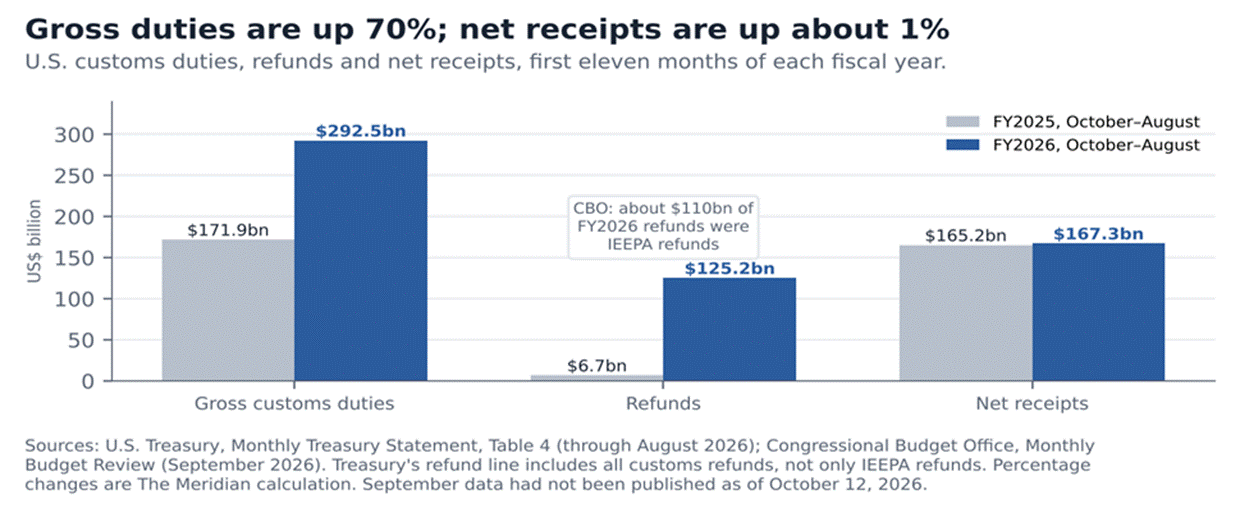
Gross duties rose by about $121 billion over the first eleven months of fiscal 2026, but refunds rose by about $118 billion, leaving net receipts roughly $2 billion higher (The Meridian calculation).
Two cautions follow. Once IEEPA refunds run off, net receipts should move back toward gross collections, so the 1% gain understates what the new layers collect on a forward basis. And neither series is a tariff rate. Independent estimates measure different things: the Federal Reserve Bank of St. Louis estimated that the effective tariff rate peaked near 11% in late 2025 and was just below 7% in May 2026, before the forced-labor layer took effect, while the Yale Budget Lab models the average statutory rate at 11.0%. A statutory average describes the schedule; an effective rate reflects what importers actually paid after substitution, exemptions and caps. Treasury's September statement, due in mid-October, will show whether refunds are still falling.
Where the weight falls
The new system's burden is concentrated. Section 232 rates run from 10% to 50% on steel, aluminum and copper, 15–25% on autos, 25% on trucks and 10% on buses, 10–100% on pharmaceuticals, 25% on semiconductors, 10–25% on lumber, 10–15% on polysilicon, and up to 100% on drones heavier than 25 kilograms. Partner agreements cut into those rates from the other side. Drone tariffs are capped at 15% for the EU, Japan, South Korea, Taiwan and Switzerland and 10% for the United Kingdom. Global Trade Alert reports that pharmaceutical Section 232 rates were cut from 15% to zero for the EU, Japan, South Korea and Switzerland, and from 100% to zero for 14 jurisdictions.
Stacking rules decide the rest. Section 232 goods are exempt from the forced-labor layer, but Section 338 duties apply on top of Section 232. PwC's worked example puts the combined additional duty on some Canadian aluminum articles at 100%. A buyer comparing two suppliers of the same part can therefore face anything from zero additional duty, for a USMCA-qualifying good outside the Section 232 and Section 338 lists, to 100% or more for a Canadian aluminum derivative. That range applies only where classification, origin and the overlap of authorities produce it, and it does not describe imported goods generally.
Durable in law, less certain in politics
The legal case for durability is that each layer carries an administrative record, scheduled step-ups are written into proclamations, and the 2018–19 Section 232 and Section 301 actions survived years of litigation. The political case is weaker. Every layer can be narrowed in a partner deal, modified by proclamation or terminated, and several already have been: the furniture and cabinet increases now due January 1, 2027 were delayed by a year once. The forced-labor action is also exposed in court. According to reporting on the September 30 argument, the panel of Judges Reif, Choe-Groves and Wang appeared skeptical, and challengers argued that investigations had reached 86 countries and 99.4% of imports. The court has set no ruling date.
A ruling against the forced-labor layer would not end the system. It would make it almost entirely sectoral and country-specific, and it could open a second refund cycle. Equally, a run of country frameworks could cap many Section 232 layers at negotiated ceilings, as has happened for drones and pharmaceuticals. The Meridian's base case is more layering than consolidation over the next six months, because four Section 232 investigations remain open, an anti-stockpiling tool now exists for polysilicon, and the 15-economy statement on excess capacity could give the open Section 301 investigation international cover.
The dates that set costs
The calendar matters more than the headline rates. Several deadlines fall in the next four months, and some are fixed by law while others depend on political decisions.
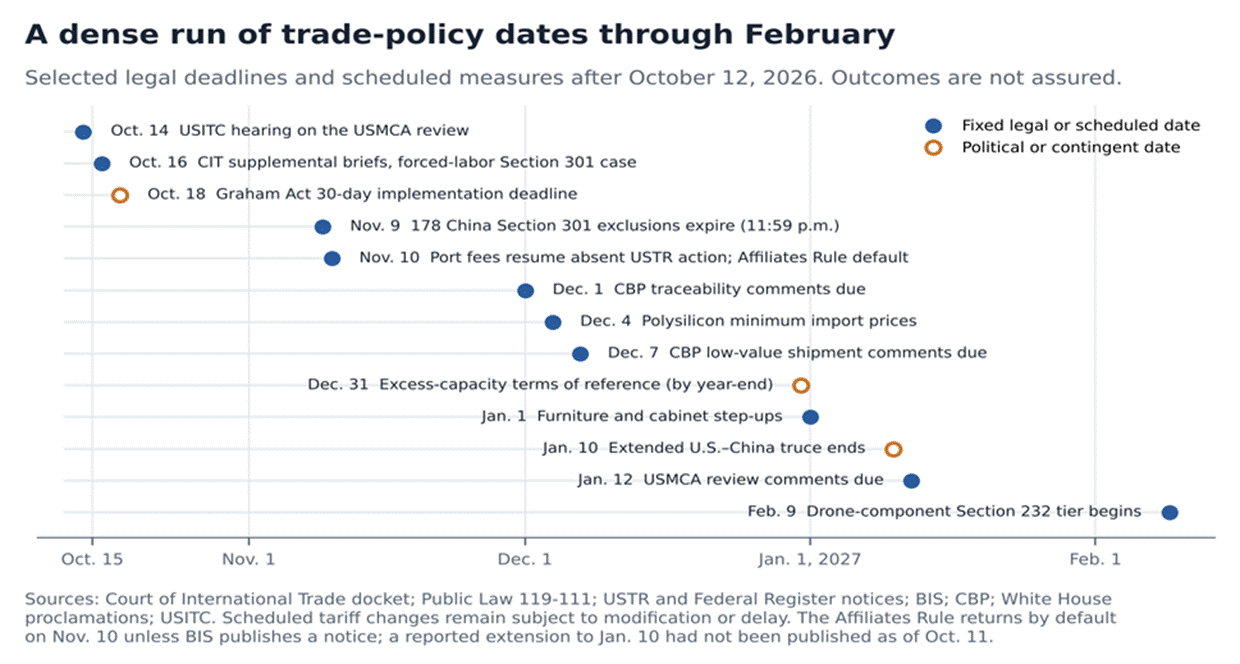
Fixed dates include court deadlines, comment periods and scheduled tariff steps. Political dates, such as the end of the U.S.–China truce and the Graham Act determinations, may move or produce no action.
What it means for importers
• Map exposure by authority at the 10-digit HTS line and by country of origin. Action counts and average rates do not describe a specific bill of materials.
• Treat USMCA qualification, Section 232 metal-content valuation and partner caps as cost levers, and document them before the step-up dates.
• Write contract price-adjustment clauses that refer to specific dates (November 10, December 4, January 1, February 9) and to the statutes behind them.
• Budget working capital for duty deposits and the timing of IEEPA refunds, and plan for a possible second refund cycle if the forced-labor action is vacated.
USMCA Remains in Force, but Canada and Mexico Are on Different Tracks
The legal frame
The USMCA has not expired and is not about to. Under Article 34.7, the July 1, 2026 joint review was the point at which each party could confirm a new 16-year term. The United States did not, so the agreement now runs on annual reviews toward a July 1, 2036 end date unless the parties extend it. USTR has opened the record for the 2027 review, with comments and hearing requests due January 12, 2027, and the U.S. International Trade Commission holds a hearing on October 14. The consultation itself is evidence that the agreement's institutions are working.
The two partner relationships around it have diverged. The U.S.–Canada negotiating track is suspended, according to the International Compliance Professionals Association's review tracker, which also records USTR's Jamieson Greer as “holding fast” with Canada on October 8. In a late-September CNBC interview, as relayed by a news aggregator, Greer said the United States is still getting what it needs from Canada, which points to little urgency for a deal. Canada's trade minister, Maninder Sidhu, met Greer on October 1, and the Globe and Mail described the issues as difficult. With Mexico, by contrast, the agenda is negotiated relief and labor enforcement.
Canada: overrides, bans and procurement
The measures against Canada combine tariffs, prohibitions and procurement. The White House describes them as a response to Canadian retaliation and discrimination; that is the administration's stated rationale. The Section 338 duties of 50% on Canadian motor vehicles, alcohol and dairy took effect on August 22. Five proclamations followed on September 8, Federal Register notices on September 14, a scope change on September 15 under which Section 338 stacks on Section 232, and import bans from September 29. A September 16 presidential memorandum directed that Canadian-origin goods be removed or made unavailable in federal civil procurement. The White House said Canadian companies had enjoyed preferential access to more than $280 billion of federal procurement; the value of Canadian purchases actually affected has not been established.
Canada: the restriction stack
|
Measure |
Scope |
Effective |
Status and notes |
|
U.S. Section 338 duties |
50% on Canadian motor vehicles, alcohol and dairy; no USMCA
exemption |
Aug. 22, 2026; stacking from Sept. 15 |
In effect; applies in addition to Section 232 |
|
U.S. Section 338 import bans |
Alcohol, dairy and motorcycles over 800cc |
Sept. 29, 2026 |
In effect |
|
U.S. Section 232 |
Steel, aluminum, copper, autos and other sectors |
Various |
Combined duty can reach 100% on some aluminum articles |
|
U.S. federal procurement |
Canadian-origin goods to be removed or made unavailable in
federal civil procurement |
Sept. 16, 2026 memorandum |
Value of affected Canadian purchases not established |
|
Canadian counter-tariffs |
15%, 25% or 50% on C$27.6 billion (about US$20 billion) of
U.S. goods |
Sept. 8, 2026 |
In effect; remission available under s.115 of the Customs
Tariff; no remission statistics published |
|
Provincial procurement |
New Brunswick bars U.S. bids above C$5 million (about US$3.6
million) |
Oct. 1, 2026 |
Reported by Global Trade Alert |
|
Trade remedies |
Anti-dumping and countervailing duty investigations on
hydraulic cylinders |
Initiated Sept. 8, 2026 |
Petitioner alleges dumping margins of 248–745%; not
determinations |
Sources: White House; Congressional Research Service; Department of Finance Canada; Federal Register; PwC Canada; Global Trade Alert. Canadian-dollar conversions are approximate at about US$0.73.
Coverage is narrower than the headlines suggest. RBC estimates that the Section 338 measures reach about 5% of Canada's exports and that more than 80% of Canadian exports still enter the United States duty-free under the agreement. The damage is concentrated in autos, alcohol, dairy, metals and federal supply, and in the predictability that cross-border investment depends on.
Mexico: negotiation and labor enforcement
Mexico's position differs in kind. Reports describe a U.S.–Mexico Section 232 package for steel and aluminum with a 15% headline rate that, according to AlCircle, could bring effective rates to about 4–5%; Bloomberg has reported a cut in the auto Section 232 rate for Mexico from 25% to 15%. Neither has been confirmed by proclamation or notice, and both should be treated as under negotiation. A fourth negotiating round is undated.
The friction with Mexico runs through the Rapid Response Labor Mechanism, which acts at the level of individual facilities. USTR asked Mexico to review alleged denials of workers' rights at Yokohama Tire Manufacturing Mexico on September 25 and at GLM Components Mexico on October 8, in both cases with liquidation of the facility's entries suspended. The Akwel case in Juárez was resolved on September 28, and the two governments agreed a course of remediation at Corporación de Occidente on October 2. Suspended liquidation leaves duty liability open on affected entries, a contingent exposure that may or may not become a final duty.
Trade flows favor Mexico for now. Census data show U.S. goods imports from Mexico of $60.5 billion in July and $60.6 billion in August, the latter 34.2% above August 2025. A secondary compilation of Mexican and U.S. data reports that 83% of Mexico's August exports to the United States paid no tariff and that Mexico supplied 18% of U.S. imports against China's 8.1%; those shares are not drawn from a primary release. Mexico is not immune to remedies either: the hydraulic-cylinder investigations cover Mexico as well as Canada, China, India and South Korea.
What the trade data show
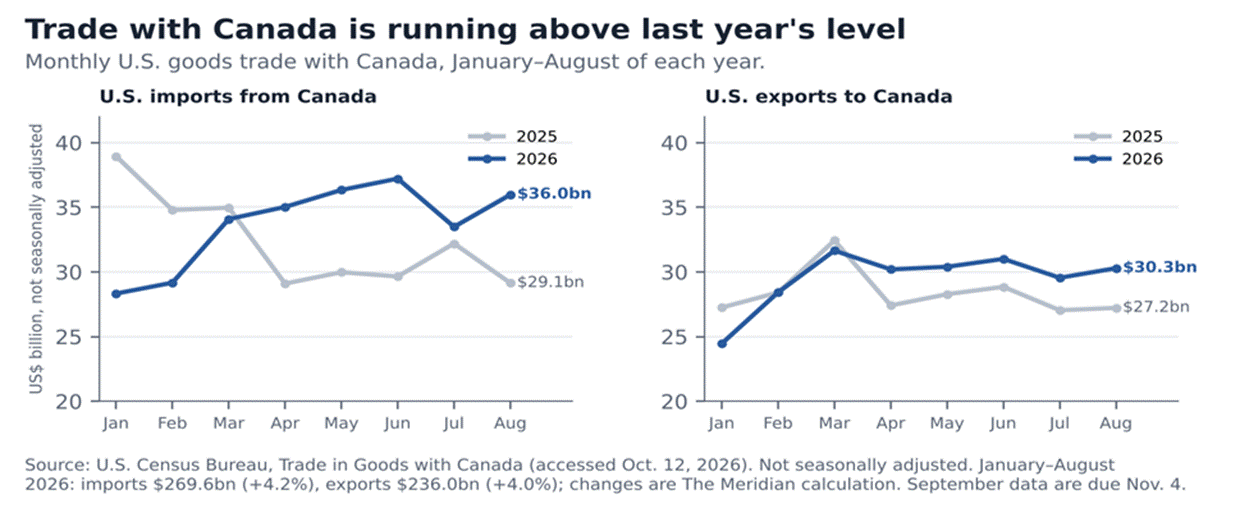
U.S. imports from Canada have run above 2025 levels since April, after a 2025 that started high. Exports to Canada have also run above last year since April.
U.S. imports from Canada were $36.0 billion in August, 23.5% more than a year earlier, and U.S. exports to Canada were $30.3 billion, up 11.3% (The Meridian calculations from Census data, not seasonally adjusted). On a seasonally adjusted balance-of-payments basis, BEA put August imports from Canada at $37.1 billion, $4.6 billion more than in July. Canada's own figures show exports to the United States up 8.1% on the month to C$54.35 billion (about US$39.5 billion), imports from the United States down 2.5% to C$43.13 billion (about US$31.4 billion), and Canada's surplus with the United States nearly doubling to C$11.2 billion (about US$8.1 billion). Canada's exports to other markets fell 8.5%, so there is no sign yet of diversification away from the United States.
CIBC reads the August surge as shipments brought forward ahead of new tariffs and expects it to unwind in September. The interpretation is plausible but unproven, and one month cannot establish either resilience or separation. September data, due on November 4, are the first real test.
The review ahead
The most important structural change is that every North American investment decision now carries an annual-review risk. Whether that is already moving auto programs toward Mexico or the United States cannot be shown from current evidence: no company filings or project announcements in this edition's record document such a shift, and The Meridian treats relocation as a scenario. Other evidence points the other way. Canada and Mexico both signed the U.S.-led statement on global excess capacity on October 7, and integrated auto, energy, agricultural and infrastructure systems are slow and costly to unwind.
Two readings of the rupture remain open. One sees a negotiating tactic before the review, aimed at concessions on dairy, digital policy and procurement. The other sees the agreement being converted into a hub-and-spoke system centered on the United States, with Mexico as the preferred spoke. The January 12 comment record should show which sectors U.S. industry wants conditioned and how far.
What it means for companies
• Model Canadian-origin exposure line by line: Section 338 products, Section 232 overlap and federal-contract content are separate risks.
• For federal suppliers, audit Canadian-origin content now; the memorandum targets availability in procurement, and contract-level effects will vary.
• For Mexican operations, track Rapid Response cases at supplier facilities; suspended liquidation can affect landed cost and cash.
• File positions in the USMCA record by January 12, 2027 if the review's sector conditions would affect qualification or investment plans.
Iran's Sea Trade Is Nearly Shut; the Rest of the Gulf Is Paying More to Keep Moving
Two outcomes in one strait
The war that began on February 28 has produced two different commercial outcomes around the Strait of Hormuz. For Iran, maritime export access has been close to eliminated. Kpler data reported by Gulf News show Iranian crude loadings of 893,000 barrels a day in July and 156,000 in the first 17 days of August. Iran International, citing Kpler, reported zero crude and condensate loadings in September, the first such month since 1979, and about 8 million barrels on the water against roughly 90 million in mid-July. Iran International is an opposition-aligned outlet, and ship-tracking data can miss vessels sailing without transponders, cargoes held in storage or relabeled, and oil moved overland, so the figure is best read as near-zero tracked exports.
For the other Gulf exporters, trade is disrupted but substantially restored or rerouted. Reuters, citing Kpler data, reported at least 10.1 million barrels a day of crude crossing Hormuz in late September and early October, about 74% of the prewar level, and 6.7 million barrels a day leaving through Gulf of Oman and Red Sea outlets, more than double the prewar volume. Gulf News, also citing Kpler, put regional crude exports at 16.3 million barrels a day in September against 19.5 million before the war, with 40% of Gulf crude now routed around Hormuz against 17% before. Middle East exports exceeded prewar levels on four days, according to Reuters reporting on October 5.
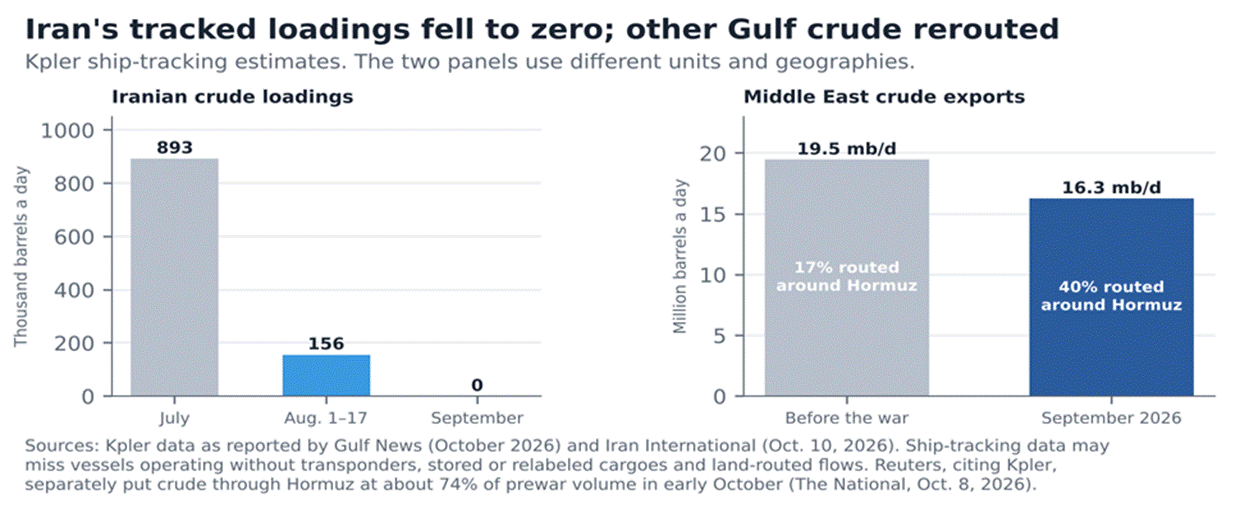
Iranian loadings fell to zero in Kpler's data while regional exporters shifted crude to outlets that avoid Hormuz. The panels use different units and geographies.
Daily vessel counts look far worse than crude volumes. Kpler counted 7 commodity vessels through the strait on October 6 and LSEG 8, the lowest in two months, against more than 20 a day on October 4–5. Those counts cover narrower vessel categories than the prewar benchmark of about 125 large vessels a day, use different tracking methods and miss dark transits, so they cannot be converted into a percentage of normal trade. Larger cargoes and bypass routes explain why barrels have held up better than ship numbers.
The layers that block Iranian trade
Iran's access is constrained by several measures operating on separate clocks. The U.S. naval blockade of Iranian ports resumed on July 14 after an earlier blockade from April 13 to June 18, during which U.S. Central Command reported more than 140 vessels redirected and nine disabled. Pete Hegseth, the Pentagon chief, said in August that it can continue indefinitely. Treasury's Operation Economic Outcast, launched on August 24, has added vessel designations; on October 8 OFAC designated 17 more ships. The table sets out the main U.S. and U.K. layers.
Iran: overlapping restrictions on trade (U.S. and U.K. measures)
|
Layer |
Measure |
Since |
What it removes |
|
Naval blockade |
U.S. blockade of Iranian ports |
Resumed July 14, 2026 |
Port access for Iranian loadings and discharges |
|
Vessel sanctions |
OFAC designations under E.O. 13902; 17 vessels on Oct. 8 |
Operation Economic Outcast from Aug. 24 |
Insurance, finance and port access for named ships |
|
Sector sanctions |
27 Iranian airlines (Sept. 8); IKCO, SAIPA and auto, rail and
steel determinations (Oct. 1) |
Sept.–Oct. 2026 |
Air cargo and industrial trade channels |
|
Payment channels |
Designations of the A7 network and a FinCEN proposed rule |
Oct. 1, 2026 |
Settlement routes linked to Russian and Iranian trade |
|
U.K. measures |
Notice to Exporters 2026/18: ship-specification powers,
Iranian cargo-aircraft ban, Schedules 1A–1I |
Sept. 29, 2026 |
Access for U.K.-linked vessels, insurers and aircraft |
|
Physical risk |
80 IMO-verified attacks on merchant ships since Feb. 28 |
Ongoing |
Willingness of owners, crews and insurers |
|
Land routes |
U.S. pressure on overland routes; reported surge in
Turkey–Iran truck rates |
October 2026 |
Overland substitution |
Sources: U.S. Central Command; U.S. Treasury; U.K. Department for Business and Trade; International Maritime Organization; Iran International (land-route figures not independently verified). EU and other jurisdictions' measures are not assessed here; their absence does not mean none exist.
Treasury says the October 8 action effectively neutralizes the vast majority of Iran's remaining shadow fleet. That is a government assessment, and it has not been independently measured. The cargo histories Treasury cited for the designated ships, among them 3.5 million barrels of crude on one tanker, describe past voyages and say little about current capacity. Iran International reports that truck freight between Turkey and Iran has risen from about $1,500 to $8,000 per load with about 8,000 trucks waiting at the Bazargan crossing, and that Treasury Secretary Scott Bessent has spoken of cutting off land routes. Those figures have not been independently verified.
The cost of moving
For non-Iranian trade, the lasting effect is cost and compliance. A law-firm analysis by Lester Aldridge puts war-risk premiums for Gulf transits at 1–5% of hull value, and up to 10%, against 0.125–0.25% before the crisis. These are quote ranges drawn from market reports; no published index tracks them. The Business Standard reported quotes that add about $20 million to a single very large crude carrier voyage. The International Maritime Organization has verified 80 attacks on merchant ships since February 28 and at least 22 seafarer deaths through September 15, without attributing them to a single actor. Reuters has reported at least one attack a day since October 2. The bypass routes carry their own risk: Yemen's Houthis declared a “blockade” of Saudi ports on July 20, and the IMO reported renewed Red Sea attacks in July and August, although the declaration does not establish control over Saudi port access.
Brent traded around $105 a barrel on October 9–10. Vice President JD Vance has said the attacks are not enough to halt flows, and the International Energy Agency has discussed releasing up to 100 million barrels. Each point argues against reading the vessel counts as a supply collapse.
Reopening would be sequenced
A reopening framework exists only as reported draft terms. The Associated Press reported on September 28 a sequence in which the strait reopens first, the blockade is lifted next and sanctions are addressed last, alongside an Iran–Oman arrangement without transit tolls. Iranian officials have called the U.S. response insufficient, according to Iran International, and Iran was still reviewing it on October 12, with Qatar and Pakistan mediating, according to Reuters. Even under the draft sequence, sanctions designations, vessel listings and insurers' risk assessments would lag any reopening. That is why The Meridian expects Iranian access to remain constrained for longer than non-Iranian traffic. The contrary risk is real: if the blockade is lifted and attacks fall sharply, traffic for other Gulf exporters could normalize faster than this edition's base case assumes.
What it means for companies
• Make route, vessel identity, insurance cover and sanctions screening a single decision for Gulf cargoes, with vessel history checks that reach back past recent reflagging.
• Price Gulf-origin crude, feedstocks and containerized cargo with insurance and voyage-risk premiums that can change weekly, and use date-stamped broker quotes in contracts.
• Review force majeure, war-risk and deviation clauses for Red Sea and Gulf of Oman outlets, which now carry a larger share of Gulf crude.
• Expect counterparties and payment routes linked to Iranian or Russian trade to fail screening at banks and insurers even where the cargo itself is lawful.
TARIFFS, DUTIES & TRADE REMEDIES
Post-IEEPA architecture. Covered in the lead editorial: ten Section 232 actions in effect, the forced-labor and Brazil Section 301 actions, Section 338 against Canada and the de minimis suspension, with net customs receipts only about 1% above last year after refunds.
Hydraulic cylinders. Commerce initiated anti-dumping investigations on hydraulic cylinders (HTS 8412.21.00) from Canada, China, India, South Korea and Mexico, and countervailing duty investigations on some of them, on September 8 (Federal Register, September 14), after a July 29 petition. The petitioners allege dumping margins of 248–745% for Canada, up to 440% for China, 85–371% for India, 73–159% for Korea and 57–157% for Mexico. These are allegations; final margins are often lower. The ITC's preliminary vote comes next. The case matters because trade remedies now reach both USMCA partners, and the products feed agricultural and construction equipment.
Scheduled U.S. measures. Anti-stockpiling limits on polysilicon apply from September 22 to December 3, and minimum import prices take effect on December 4. On January 1, 2027, the Section 232 rate on upholstered furniture rises from 25% to 30% and on kitchen cabinets and vanities from 25% to 50%, absent agreements. The drone-component tier begins on February 9, 2027. All remain subject to modification.
China exclusions and port fees. The 178 China Section 301 exclusions extended in November 2025 expire at 11:59 p.m. on November 9, and no further extension had been located as of October 12. The one-year suspension of USTR's fees on Chinese-owned or -operated and Chinese-built vessels runs through November 9. If it lapses unchanged, USTR's published schedules set $80 per net ton for vessels owned or operated by Chinese entities and the higher of $23 per net ton or $153 per container discharged for Chinese-built vessels in the tier that applies from April 2026; secondary summaries quoting $50, $18 and $120 refer to the original 2025 tier. More than 200 associations asked for an extension on September 23. No USTR notice on resumption had been published.
EU and China remedies. The EU imposed definitive anti-dumping duties of 40.5–67.1% for five years on Chinese pea protein (Regulation 2026/2101) on September 25, in a market of about €175 million (about US$200 million). China opened an anti-dumping investigation into EU p-nitrotoluene on October 3; its commerce ministry said the EU had opened 28 cases against China since 2025. Remedies are continuing on both sides alongside the vehicle understanding described below.
SANCTIONS & ECONOMIC RESTRICTIONS
Graham Act. The Lindsey O. Graham Sanctioning Russia and Iran Act (Public Law 119-111) was signed on September 18 after votes of 86–11 in the Senate and 262–159 in the House. Section 112 authorizes duties of up to 500% on Russian goods. Section 113 authorizes duties of up to 100% on countries the statute describes, which include buyers of new Russian-origin crude oil or natural gas and leading sanctions-evasion facilitators, subject to methodology, determination, exception, adjustment, review and waiver provisions. October 18 is an implementation and determination deadline, not the date an automatic tariff applies to China or India. The Act's other 30-day provisions, covering transactions with Russian financial institutions and government-controlled entities, fund transfers and new investment, may matter more to companies on the same date. The United States has itself bought more than 300,000 tons of Russian diesel under OFAC General License 135, which runs to April 2027, according to IANS. Senator Thom Tillis said the President “may be” breaking the law; Bessent says the Act does not bar such purchases. A transaction under a general license does not by itself establish a violation. The Act also extends the Iran Sanctions Act to 2031.
Iran shadow fleet. On October 8 OFAC designated 17 vessels under E.O. 13902 for carrying Iranian crude, naphtha, fuel oil and LPG, and removed two others. Treasury's claim that the action neutralizes the vast majority of the fleet is a government assessment; the stated cargo histories are past voyages.
A7 network. On October 1 OFAC designated parts of the A7 payment network and FinCEN proposed a special measure against it. Treasury says the network processed more than $17 billion between January 2025 and June 2026 and that 7.5 trillion rubles (about $91.5 billion), roughly 13% of Russia's foreign trade, ran through it. The target is settlement rails, so correspondent banks and commodity traders should expect further de-risking.
OFAC list maintenance. OFAC removed 125 entries from the Specially Designated Nationals list and updated 22 on October 5. OFAC says many removals involved deceased individuals, defunct companies or entries without adequate identifiers, so the action does not reopen meaningful commercial channels in most cases, and other jurisdictions' lists may still apply. Screening files should be refreshed. Separately, a consolidated Sanctions Penalties Regulation (31 CFR Part 505) took effect on September 25; KPMG reports no substantive change to penalty exposure.
U.K. and U.S. Iran measures. The U.K.'s Iran sanctions amendments took effect on September 29, adding Schedules 1A–1I, powers to specify ships, a ban on Iranian cargo aircraft and licensing for the Shah Deniz gas project. In the United States, 27 Iranian airlines were designated on September 8 and an aviation general license was suspended, and Iran Khodro, SAIPA and new automotive, rail and steel determinations followed on October 1.
EXPORT CONTROLS & TECHNOLOGY RESTRICTIONS
Affiliates Rule. The central compliance point is a missing notice. The U.S.–China truce was extended to January 10, 2027, according to Bessent on September 24, and the suspension of BIS's Affiliates Rule, which extends Entity List restrictions to companies 50% or more owned by listed parties, is reported to run alongside it. But no Federal Register notice extending the suspension appeared on BIS's notice list as of October 11. Legally, the rule returns on November 10 unless a notice is published. Compliance teams should prepare ownership screening for that date and treat the reported extension as political until it is published.
Drones. China imposed case-by-case reviews on drone exports to the United States on August 5 and banned six U.S. entities. In August, BIS eased U.S. export controls on certain drones, raising the endurance threshold from 30 minutes to three hours, alongside the Section 232 drone tariffs. Whether the combination supports domestic production is a policy argument that results have yet to test.
ITAR. An interim final rule moving unmanned underwater vehicles into Category XX(a) takes effect on October 19. The State Department also amended ITAR treatment for Ethiopia and Somalia, and Saudi Arabia and Peru were designated major non-NATO allies. That status eases some defense trade but does not authorize transactions ITAR otherwise restricts.
TRADE AGREEMENTS, NEGOTIATIONS & MARKET ACCESS
U.S.–India talks have stalled. India's finance minister, Nirmala Sitharaman, described bilateral negotiations as having reached a plateau in early October, and Greer has said a deal is not imminent, according to a Reuters explainer of October 6. An interim framework agreed in February cut U.S. tariffs on Indian goods from 50% to 18%, but the fuller agreement it anticipated is unfinished. India's exports to the United States were $42.79 billion in April–August, against $40.39 billion a year earlier, a rise of about 6% (The Meridian calculation from Indian data cited by Reuters). The impasse matters because India is exposed at once to the Graham Act's Russian-energy provisions and to the open Section 301 investigation on structural excess capacity, although India also signed the October 7 excess-capacity statement. Secretary of State Marco Rubio is expected to visit later in October, and Prime Minister Narendra Modi is expected at the Group of 20 summit in December. Reuters also cited the deaths of three Indian seafarers in a U.S. strike off Oman as an additional strain. The Meridian does not expect the Graham Act deadline to be resolved through the India talks alone, and treats any implementation text as the signal to watch.
U.S.–China 30-for-30. USTR published lists on September 27 of about $30 billion of trade on each side recommended by the Board of Trade “for consideration.” They cover 1,696 tariff lines (1,619 on China's side and 77 on the U.S. side), with more than 90% moving to most-favored-nation rates, according to China Logistics Daily. Both governments must complete domestic procedures, so the lists are not tariff relief until implemented.
EU–China. EU and Chinese officials reached a hybrid-vehicle understanding on October 8–9 that reporting describes as cutting Chinese hybrid exports to the EU by more than half; China supplied 30% of EU plug-in hybrid imports in 2025. Euronews reported lower Chinese duties on about €4 billion (about US$4.6 billion) of EU exports, with announced savings of at least €225 million, and a “green channel” for rare-earth licenses, with follow-up meetings in January and March 2027. The texts have not been published, the savings are announced aggregates, and the Financial Times had earlier reported that China rejected the EU's request. China's exports to the EU rose 15.3% in January–August while its imports from the EU rose 6.2%, on Chinese customs data reported by AP.
Other agreements. The EU and the Philippines substantially concluded a free trade agreement on September 22, liberalizing more than 94% of tariff lines on €17.6 billion (about US$20 billion) of goods trade; it has yet to be signed or ratified. The U.K.–India Comprehensive Economic and Trade Agreement has been in force since July 15, covering 99% of Indian and 90% of U.K. tariff lines in £48 billion (about US$64 billion) of trade; utilization data are not yet available. The USMCA review is covered in the second editorial.
CUSTOMS, ENFORCEMENT & TRADE COMPLIANCE
Supply-chain traceability. CBP's advance notice of proposed rulemaking on import disclosure and supply-chain visibility, published September 2 under Executive Order 14411, poses 64 questions, with comments due December 1. It is pre-rulemaking, so no obligations have changed yet, but the direction points toward deeper know-your-supplier data, longer supplier onboarding and larger inventory buffers.
Low-value shipments. CBP's proposed rule of October 8 (91 FR 64532) sets entry procedures for shipments valued at $2,500 or less, including bond requirements and a $1,000 liquidated-damages provision, with comments due December 7. The statutory end of de minimis treatment is July 1, 2027. Reports of an October 22 change to de minimis treatment are not supported by a legal notice and are not relied on here.
Forced-labor enforcement. USTR said on September 15 that it had trained more than 50 trading partners on forced-labor import bans and that 12 economies have adopted bans. Those are USTR statements; training does not establish enforcement, and partner detention data are not published.
Contingent exposures. Suspended liquidation in the USMCA labor cases and Canada's discretionary remission of counter-tariffs both create contingent costs that depend on later decisions. IEEPA refunds, about $110 billion through August on CBO's count, remain a working-capital item for importers still awaiting them.
INDUSTRIAL POLICY, SUBSIDIES & LOCALIZATION
Excess capacity. Fourteen economies joined the United States on October 7 in a joint ministerial statement on global excess capacity, including Canada, Mexico, the EU, India, Japan and South Korea, with terms of reference due before the end of 2026. The statement names no sectors and agrees no remedies; it is political coordination for now. It follows Greer's “Milwaukee Framework” on excess steel capacity, announced on September 30.
EU Industrial Accelerator Act. The proposed regulation, still under negotiation, would attach conditions to foreign investments above €100 million (about US$115 million), including foreign ownership below 49% and 30% EU sourcing, alongside a target of 20% manufacturing share of GDP by 2035.
Procurement localization. Binding measures and proposals need to be kept apart. The U.S. federal procurement directive on Canadian-origin goods and New Brunswick's bar on U.S. bids above C$5 million are in force. Global Trade Alert reports a Taiwanese procurement measure effective March 11, 2027, and an Indian procurement program of $11.6 billion with 98% domestic sourcing; that statistic comes from GTA's monitoring and should not be generalized across Indian procurement.
FOREIGN INVESTMENT & ECONOMIC SECURITY
First outbound investment penalty. Treasury imposed a $200,000 civil penalty on Amidi LLC for an investment of about $92,478, made through a controlled foreign entity, in Noematrix, a China-based technology company. The penalty is about 2.2 times the investment (The Meridian calculation), but a civil penalty reflects statutory limits, aggravating factors and cooperation, so the case is best read as an initial enforcement signal. Its clearest message is that investments routed through controlled foreign entities are within reach.
COINS Act. The Comprehensive Outbound Investment National Security Act adds Cuba, Iran, North Korea, Russia and Venezuela to the outbound regime, with regulations due by March 13, 2027.
EU investment screening. Regulation (EU) 2026/1386 revises the EU's foreign direct investment screening framework. The Commission's guidance page gives inconsistent dates, including application from January 17, 2028, so companies should confirm the commencement date from the regulation itself before planning around it.
GEOPOLITICAL RISK TO INTERNATIONAL COMMERCE
Hormuz. Covered in the third editorial: near-zero tracked Iranian exports, partial recovery and rerouting for other Gulf crude, and costs set by insurance, vessel eligibility and attack risk. The next signals are Iran's formal reply on the reopening sequence and the discharge of the remaining Iranian cargoes on the water.
Red Sea. The Houthi declaration against Saudi ports and the renewed attacks of July and August mean the main bypass outlets for Gulf crude are themselves exposed. A second chokepoint under pressure would remove much of the adaptation described above.
Russia through third countries. The Graham Act and the A7 action both target Russia through its trading partners and payment channels. The commercial risk is that unrelated exports from a designated country could face substantial U.S. tariffs, which is why the waiver and determination provisions matter as much as the headline rates.
EU–China. Tension continues alongside the partial vehicle understanding. A widening bilateral imbalance is not by itself evidence of industrial overcapacity, but it raises the political pressure for remedies on both sides.
Meridian Outlook
None of The Meridian's Trade Policy & Geopolitics calls has resolved, so this edition carries no Prior Outlook Audit. The calls published on September 28 and October 5 remain open, together with earlier outlook views that the forecast record scores separately. The table records evidence since publication without classifying any of them.
Open calls: evidence since publication
|
Call |
Proposition |
Evidence since publication |
Status |
|
TPG-20260928-01 |
No Section 113 duty in collection on goods entered before Oct.
28 |
No Section 113 determination, proclamation or Chapter 99
heading identified as of Oct. 12; Oct. 18 is the statutory determination
point |
Open |
|
TPG-20260928-02 |
No non-waived Section 113 duty on Chinese-origin goods in
force on Jan. 10, 2027 |
No designation of any country identified; truce extended to
Jan. 10 |
Open |
|
TPG-20260928-03 |
Title I prohibitions take effect Oct. 18 with OFAC guidance or
general licenses |
No deferral identified; General License 135 on Russian diesel
reported, but whether it is guidance on the Title I prohibitions is not
established |
Open |
|
TPG-20260928-04 |
Neither 30-for-30 list implemented by a U.S. tariff notice
before Jan. 10, 2027 |
Lists published Sept. 27 “for consideration”; domestic
procedures required; no notice identified |
Open |
|
TPG-20261005-01 |
Forced-labor Section 301 duties still in collection on Jan. 1,
2027 |
Argued Sept. 30; supplemental briefs due Oct. 16; no ruling
date; duties in collection |
Open |
|
TPG-20261005-02 |
At least one economy gets lower forced-labor treatment by Mar.
31, 2027 |
No qualifying tier change, carve-out or quota activation
identified since Oct. 5 |
Open |
|
TPG-20261005-03 |
Port-fee and rare-earth suspensions extended or folded into
the truce by Nov. 10 |
No USTR or MOFCOM notice identified; more than 200
associations sought a fee extension |
Open |
|
TPG-20261005-04 |
No Board of Trade list implemented by either government before
Jan. 10, 2027 |
No implementing notice identified |
Open |
|
TPG-20261005-05 |
No non-waived Section 113 tariff in force by Dec. 31, 2026 |
No determinations as of Oct. 12; Bessent says the Act does not
bar diesel purchases |
Open |
|
TPG-20261005-06 |
USMCA stays in annual review without a 16-year extension
through the 2027 review |
Comment period open to Jan. 12, 2027; U.S.–Canada track
suspended |
Open |
|
TPG-20261005-07 |
U.S. imports from Mexico in H2 2026 exceed H1 (Census) |
July–August $121.2 billion against $298.2 billion for H1;
September–December needs more than $177.0 billion, about $44.2 billion a
month (The Meridian calculation) |
Open |
|
TPG-20260817-03 (earlier outlook) |
No Hormuz reopening agreement announced Aug. 17–Sept. 30 |
Draft sequence reported Sept. 28; Iran still reviewing the
U.S. response on Oct. 12 |
Open; evaluation date passed |
|
TPG-20260831-01 (earlier outlook) |
U.S. Section 338 duty and Canada's retaliation both in force
on Sept. 8 |
Section 338 duties effective Aug. 22; Canadian counter-tariffs
effective Sept. 8 |
Open; evaluation date passed |
|
TPG-20260824-04 (earlier outlook) |
Interim arrangement cuts some Section 232 burden on USMCA
trade by Nov. 30 |
Mexico metals and auto relief reported but not confirmed by
proclamation or notice |
Open |
Status reflects the forecast record as last updated October 8, 2026. Outcomes are determined by The Meridian's forecast record on each call's evaluation date.
Changes to prior views. This edition narrows The Meridian's Hormuz framing. The August 17 outlook expected transits to remain a small fraction of prewar levels; vessel counts have stayed low, but crude volume data show non-Iranian Gulf trade substantially restored or rerouted. The persistence thesis now rests on cost, compliance and Iranian access, not on Gulf-wide volume. On U.S. tariffs, the October 5 view that sectoral Section 232 actions become the binding cost floor stands, with the added qualification that net customs receipts have not yet shown a materially heavier aggregate burden.
BASE CASE (October 2026 through March 2027; MODERATE CONFIDENCE). U.S. trade policy stays targeted, layered and deal-dependent, with no return to a single universal tariff mechanism. Section 232 and Section 301 layers are added or adjusted product by product while partner frameworks carve exceptions inside them. The USMCA remains formally intact but more sector-conditioned: Canada stays under Section 338 measures into the January comment deadline while Mexico negotiates Section 232 relief. U.S.–China trade proceeds through limited procedural extensions while strategic controls stay in place. Iranian maritime access remains near zero, while other Gulf exporters keep adapting through rerouting and higher-cost risk management. Confidence is higher on the direction of policy than on the timing of individual decisions.
PRINCIPAL EVIDENCE. Four open Section 232 and four open Section 301 investigations; dated step-ups for polysilicon, furniture and drones; pending litigation that leaves duties in collection meanwhile; the annual-review mechanics of Article 34.7; the Section 338 measures and the suspended Canada track; the unpublished Affiliates Rule notice and nonoperative 30-for-30 lists; and a blockade, designation and insurance structure in the Gulf whose layers run on separate clocks.
CONTRARY CASE. The CIT vacates the forced-labor action and country agreements consolidate the remaining layers at low caps; Canada settles quickly by trading dairy or alcohol concessions for removal of the Section 338 measures; U.S.–India and U.S.–China agreements broaden relief; and a Hormuz agreement lifts the blockade, attacks stop and insurance costs compress within weeks.
WHAT WOULD STRENGTHEN THE BASE CASE. New Section 232 or Section 301 findings; lapse of the China exclusions and resumption of port fees; implementation of the polysilicon, furniture and drone measures on schedule; new Canadian restrictions or failed settlement talks; Graham Act tariffs imposed without broad waivers; continued Gulf attacks and elevated war-risk quotes.
WHAT WOULD WEAKEN IT. An adverse CIT ruling without duties remaining in place; broad partner exemptions or negotiated caps; removal of the Section 338 measures; published U.S.–China and U.S.–India implementation texts; sustained recovery in Hormuz vessel traffic with falling premiums.
INVALIDATORS. Suspension or negotiated removal of most post-IEEPA tariff layers; an early trilateral USMCA extension with rollback of the Canada measures; sustained normalization of Hormuz traffic, insurance and Iranian loadings; repeated Graham Act waivers that prevent any material third-country effect.
CALLS TO AUDIT. These are new and do not repeat the open calls above. Each states its own evaluation condition:
• The U.S. naval blockade of Iranian ports, resumed on July 14, 2026, will still be in force on December 31, 2026: no U.S. government announcement lifting or suspending it will be made between October 12 and December 31, 2026. A partial easing that leaves the blockade of Iranian ports in place does not count as lifting. Evaluated December 31, 2026. MODERATE CONFIDENCE.
• The Section 338 duties on Canadian motor vehicles, alcohol and dairy will each still be in effect on January 12, 2027, with no proclamation or Federal Register notice published before that date terminating or suspending the duty on any of the three categories. A reduced rate or product exclusions that leave a duty above zero on each category do not count as termination. Evaluated January 12, 2027. MODERATE CONFIDENCE.
• Before March 31, 2027, a presidential proclamation or Federal Register notice will lower the Section 232 duty rate applied to steel or aluminum products of Mexico below the rate in effect on October 12, 2026, for at least some products. Press reports and announced frameworks without a proclamation or notice do not count. Evaluated March 31, 2027. LOW CONFIDENCE. (Related to the earlier outlook view TPG-20260824-04, which covers either partner through November 30, 2026; this call is narrower and runs longer.)
• BIS will publish in the Federal Register, on or before November 10, 2026, a notice extending the suspension of the Affiliates Rule beyond November 10. Evaluated November 10, 2026. MODERATE CONFIDENCE.
• USTR will extend at least some of the 178 China Section 301 exclusions that expire at 11:59 p.m. on November 9, 2026, through a notice published on its website or in the Federal Register on or before November 9. Evaluated November 9, 2026. MODERATE CONFIDENCE.
Decision calendar
|
Date |
Decision point |
Status |
|
Oct. 14 |
USITC hearing on the USMCA joint review |
Scheduled |
|
Oct. 16 |
Supplemental briefs in the forced-labor Section 301 case (CIT) |
Court-ordered |
|
Mid-October |
Treasury Monthly Treasury Statement for September: gross
duties, refunds and net receipts |
Expected |
|
Oct. 18 |
Graham Act 30-day deadline: Section 113 determinations and
Title I provisions |
Statutory; outcome uncertain |
|
Oct. 19 |
ITAR interim final rule on unmanned underwater vehicles takes
effect |
Scheduled |
|
Later in October |
Rubio visit to India |
Reported |
|
Nov. 4 |
U.S. September trade data by partner (Census and BEA) |
Scheduled |
|
Nov. 9 |
178 China Section 301 exclusions expire at 11:59 p.m.;
port-fee suspension ends |
Unless extended |
|
Nov. 10 |
Port fees resume and the Affiliates Rule returns unless
notices are published |
Pending USTR and BIS action |
|
Dec. 1 |
CBP supply-chain traceability comments due |
Scheduled |
|
Dec. 4 |
Polysilicon minimum import prices take effect |
Scheduled |
|
Dec. 7 |
CBP low-value shipment comments due |
Scheduled |
|
December |
Excess-capacity terms of reference; Group of 20 summit |
Expected |
|
Jan. 1, 2027 |
Furniture and cabinet Section 232 step-ups |
Scheduled; subject to agreements |
|
Jan. 10, 2027 |
End of the extended U.S.–China truce |
Announced |
|
Jan. 12, 2027 |
USMCA review comments and hearing requests due |
Scheduled |
|
Feb. 9, 2027 |
Drone-component Section 232 tier begins |
Scheduled |
|
Mar. 13, 2027 |
COINS Act regulations due |
Statutory |
Sources: as cited in this edition. None of the scheduled actions after October 12 has yet occurred.
Signals to Watch
• A CIT ruling or remand instructions in the forced-labor Section 301 case, and whether duties stay in collection during any remand.
• A USTR notice extending, or allowing to lapse, the 178 China exclusions, and a legal notice on port fees and the tier that applies.
• A BIS Federal Register notice on the Affiliates Rule before November 10.
• Graham Act determinations: named countries, rates, exceptions and waivers, and OFAC guidance on the Title I prohibitions.
• September and October U.S.–Canada trade by product, Canadian remission decisions and published remission values.
• Company announcements on Canadian, Mexican or U.S. automotive investment, and changes in USMCA preference use and qualification rates.
• A U.S.–Mexico metals or auto proclamation, as distinct from press reporting.
• A U.S.–India statement or implementation text, and the outcome of the Rubio visit.
• Terms of reference and named sectors under the excess-capacity initiative.
• The scope of CBP's traceability and low-value rulemakings after the comment periods close.
• Monthly gross and net customs collections as IEEPA refunds run off.
• Like-for-like Hormuz transit counts by vessel class, crude volumes through the strait, Iranian loadings and bypass-pipeline use.
• Date-stamped war-risk insurance quotes and IMO-verified attack frequency.
• Further Iranian vessel designations and evidence of replacement tonnage.
• EU–China implementing documents and the performance of rare-earth licensing.
Sources
• Congressional Research Service (via EveryCRSReport) — R49481: Trump tariff actions: authorities and status (current to September 30, 2026), October 8, 2026. https://www.everycrsreport.com/files/2026-10-08_R49481_ab4c7edd9ff7686b08fe8599738ceea629983ebf.html
• Supreme Court of the United States — Learning Resources, Inc. v. Trump, No. 24-1287, February 20, 2026. https://www.supremecourt.gov/opinions/25pdf/24-1287_4gcj.pdf
• Office of the U.S. Trade Representative — USTR Takes Action in Forced Labor Section 301 Investigations, July 23, 2026. https://www.ustr.gov/about/policy-offices/press-office/press-releases/2026/july/ustr-takes-action-forced-labor-section-301-investigations
• U.S. Customs and Border Protection — CSMS #69326983: Section 301 forced-labor duties guidance, July 23, 2026. https://content.govdelivery.com/accounts/USDHSCBP/bulletins/421d887
• EY Tax News — USTR finalizes Section 301 forced-labor tariffs on 60 economies, July 2026. https://taxnews.ey.com/news/2026-1607-ustr-finalizes-section-301-forced-labor-tariffs-on-60-economies-additional-tariffs-of-10-percent-or-125-percent-take-effect-24-july-2026
• CourtListener (Court of International Trade docket) — In re Section 301 Forced Labor Cases, No. 1:26-cv-03555, accessed October 5, 2026. https://www.courtlistener.com/docket/74219533/in-re-section-301-forced-labor-cases/
• Transport Topics (Bloomberg) — Judges skeptical of Trump's forced-labor tariffs, October 1, 2026. https://www.ttnews.com/articles/trump-forced-labor-tariffs
• U.S. Treasury, Fiscal Data — Monthly Treasury Statement, Table 4: Customs Duties, accessed October 12, 2026. https://api.fiscaldata.treasury.gov/services/api/fiscal_service/v1/accounting/mts/mts_table_4?filter=classification_desc:eq:Customs%20Duties&sort=-record_date
• Congressional Budget Office — Monthly Budget Review: August 2026, September 2026. https://www.cbo.gov/system/files/2026-09/61984-MBR.pdf
• U.S. Bureau of Economic Analysis — U.S. International Trade in Goods and Services, August 2026, October 6, 2026. https://www.bea.gov/news/2026/us-international-trade-goods-and-services-august-2026
• U.S. Census Bureau — Trade in Goods with Canada, accessed October 12, 2026. https://www.census.gov/foreign-trade/balance/c1220.html
• U.S. Census Bureau — Trade in Goods with Mexico, accessed October 12, 2026. https://www.census.gov/foreign-trade/balance/c2010.html
• Federal Reserve Bank of St. Louis — Tariff effects on inflation stabilize in recent months, August 2026. https://www.stlouisfed.org/on-the-economy/2026/aug/tariff-effects-inflation-stabilize-recent-months
• Yale Budget Lab — State of U.S. Tariffs, August 24, 2026. https://budgetlab.yale.edu/research/state-us-tariffs
• Federal Register (Bureau of Industry and Security) — Polysilicon and derivatives: anti-stockpiling temporary final rule (2026-19537), September 24, 2026. https://www.govinfo.gov/content/pkg/FR-2026-09-24/html/2026-19537.htm
• The White House — Adjusting imports of unmanned aircraft systems and components into the United States, August 13, 2026. https://www.whitehouse.gov/presidential-actions/2026/08/adjusting-imports-of-unmanned-aircraft-systems-and-unmanned-aircraft-systems-components-into-the-united-states/
• DLA Piper — Two U.S. drone actions reshape export controls and import tariffs, August 2026. https://www.dlapiper.com/en-us/insights/publications/2026/08/two-us-drone-actions-reshape-export-controls-and-import-tariffs
• NNR Global Logistics — Increased tariffs on wood furniture and cabinets delayed one year, 2026. https://www.nnrglobal.com/insight/increased-tariffs-on-wood-furniture-and-cabinets-delayed-one-year/
• Office of the U.S. Trade Representative — Notice of extension of certain China Section 301 exclusions to November 2026, November 2025. https://ustr.gov/sites/default/files/files/Press/Releases/2025/Extending%20Exclusions%20to%20Nov%202026%20-%20Final%20FRN%20for%20Posting.pdf
• Office of the U.S. Trade Representative — Notice of Action: Section 301 investigation of China's targeting of the maritime, logistics and shipbuilding sectors (fee schedules), April 17, 2025. https://ustr.gov/sites/default/files/files/Press/Releases/2025/301%20Ships%20-%20Action%20FRN%204-17.pdf
• Office of the U.S. Trade Representative — Notice of suspension of Section 301 ships action, November 2025. https://ustr.gov/sites/default/files/files/Press/Releases/2025/Section%20301%20Ships%20FRN%20Action%20Suspension%2011-9-25%20Final.pdf
• China Logistics Daily — Briefing, September 29, 2026, September 29, 2026. https://chinalogisticsdaily.com/briefing/2026-09-29/
• GetTransport — Section 301 maritime fees on Chinese ships: November 2026 guide, October 2026. https://blog.gettransport.com/logistics-guide/section-301-maritime-fees-chinese-ships-november-2026-guide/
• Crowell & Moring — The Month in International Trade: September 2026, October 2026. https://www.crowell.com/en/insights/client-alerts/the-month-in-international-trade-september-2026
• Federal Register (International Trade Administration) — Hydraulic cylinders from Canada, China, India, Korea and Mexico: initiation of investigations (2026-18706), September 14, 2026. https://www.govinfo.gov/content/pkg/FR-2026-09-14/html/2026-18706.htm
• Global Trade Alert — GTA monthly roundup: September 2026, October 2026. https://globaltradealert.org/blog/gta-monthly-roundup-September-2026
• Department of Finance Canada — List of products from the United States subject to counter-tariffs effective September 8, 2026, August 2026. https://www.canada.ca/en/department-finance/news/2026/08/list-of-products-from-the-united-states-subject-to-counter-tariffs-effective-september-8-2026.html
• Department of Finance Canada — Process for requesting remission of tariffs on certain goods from the United States, 2026. https://www.canada.ca/en/department-finance/programs/international-trade-finance-policy/process-requesting-remission-tariffs-that-apply-on-certain-goods-us.html
• Global Affairs Canada, Office of the Chief Economist — Canada's monthly trade, August 2026, October 2026. https://international.canada.ca/en/global-affairs/corporate/reports/chief-economist/monthly/2026-08
• The Canadian Press — Canada sees record surge in U.S. exports ahead of new tariffs in August, October 6, 2026. https://www.thecanadianpressnews.ca/business/canada-sees-record-surge-in-u-s-exports-ahead-of-new-tariffs-in-august/article_e72a093c-ef75-54ae-bbdd-20a5e98ee917.html
• PwC Canada — U.S. escalates trade measures (Tax Insights), September 2026. https://www.pwc.com/ca/en/services/tax/publications/tax-insights/us-escalates-trade-measures-2026.html
• Congressional Research Service — IF12595: U.S.–Canada trade relations, September 2026. https://www.congress.gov/crs-product/IF12595
• Congressional Research Service — R49349: Section 338 of the Tariff Act of 1930, 2026. https://www.congress.gov/crs_external_products/R/PDF/R49349/R49349.2.pdf
• International Compliance Professionals Association — USMCA joint review tracker, accessed October 11, 2026. https://www.icpainc.org/usmca-joint-review-tracker-home/
• International Compliance Professionals Association — USMCA joint review: automotive, accessed October 11, 2026. https://www.icpainc.org/usmca-joint-review-automotive/
• Office of the U.S. Trade Representative — USTR seeks public comment on 2027 joint review of the USMCA, October 2, 2026. https://www.ustr.gov/about/policy-offices/press-office/press-releases/2026/october/ustr-seeks-public-comment-2027-joint-review-usmca
• Congressional Research Service — R48787: USMCA joint review, September 29, 2026. https://www.congress.gov/crs-product/R48787
• The Rio Times — Mexico exports to the U.S. hit record in August 2026, October 2026. https://www.riotimesonline.com/mexico-exports-us-record-august-2026/
• AlCircle — Mexico nears lower U.S. aluminum and steel tariff deal; effective rates could fall to about 5%, October 2026. https://www.alcircle.com/news/mexico-nears-lower-us-aluminum-and-steel-tariff-deal-finalisation-as-effective-rates-could-fall-to-5-121432
• Office of the U.S. Trade Representative (reproduced by EIN Presswire) — United States seeks Mexico's review of alleged denial of workers' rights at GLM Components Mexico, October 8, 2026. https://www.einpresswire.com/article/948345426/united-states-seeks-mexico-s-review-of-alleged-denial-of-workers-rights-at-glm-components-mexico
• Office of the U.S. Trade Representative — United States seeks Mexico's review of alleged denial of workers' rights at Yokohama Tire Manufacturing Mexico, September 25, 2026. https://ustr.gov/about/policy-offices/press-office/press-releases/2026/september/united-states-seeks-mexicos-review-alleged-denial-workers-rights-yokohama-tire-manufacturing-mexico
• Office of the U.S. Trade Representative — United States and Mexico announce course of remediation at Corporación de Occidente facility, October 2, 2026. https://ustr.gov/about/policy-offices/press-office/press-releases/2026/october/united-states-and-mexico-announce-course-remediation-corporacion-de-occidente-facility
• Office of the U.S. Trade Representative — Press releases (Akwel Juárez case resolved September 28), accessed October 2026. https://www.ustr.gov/about-us/policy-offices/press-office/press-releases
• The Globe and Mail — Canada's trade minister meets Greer as autos dispute drags, October 1, 2026. https://www.theglobeandmail.com/world/article-canada-us-trade-war-international-trade-minister-meets-greer-autos/
• Ground News (aggregating a CNBC interview) — “We're still getting what we need from Canada,” Trump's trade lead tells U.S. media, September 2026. https://ground.news/article/were-still-getting-what-we-need-from-canada-trumps-trade-lead-tells-us-media_3adf2a
• The White House — Fact Sheet: President Donald J. Trump Responds to Canada's Retaliation, September 2026. https://www.whitehouse.gov/fact-sheets/2026/09/fact-sheet-president-donald-j-trump-responds-to-canadas-retaliation/
• The White House — Fact Sheet: President Donald J. Trump Restores Reciprocity in Government Procurement, September 16, 2026. https://www.whitehouse.gov/fact-sheets/2026/09/fact-sheet-president-donald-j-trump-restores-reciprocity-in-government-procurement/
• International Maritime Organization — Stop attacking merchant ships and seafarers: IMO Secretary-General to member states, September 2026. https://imo-newsroom.prgloo.com/news/stop-attacking-merchant-ships-and-seafarers-imo-secretary-general-to-member-states
• PortNews (citing IMO) — IMO: 80 verified attacks on merchant ships since February 28, September 2026. https://en.portnews.ru/news/397087/
• The National (Reuters; Kpler and LSEG data) — Hormuz traffic hits lowest level in two months as tanker attacks surge, October 8, 2026. https://www.thenationalnews.com/business/2026/10/08/hormuz-traffic-hits-lowest-level-in-two-months-as-tanker-attacks-surge/
• Gulf Daily News (Kpler data) — Hormuz shipping and crude flows, October 11, 2026. https://www.gdnonline.com/Details/1407683
• Straits.live (IMF PortWatch data) — Daily brief, October 10, 2026, October 10, 2026. https://straits.live/briefs/2026-10-10
• The Business Standard — Hormuz crisis drives tanker crew pay, freight and insurance costs higher, October 2026. https://www.tbsnews.net/worldbiz/middle-east/hormuz-crisis-drives-tanker-crew-pay-freight-and-insurance-costs-higher-1564971
• Legal500 (Lester Aldridge) — Strait of Hormuz: current situation and implications for marine insurance, 2026. https://www.legal500.com/intelligence/united-kingdom/insurance/strait-of-hormuz-current-situation-and-implications-for-marine-insurance
• U.S. Central Command — U.S. forces to resume naval blockade against Iran, July 13, 2026. https://www.centcom.mil/MEDIA/PUBLIC-RELEASES/Article/4542098/us-forces-to-resume-naval-blockade-against-iran/
• Reuters — U.S. can keep naval blockade of Iranian ports indefinitely, Pentagon chief says, August 13, 2026. https://www.reuters.com/world/middle-east/us-can-keep-naval-blockade-iranian-ports-indefinitely-pentagon-chief-says-2026-08-13/
• Associated Press — Hormuz reopening talks (draft sequence), September 28, 2026. https://apnews.com/article/871504dbd98d9b08b226b9805d8f4606
• MarineLink (Reuters) — Iran weighs U.S. response on Hormuz reopening, October 12, 2026. https://www.marinelink.com/news/iran-weighs-us-response-hormuz-reopening-543600
• Iran International — Iran's land routes, freight costs and U.S. pressure, October 11, 2026. https://www.iranintl.com/en/202610111620
• Iran International (Kpler data) — Iran's oil loadings fall to zero, October 10, 2026. https://www.iranintl.com/en/202610105397
• Gulf News (Kpler data) — Iran's oil lifeline is choking while Gulf rivals restore the flow, October 2026. https://gulfnews.com/world/mena/irans-oil-lifeline-is-choking-while-gulf-rivals-restore-the-flow-kpler-data-1.500695672
• Iran International (Reuters) — Middle East oil exports top pre-war levels on some days, October 5, 2026. https://www.iranintl.com/en/202610050916
• CNBC-TV18 — Crude prices rise as Hormuz tanker attacks continue, October 2026. https://www.cnbctv18.com/market/commodities/crude-oil-prices-rise-brent-wti-hormuz-tanker-attack-supply-flow-us-iran-west-asia-war-saudi-group-of-seven-20006147.htm
• U.S. Treasury (OFAC) — Press release sb0653: Iran shadow-fleet designations, October 8, 2026. https://home.treasury.gov/news/press-releases/sb0653
• U.S. Treasury (OFAC and FinCEN) — Press release sb0644: A7 network and FinCEN proposed rule, October 1, 2026. https://home.treasury.gov/news/press-releases/sb0644/
• U.S. Treasury (OFAC) — Press release sb0650: SDN list removals and updates, October 5, 2026. https://home.treasury.gov/news/press-releases/sb0650/
• U.S. Treasury — Press release sb0652: first Outbound Investment Security Program penalty, October 2026. https://home.treasury.gov/news/press-releases/sb0652/
• U.S. Treasury (OFAC) — Press release sb0623: Iran aviation designations, September 8, 2026. https://home.treasury.gov/news/press-releases/sb0623/
• U.S. Treasury (OFAC) — Press release sb0643: Iran automotive, rail and steel, October 1, 2026. https://home.treasury.gov/news/press-releases/sb0643/
• U.K. Department for Business and Trade — Notice to Exporters 2026/18: Iran sanctions amendments effective from September 29, 2026, September 8, 2026. https://www.gov.uk/government/publications/notice-to-exporters-202618-iran-sanctions-amendments-effective-from-29-september-2026/nte-202618-iran-sanctions-amendments-effective-from-29-september-2026
• The White House — Congressional bill H.R. 5334 signed into law, September 18, 2026. https://www.whitehouse.gov/briefings-statements/2026/09/congressional-bill-h-r-5334-signed-into-law/
• U.S. Government Publishing Office — Public Law 119-111: Lindsey O. Graham Sanctioning Russia and Iran Act of 2026, September 18, 2026. https://www.govinfo.gov/content/pkg/PLAW-119publ111/html/PLAW-119publ111.htm
• Paul, Weiss — President signs bipartisan Russia and Iran sanctions bill into law, September 2026. https://www.paulweiss.com/insights/client-memos/president-signs-bipartisan-russia-and-iran-sanctions-bill-into-law-key-provisions-of-the-lindsey-o-graham-sanctioning-russia-and-iran-act-of-2026
• AP7AM (IANS) — U.S. buys Russian diesel as Graham Act deadline nears, October 2026. https://www.ap7am.com/en/137566/us-buys-russian-diesel-as-graham-act-deadline-nears
• SocialNews (IANS) — Graham law doesn't bar Russian diesel buys: Bessent, October 11, 2026. https://www.socialnews.xyz/2026/10/11/graham-law-doesnt-bar-russian-diesel-buys-bessent/amp/
• KPMG TaxNewsFlash — U.S. OFAC adds Sanctions Penalties Regulations, September 2026. https://kpmg.com/us/en/taxnewsflash/news/2026/09/us-ofac-adds-sanctions-penalties-regulations.html
• National Law Review — BIS Affiliates Rule suspension extended; uncertainty remains, October 2026. https://natlawreview.com/article/bis-affiliates-rule-suspension-extended-uncertainty-remains
• Bureau of Industry and Security — Federal Register notices, accessed October 10, 2026. https://www.bis.gov/regulations/federal-register-notices
• CNBC — U.S.–China trade truce extended, Bessent says, September 24, 2026. https://www.cnbc.com/2026/09/24/us-china-trade-truce-bessent-trump-xi.html
• Office of the U.S. Trade Representative — Ambassador Greer statement on U.S.–China Board of Trade recommendations, September 27, 2026. https://www.ustr.gov/about/policy-offices/press-office/press-releases/2026/september/ambassador-greer-issues-statement-announcement-recommendations-us-china-board-trade
• Associated Press — China imposes case-by-case reviews on drone exports to U.S., August 5, 2026. https://apnews.com/article/ad0b637298e9608c5351bca84debeb25
• Reuters — China, EU reach hybrid-vehicle trade understanding, keep talks alive on EV dispute, October 9, 2026. https://www.reuters.com/5f374b32b07b/world/china/china-eu-reach-hybrid-vehicle-trade-understanding-keep-talks-alive-ev-dispute-2026-10-09/
• Euronews — EU and China clinch deal over cars after heated trade talks, October 9, 2026. https://www.euronews.com/2026/10/09/eu-and-china-clinch-deal-over-cars-after-heated-trade-talks-as-brussels-pushes-to-rebalanc
• MLex — China, EU agree on hybrid-vehicle trade, export controls, further tariff talks, October 2026. https://www.mlex.com/mlex/articles/2536652/china-eu-agree-on-hybrid-vehicle-trade-export-controls-further-tariff-talks
• CNBC — China–Europe hybrid-vehicle exports deal, October 9, 2026. https://www.cnbc.com/2026/10/09/china-europe-hybrid-vehicle-exports-deal.html
• Associated Press — EU–China trade tensions, October 8, 2026. https://apnews.com/article/77559db8f9909cd4bbf3c812e1041c6f
• State Council Information Office (Xinhua) — China launches anti-dumping probe into EU p-nitrotoluene, October 4, 2026. http://english.scio.gov.cn/pressroom/2026-10/04/content_118721996.html
• European Commission (DG Trade) — Commission acts against imports of pea protein from China, September 25, 2026. https://policy.trade.ec.europa.eu/news/commission-acts-against-imports-pea-protein-china-2026-09-25_en
• European Commission — EU and the Philippines reach substantial conclusion of free trade agreement negotiations (IP/26/1929), September 22, 2026. https://ec.europa.eu/commission/presscorner/api/files/document/print/en/ip_26_1929/IP_26_1929_EN.pdf
• GOV.UK — Historic UK–India free trade agreement is now in effect, July 15, 2026. https://www.gov.uk/government/news/historic-uk-india-free-trade-agreement-is-now-in-effect
• Internazionale (Reuters) — Explainer: Why have India–U.S. trade talks stalled again and what's next, October 6, 2026. https://www.internazionale.it/ultime-notizie-reuters/2026/10/06/explainer-why-have-india-us-trade-talks-stalled-again-and-what-s-next
• Office of the U.S. Trade Representative — Fourteen economies join United States in signing joint ministerial statement to address global excess capacity, October 7, 2026. https://www.ustr.gov/about/policy-offices/press-office/press-releases/2026/october/fourteen-economies-join-united-states-signing-joint-ministerial-statement-address-global-excess
• Reuters — U.S. trade chief Greer says new “Milwaukee Framework” to combat global excess steel, September 30, 2026. https://www.reuters.com/business/autos-transportation/us-trade-chief-greer-says-new-milwaukee-framework-combat-global-excess-steel-2026-09-30/
• European Parliamentary Research Service — Industrial Accelerator Act: briefing, September 2026. https://eprs.europarl.europa.eu/contents/publications/EPRS/2026/09/EPRS_BRI%282026%29791495.html
• European Commission (DG Trade) — Investment screening, accessed October 2026. https://policy.trade.ec.europa.eu/enforcement-and-protection/investment-screening_en
• Reuters (Practical Law) — COINS Act: keeping up with the U.S. outbound investment regime, June 10, 2026. https://www.reuters.com/legal/transactional/coins-act-keeping-up-with-us-outbound-investment-regime--pracin-2026-06-10/
• KPMG TaxNewsFlash — U.S. CBP import disclosure and supply-chain visibility requirements (ANPRM), September 2026. https://kpmg.com/us/en/taxnewsflash/news/2026/09/us-cbp-import-disclosure-supply-chain-visibility-requirements.html
• Federal Register (U.S. Customs and Border Protection) — Low-value shipments: notice of proposed rulemaking (2026-20650; 91 FR 64532), October 8, 2026. https://www.govinfo.gov/content/pkg/FR-2026-10-08/pdf/2026-20650.pdf
• Office of the U.S. Trade Representative — USTR convenes over 50 trading partners to provide training on forced-labor import bans, September 15, 2026. https://ustr.gov/about/policy-offices/press-office/press-releases/2026/september/ustr-convenes-over-50-trading-partners-provide-training-related-imposing-and-enforcing-forced-labor
• Reuters — Houthis warn shipping companies to avoid Saudi ports, email shows, July 21, 2026. https://www.reuters.com/world/middle-east/houthis-warn-shipping-companies-avoid-saudi-ports-email-shows-2026-07-21/
• International Maritime Organization — Red Sea (hot topic page), accessed October 2026. https://www.imo.org/en/mediacentre/hottopics/pages/red-sea.aspx