
Copper Stocks Are Concentrated in U.S. Warehouses While Chile's Mine Losses Tighten Supply Outside the United States
About 70% of the exchange and bonded copper tracked by The Meridian sits in COMEX warehouses, while Chinese stocks are thin, premiums are at a three-year high and Chile's August output was the lowest since 2011.

About 70% of the exchange and bonded copper tracked by The Meridian sits in COMEX warehouses, while Chinese stocks are thin, premiums are at a three-year high and Chile's August output was the lowest since 2011. The U.S. pull has stopped, but the metal has not moved. In fertilizers, sulfur is the input that has failed to normalize, and phosphate buyers are absorbing it. In rice, export offers are falling now; the risk lies in El Niño and Indian policy in early 2027.
Executive Takeaway
Copper's availability problem is geographic and commercial rather than global. On October 6, COMEX warehouses held 782,363 short tons of copper, about 710,000 tonnes, against 243,000 tonnes in LME warehouses, and on September 30 about 39,000 tonnes at the Shanghai Futures Exchange and 23,500 tonnes in Shanghai and Guangdong bonded stores. COMEX therefore accounts for about 70% of these four series on The Meridian's calculation. In China, the SMM premium for top-grade cathode reached about $205 a tonne, the highest since October 2023, and LME prompt metal traded about $73.50 a tonne above three-month on October 6. The U.S. pull has ended: COMEX's October contract traded below LME by late September, so the U.S. holding is now a stock rather than a flow. Chile has meanwhile weakened sharply. Its August mine output of 369,500 tonnes was 12.8% below a year earlier and the lowest monthly figure since February 2011.
The aggregate picture is less dramatic. The International Copper Study Group's data showed a small refined surplus for January–July, Chinese apparent demand fell 3.4% in August, and Zambia's output rose slightly in the first half. The U.S. decision on a phased duty on refined copper, proposed at 15% from 2027 and 30% from 2028, has still not been made. The Meridian expects ex-U.S. availability to stay tighter than aggregate stocks imply until that policy is settled or COMEX stocks begin to leave, but a tariff decision would not by itself release all of the COMEX metal, whose ownership, financing and commitments are not public.
In fertilizers, sulfur is the clearest common upstream constraint on phosphate. World elemental-sulfur exports fell by a third in the first half of 2026, to 9 million tonnes, according to IFPRI; Gulf suppliers accounted for almost three-quarters of the drop, and Kazakhstan's restrictions and other export controls for much of the rest. Phosphate prices have stayed about 30% above pre-war levels since mid-May while urea returned to its January level by late August. Sulfur prices are now easing, with QatarEnergy cutting its October price by $45 to $835 a tonne, but that reflects buyers stepping back and product switching more than restored supply.
Rice is the opposite case: comfortable now, exposed later. Thai and Vietnamese export offers have fallen, Pakistan shipped a record volume in July and August, and India's government holds large stocks. The risk is forward-dated. NOAA puts the chance of a very strong El Niño this autumn and winter above 90%, India's monsoon ended 13% below normal, and USDA's forecasts show China and India holding about 82% of the world's 2026/27 ending stocks. Whether that concentration acts as a buffer or a risk depends mainly on Indian export policy. Importers have a buying window now, with option value in cover for the first quarter of 2027.
The Meridian's base case for October 2026 through March 2027, held with moderate confidence, is that commodity markets are defined by regional and ownership-based differences in availability rather than by a uniform global shortage. Copper stays tighter outside the United States while COMEX stocks remain high; phosphate normalizes more slowly than nitrogen while sulfur flows remain impaired; and rice stays amply available near term while acquiring a larger weather-and-policy risk premium toward early 2027. Buyers should price copper on delivered regional premiums, budget phosphate for 2027 planting at elevated levels, and treat early-2027 rice cover as insurance rather than a bet on scarcity.
Copper's Visible Stocks Sit in COMEX Warehouses; Nearby Supply Outside the United States Is Getting Tighter
Where the reported metal is
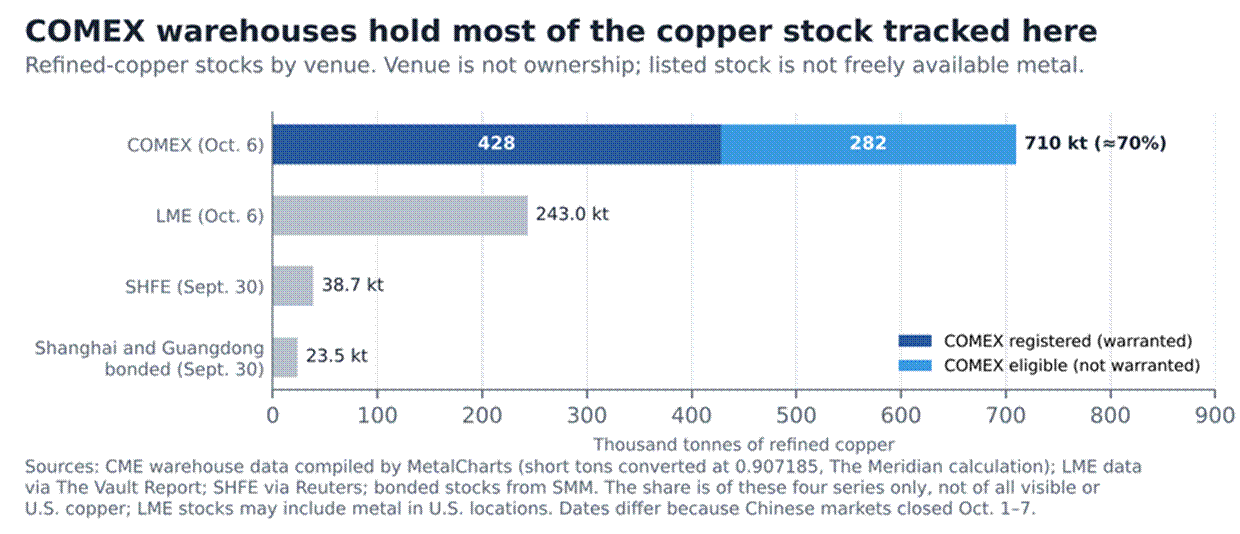
COMEX accounts for about 70% of the copper held across these four reporting venues. Chinese exchange and bonded stocks are a small fraction of their levels earlier in the year.
COMEX reported 782,363 short tons of copper in its warehouses on October 6, of which 471,425 were registered (warranted for delivery against COMEX contracts) and 310,938 eligible (meeting exchange specifications but not warranted), according to CME data compiled by MetalCharts. That is about 710,000 tonnes. LME stocks were 243,000 tonnes the same day; on October 2, 114,000 tonnes, or 45.8% of the LME total, were on cancelled warrants and earmarked for removal. On September 30, before China's National Day holiday, Shanghai Futures Exchange stocks were 38,744 tonnes, down 79% in four months, and Shanghai and Guangdong bonded stocks were 23,500 tonnes, down 4,500 tonnes in a week, according to SMM. China's social inventory, which overlaps with exchange stocks and is not added here, was 78,300 tonnes.
These are venue figures, not a geographic census. COMEX does not capture all U.S. copper, LME stocks may include metal held in U.S. locations, and no public data show how much of the COMEX stock is financed, hedged or committed to buyers. Registered metal is deliverable against COMEX contracts, but that does not mean it is unencumbered or that its owners intend to ship it. What the figures do show is that the stock visible to the market is concentrated in one venue whose economics currently discourage export.
How the metal got there, and why it is not leaving
Section 232 duties of 50% have applied to semi-finished copper products and copper-intensive derivatives since August 1, 2025, and were restructured from April 6, 2026 into a 50% tier for most covered copper articles and a 25% tier for certain others. Refined cathode has remained outside the duties. The July 2025 proclamation left open a phased universal duty on refined copper of 15% from January 1, 2027 and 30% from January 1, 2028, subject to a presidential determination after a Commerce Department update. No determination has been published. The possibility of a duty gave traders an incentive to land cathode in the United States before 2027; the COMEX premium over LME, about $420 a tonne at the end of July, paid for it, and U.S. refined imports ran at multi-year highs into the summer, according to trade reports.
That incentive has now gone. By September 29 the October COMEX contract traded $46.94 a tonne below LME three-month, and the November contract's $38.99 premium did not cover shipping, according to SMM. With no premium to attract new metal and freight costs to deter re-export, the COMEX stock is a legacy of earlier flows rather than evidence of continuing inflows. A decision against the refined-copper tariff could eventually loosen it, but owners' financing and contractual positions, warehouse queues and load-out choices would decide how much moved and how fast.
Tight nearby supply outside the United States
Outside the United States, nearby indicators point to tightness. The SMM premium for top-grade cathode in China was about $205 a tonne on September 29, the highest since October 2023, and the Yangshan import premium averaged $118 a tonne on warrants in the last days of September. LME copper moved into backwardation, with cash at $53.50 a tonne over three-month on October 2 and about $73.50 on October 6, when the three-month price was $14,427, below the record of $14,875 set on September 10. Japanese buyers agreed a 2026 premium of $330 a tonne with Pan Pacific Copper, against $88 for 2025. These measures show that prompt metal is scarce relative to demand outside the United States. They do not by themselves prove that fabricators are going short, and soft Chinese demand explains part of the pattern: apparent consumption fell 3.4% in August and refined imports 18.6%.
Chile is reinforcing the pressure
Chilean mine supply has deteriorated. National output was 403,424 tonnes in July, 9.4% lower than a year earlier, and 369,500 tonnes in August, 12.8% lower and the smallest monthly total since February 2011, according to INE; storms in the north and maintenance at large mines were cited. Output for January–August was about 3.27 million tonnes, down 7.8%. Cochilco's full-year forecast of 5.27 million tonnes would require about 500,000 tonnes a month from September to December, on The Meridian's arithmetic, well above recent months. Codelco produced 564,000 tonnes from its own mines in the first half, down 11%, or 619,000 tonnes including attributable stakes, with El Teniente down 26.5%. Labour risk persists: BHP requested government mediation at Escondida on October 5, delaying a strike by supervisors for at least five working days, and mediation at Antofagasta Minerals' Centinela ended on October 6 without agreement, with reports differing on when a strike could start. In Indonesia, Freeport said on October 2 that Grasberg's milling was running at about 67% of normal, with a target of 80% by mid-2027.
Chile's weakness should not be read as a global mine-supply verdict. Zambia's output rose 0.45% in the first half to about 447,000 tonnes, according to its mines ministry, and current official production data for Peru and the Democratic Republic of Congo were not available to The Meridian for this edition. Spot treatment charges for copper concentrate of about minus $225 a tonne, as assessed by Mysteel on September 24, show that concentrate is scarce for smelters, which is consistent with mine disruption, but they are a measure of smelter competition for concentrate and say little about refined availability.
The contrary case
The case against a shortage framing is substantial. ICSG's data for January–July showed a refined surplus of about 32,000 tonnes, with refined output up 1.7%, according to a summary of its bulletin. Forecasts for the 2026 refined balance vary widely by source and definition, from a deficit of about 150,000 tonnes (ICSG) to about 640,000 tonnes outside the United States (Goldman Sachs), with JPMorgan, Wood Mackenzie and Morgan Stanley in between; they are not interchangeable. Record prices are themselves rationing demand, encouraging scrap collection and delaying purchases. And LME copper had its worst week since April in the week to October 2. The defensible conclusion is narrower: copper is not globally exhausted, but metal is hardest to obtain where most of the demand is, and the stock that would ease that is in a venue that does not currently pay to ship it out.
What it means for buyers
Fabricators outside the United States are paying regional premiums on top of an LME price near its record, and should price procurement on delivered premiums rather than on the visible-stock total. In the United States, the policy split between duty-free cathode and dutiable semi-finished products favors domestic rod and wire mills over importers of covered semis, which matters for manufacturers' sourcing. The key tests over the next 30–90 days are whether COMEX stocks start to fall while LME and SHFE stocks build, whether Chinese premiums rise after the holiday, the outcomes at Escondida and Centinela, Chile's September output and any U.S. tariff determination.
Sulfur Is the Fertilizer Input That Has Not Normalized, and Phosphate Buyers Are Paying for It
Nitrogen recovered; phosphate did not
The Hormuz disruption hit fertilizer inputs unevenly. Urea prices rose from about $400 a tonne before the war to more than $850 in April, then fell to $453 by June, according to the WTO, and were back at their January level by late August, according to IFPRI. Phosphate prices rose about 30% after the war began and have stayed there since mid-May. The difference lies upstream. Phosphate production needs sulfuric acid made from sulfur, and the Gulf is a much larger supplier of sulfur than of finished phosphate. About 45% of traded sulfur normally transits Hormuz, according to IFPRI. Nitrogen has partly normalized on price, but continued LNG and shipping disruption means it should not be considered insulated.
Three causes behind the shortfall
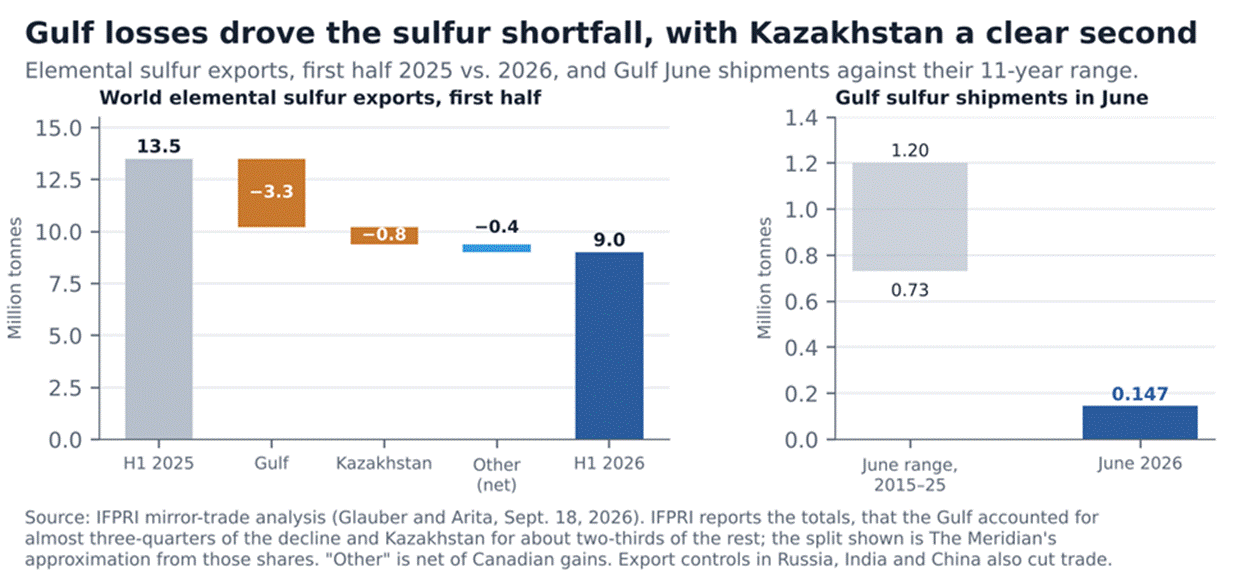
World elemental sulfur exports fell from 13.5 million to 9 million tonnes in the first half of 2026. Gulf shipments in June were about a fifth of the low end of their 11-year June range.
IFPRI's mirror-trade analysis, published September 18, shows world exports of elemental sulfur falling 33% in the first half, from 13.5 million to 9 million tonnes. Gulf suppliers accounted for almost three-quarters of the decline: UAE exports fell 41%, and those of Oman, Qatar and Kuwait each by more than half. By June, Gulf shipments were 147,000 tonnes, against an 11-year June range of 730,000 to 1.2 million tonnes. Hormuz is not the only cause. Kazakhstan accounted for about two-thirds of the decline outside the Gulf after restricting exports other than rail shipments through Russia in June. Russia has extended its sulfur export ban to the end of 2026, India suspended sulfur exports, and China suspended sulfuric-acid exports in May, cutting them from 2.19 million tonnes in the first half of 2025 to 784,000 tonnes. Canada partly filled the gap, with May shipments up 68% to 325,000 tonnes, according to S&P Global. China's sulfur imports fell 58% in the first half. Hormuz traffic remains low: Argus counted 17 transits on September 30, about 13% of the pre-war daily average.
How phosphate producers are absorbing it
About 0.4 tonnes of sulfur goes into each tonne of DAP or MAP. As an illustration only, the sulfur needed for a tonne of DAP was worth about $420 at India's August delivered sulfur price of about $1,050 a tonne, against an Indian DAP price of about $925 delivered. That ratio compares two delivered benchmarks and is not a production-cost share, because DAP prices also cover phosphate rock, ammonia, conversion, logistics and margins. SMM's cost model shows sulfur rising from 30–35% of Chinese phosphate production cost to more than 130% at the June peak, a model built on benchmark prices; producers have not reported comparable figures.
Producers have responded by cutting output and changing products. Ma'aden's DAP output fell to 1.23 million tonnes in the second quarter from 1.705 million a year earlier. OCP raised triple superphosphate, which needs less sulfur, to 35% of its exports from 26%, a product shift that still requires sulfur. Chinese MAP and DAP plants ran at about 40% and 30% in the first half, according to SMM. Producers that secured sulfur early or could switch products held up better: OCP's phosphate EBITDA fell 26%, against declines of 34–51% at Ma'aden, PhosAgro, Mosaic and Nutrien, according to a compilation of company results by LeBrief.ma. Global phosphate exports, in phosphorus terms, were down more than 9% in the first half, with imports down 27% in India, 31% in the EU and 14% in the United States, according to IFPRI.
Prices are easing because buyers are stepping back
Sulfur prices have started to fall. QatarEnergy cut its October price by $45 to $835 a tonne free on board, Kuwait's KPC by $45 to $820, and ADNOC's October price for India fell to $890 from $960, according to Argus. Granular sulfur delivered to China fell from $1,050 a tonne on August 6 to $965 on October 1, below the delivered cost implied by the new contract prices, which suggests buyers are refusing to pay contract levels. Prices remain roughly three times their level of a year earlier. The evidence points to demand refusal, product switching and lost affordability rather than a return of supply, but the share of each is not known. Brazil's phosphate imports fell 58% year on year in August and 22% in January–August, according to a weekly market update, and Pakistani importers expect 2026 DAP offtake to fall 20–30%, according to Argus.
Who is exposed
India has shielded its farmers through subsidy. DAP stocks were 2.35 million tonnes on September 30, 17% higher than a year earlier, and urea stocks 6.8 million tonnes, up 86%, ahead of the rabi sowing season, according to Business Standard. That reduces immediate physical risk, but at a fiscal cost: IFPRI notes that India's fertilizer subsidy bill may exceed ₹3 trillion (about $31 billion) this year against a budget of ₹1.71 trillion. Price-sensitive importers without subsidies, such as Brazil and Pakistan, are cutting purchases, which raises the risk of lower phosphate application ahead of 2027 crops. Whether acreage shifts toward lower-input crops is a scenario that would need crop-price and affordability evidence to test. Sulfuric-acid users in metals processing, such as copper leaching and nickel high-pressure acid leaching, compete for the same feedstock, although the effect on their output has not been quantified.
The outlook depends on Gulf shipping. Sulfur is a by-product of gas processing and refining, so if Hormuz traffic normalizes, delayed volumes could return quickly and prices could fall sharply, with phosphate following after a lag. If shipping stays impaired, phosphate is likely to stay elevated into Northern Hemisphere spring 2027 planting. The Meridian does not forecast a sulfur price level for the fourth quarter. The decisive signals are Gulf sulfur loadings, the November contract prices and Chinese port inventories.
Rice Is Cheap Now; the Risk Is El Niño and Indian Policy in Early 2027
Export supply is ample today
Current rice markets show no export shortage. Thai 5% broken rice fell from $488 to $460 a tonne over the two weeks to September 26, and Vietnamese 5% eased to $423–427, according to trader surveys and the Vietnam Food Association. Pakistan shipped a record 655,000 tonnes in July and August, up 20%. Indian 5% parboiled rice rose to $375–381 a tonne, a one-year high, narrowing the gap with Thai offers, but Indian supply remains open to export. On September 1, the Food Corporation of India held 39.1 million tonnes of rice and 30.8 million tonnes of unmilled paddy, according to Informist; the rice figure alone is about 2.9 times the July 1 buffer norm of 13.54 million tonnes, although the dates differ and paddy has not been converted to a rice equivalent. Indonesia's Bulog holds about 4.8 million tonnes and plans no imports this year. The FAO all-rice price index rose 1.4% in September. For importers, this is a buying window.
Stocks are concentrated, and that cuts both ways
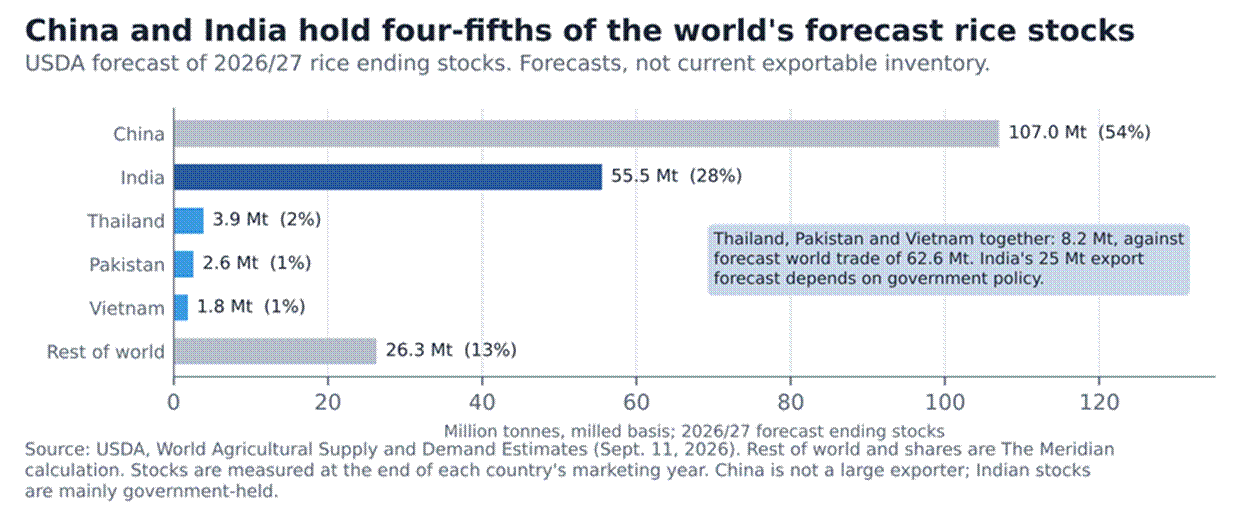
USDA forecasts world rice ending stocks of 197 million tonnes for 2026/27, of which China and India hold about 82%. The three other main exporters together hold about 8 million tonnes.
USDA's September forecasts put world rice ending stocks for 2026/27 at 196.99 million tonnes, down from 202.74 million a year earlier, because forecast consumption of 539.61 million tonnes exceeds production of 533.85 million. China is forecast to hold 107.0 million tonnes and India 55.5 million, together about 82.5% of the total. Thailand (3.85 million), Pakistan (2.56 million) and Vietnam (1.80 million) together hold about 8.2 million tonnes, against forecast world trade of 62.6 million. These are forecasts of stocks at the close of each country's marketing year, not a measure of rice available for export today. China is not a large exporter, although its stocks are not wholly inaccessible. India's stocks are mostly government-held, so their use depends on policy: they can stabilize world prices through open-market sales and exports, or be held back.
Rice trade is thin, about 12% of world production on USDA's forecasts, and concentrated among India, Thailand, Vietnam and Pakistan. Exporters other than India hold small stocks, so weather losses in Thailand or Vietnam would pass quickly into export prices unless India supplies the gap. That makes Indian policy the central swing factor, more than the global stock total.
The forward risk
The risk is forward-dated and conditional. NOAA's Climate Prediction Center gives a greater than 90% chance of a very strong El Niño through the 2026–27 northern autumn and winter, although NOAA itself cautions that the strength of an event does not map mechanically onto local rainfall or yields. India's monsoon ended 13% below normal, and kharif rice area was 3.6% lower than a year earlier as of September 25 on preliminary data. USDA cut its forecast of world production by 3.42 million tonnes in September and expects India's crop to fall to 147 million tonnes from 154 million. GEOGLAM's October 1 Crop Monitor described global rice conditions as generally favorable but reported drought damage in Thailand, damage from Cyclone Narra in Vietnam and monsoon losses in the Philippines. In past El Niño years, global rice yields have run 1.0–1.5% below trend and India's 0–3% below trend in strong events, according to GEOGLAM; those are historical tendencies, not forecasts. The crops most exposed are India's rabi crop and the dry-season and off-season crops in Thailand, Indonesia and the Philippines, which are harvested from early 2027.
Policy is moving on both sides. Thailand has proposed raising its strategic rice reserve by 30%, Vietnam tightened exporter licensing under Decree 365/2026 from October 1, and the Philippines, which imported 3.3 million tonnes by early August, has said it will not ban imports. India has made no announcement on new rice export restrictions, but a probe into irregular allocations under its Open Market Sale Scheme may lead to tighter oversight of government stock releases, according to trade commentary. Higher fertilizer costs could compound weather risk on dry-season crops, but the evidence is not sufficient to quantify that interaction.
A testable window
The next 60–120 days will test the thesis. Thai and Vietnamese offers staying weak through December with normal Thai off-season planting, Indian exports remaining open and Indian stock releases increasing, or an El Niño peak below "very strong" would all indicate that India's stocks can absorb regional losses. Damage to Thai and Indonesian dry-season planting, falling reservoir levels, larger Philippine or Indonesian import tenders, or any Indian export restriction or minimum export price would indicate that the risk premium is building. For buyers, the commercial logic is to take advantage of current offers while treating forward cover for the first quarter of 2027 as insurance. A specific price increase is a scenario, not a forecast.
BASE & INDUSTRIAL METALS
Copper is covered in the lead editorial.
Bauxite. Emirates Global Aluminium has resumed Guinean bauxite supply under renewed agreements with CBG for up to 4.9 million tonnes a year through 2044, after a settlement with Guinea's government; the first cargo, about 66,000 tonnes, was loaded at Kamsar in late August and announced on October 5. The 4.9 million tonnes is a contractual maximum, not shipments. Guinea's bauxite exports reached about 20 million tonnes a month this year, about 95% to Asia, according to CRU, adding long-haul dry-bulk tonne-miles. Alumina prices had fallen back to about $300 a tonne by mid-2026, according to CRU; current alumina refinery curtailments and restarts were not assessed for this edition.
Nickel. Indonesia's ore supply is tight while refined nickel is not. Indonesia's energy ministry has reportedly limited the 2026 ore quota to 250–260 million tonnes, against 379 million in 2025, according to ANTARA; the miners' association expects 260–270 million, and the ministry said in June that the final total had not been decided. Smelters would need about 315 million tonnes at full capacity, according to the association, and ore is being imported from the Philippines. Yet LME nickel stocks rose to 284,178 tonnes on October 6 from 255,282 tonnes at the start of January, and cash nickel fell 7.4% over the same period to $15,530. An ore constraint is not a nickel shortage.
Other metals. Aluminium fell $141.50 a tonne in the week to October 5, to $3,134.50, which SMM attributes to an unwinding risk premium; falling prices do not by themselves indicate a physical surplus. Zinc cash was $3,803 a tonne on October 6, 22.4% higher than at the start of January, with LME stocks of 127,275 tonnes. Tin cash was $54,275, up 29.1% since January, with LME stocks of only 4,405 tonnes; export flows from Myanmar's Wa region and Indonesia were not verified for this edition and are a watchpoint.
FERROUS METALS & STEEL RAW MATERIALS
Iron ore. Simandou's high-grade ore is arriving in a well-stocked market. UBS estimates the project's annualized run-rate at about 39 million tonnes a year; market estimates for 2026 shipments are 16–22 million tonnes, with Wood Mackenzie's base case about 16 million, against eventual system capacity of about 120 million tonnes. Those are analyst figures, not company-reported shipments; Rio Tinto's next operational review should update them. Chinese port stocks were 172.18 million tonnes on October 1, according to Mysteel, while China's crude steel output fell 3.7% year on year in August and 3.1% in January–August. Mysteel's index put 61% iron ore at $91.65 a dry tonne and 65% at $110.00 on October 6, a spread of $18.35. The Meridian treats Simandou as pressure on grade spreads and marginal suppliers rather than as evidence of an imminent price collapse.
Metallurgical coal. Australian premium low-volatile hard coking coal rose by more than $60 a tonne from late July to nearly $280, according to Kpler, after mine-safety crackdowns in China following fatal accidents cut domestic coking-coal output. Higher coal costs offset part of the benefit blast-furnace producers gain from cheaper iron ore. No validated scrap or DRI spread data were available, so no claim is made about the relative competitiveness of steelmaking routes.
CRITICAL & STRATEGIC MINERALS
China's November 10 deadline. China's one-year suspension of the expanded export controls it announced in October 2025, covering certain rare-earth items and technologies, lithium-battery materials and synthetic graphite anode materials, expires on November 10, 2026, according to China's State Council Information Office. The April 2025 controls on seven medium and heavy rare earths were not suspended and remain in force. The suspended rules are not restricting trade today; the risk is that they are reinstated, extended or replaced. Buyers of magnets, battery materials and graphite face inventory and dual-sourcing decisions before the deadline. The Meridian's October 5 call that both this suspension and the U.S. port-fee suspension will be extended or folded into the U.S.–China truce remains open.
Cobalt, lithium and graphite. The Democratic Republic of Congo's 2026 cobalt export quota is 87,000 tonnes plus a 9,600-tonne strategic reserve, and unshipped second-quarter allocations were removed, according to Fastmarkets; market reports put payables for Congolese hydroxide near 100% of the metal price, but no current cobalt benchmark was obtained. Lithium remains weak: China's January 2027 lithium-carbonate contract closed at CNY119,100 a tonne, down 3.8% in a week, according to SMM, and Chile's August lithium-carbonate exports rose 42.5% to 24,100 tonnes. China's August graphite exports were 6,360 tonnes of flake (down 2%) and 57,867 tonnes of artificial graphite (up 3.1%).
INDUSTRIAL MINERALS & FERTILIZER RAW MATERIALS
Sulfur and phosphate are covered in the second editorial.
Potash is the counterpoint: comparatively well supplied and getting cheaper. The World Bank's potash benchmark fell from $405 a tonne in May to $367.50 in September, and Brazilian muriate of potash was quoted at $380–385 a tonne delivered. The U.S. Treasury removed Belaruskali and Belarusian Potash Company from its sanctions list on March 26, 2026, and a 30,000-tonne Belarusian cargo is reported to be due at New Orleans on October 14, the first in four years; its arrival and customs entry have yet to be confirmed, and a single cargo, about 0.5% of 2025 U.S. imports, does not establish normal trade.
Excluded. Reports of a helium shortfall linked to damage at Ras Laffan rely on a single commercial distributor's wide estimates and are not included.
GRAINS & FEED COMMODITIES
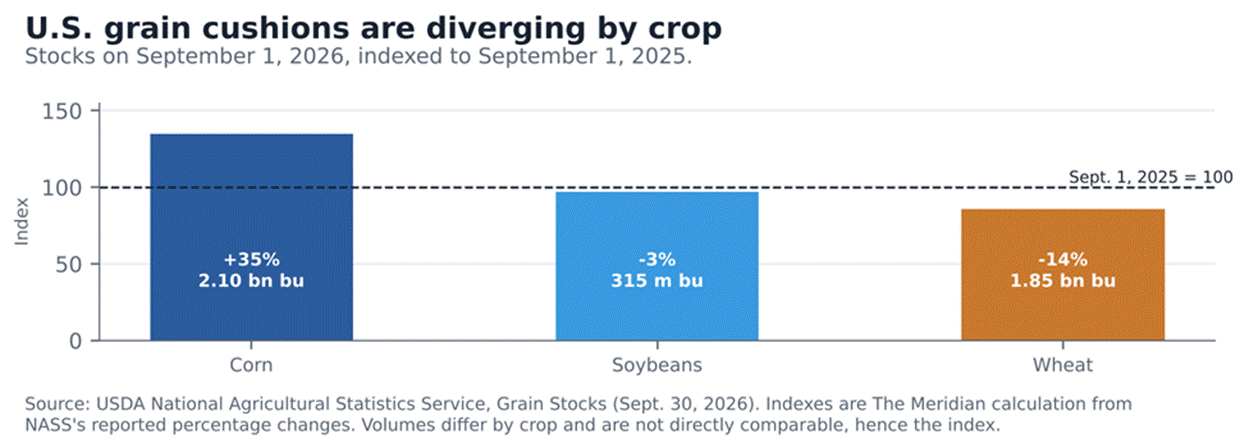
U.S. corn stocks on September 1 were 35% higher than a year earlier, while wheat stocks were 14% lower and soybean stocks 3% lower.
U.S. stocks. USDA's September 1 stocks report showed corn at 2.10 billion bushels, up 35%, with off-farm stocks up 44% to 1.31 billion bushels in commercial storage, even though June–August use rose to 3.20 billion bushels from 3.09 billion. Wheat stocks were 1.85 billion bushels, down 14%, after a 2026 crop of 1.53 billion bushels, 23% smaller than last year's. A larger corn carry-in meets a crop USDA forecast at 15.8 billion bushels, which points to harvest storage pressure and weak basis, although regional basis, logistics and crop quality determine actual feed costs.
Black Sea. Attacks on shipping are disrupting grain exports. Russia's July–August grain exports were 4.4 million tonnes, down 31%, and Sovecon estimates September at about 2.45 million tonnes, according to Reuters. In August alone, Ukraine's exports were 0.98 million tonnes (down 58%) and Russia's 1.70 million tonnes (down 71%), according to Miller Magazine. Freight from Izmail to Egypt rose from about $40 to $100–105 a tonne, and London's Joint War Committee extended its Black Sea listed area to the whole sea on September 18, adding war-risk premiums of hundreds of thousands of dollars per voyage, according to gCaptain. Russia is adapting Baltic and Arctic terminals, but their capacity is a small fraction of the southern ports'. About 30 million tonnes could remain unexported this season, according to one estimate. Higher stocks among other wheat exporters, reported by AMIS, weaken any global-shortage narrative; the main effect is on freight and landed costs in the Middle East, North Africa and Asia. The FAO cereal price index rose 5.1% in September.
OILSEEDS & VEGETABLE OILS
Soybeans. U.S. soybean stocks were 315 million bushels on September 1, down 3%, as June–August use rose to 744 million bushels from 683 million. USDA forecasts 2026/27 U.S. ending stocks of 310 million bushels and world ending stocks of 124 million tonnes, which is comfortable but tightening. China has booked 8.98 million tonnes of U.S. soybeans for 2026/27, with total U.S. export commitments more than double a year earlier, according to S&P Global; nearly all purchases are by state buyers, because U.S. beans face a combined 13% Chinese duty against 3% for Brazilian beans, which keeps Brazil price-competitive.
Vegetable oils. Malaysian palm-oil stocks rose 7.5% in August to 2.82 million tonnes, an eight-month high, as exports fell 7.5%, according to MPOB data; a record for September is expected but had not been published at the time of writing. The FAO vegetable-oil index rose 0.9% in September. Malaysian stocks alone do not make a global buyer's market, and the effect of Black Sea disruption on sunflower-oil exports was not assessed for this edition.
SOFT COMMODITIES & FIBERS
Cocoa. Nearby supply has rebuilt while next season's crop looks smaller. ICE certified cocoa stocks of about 3.5 million bags are at a 2.25-year high, Ivorian arrivals for the season to September 27 were 2.18 million tonnes (up 19.8%), and grindings fell 4.6% in Europe in the second quarter. Against that, an early private estimate puts Côte d'Ivoire's 2026/27 crop at 1.8 million tonnes, 18% lower, while StoneX forecasts a small 2026/27 surplus of 25,000 tonnes. New York cocoa was $5,177 a tonne on October 1. Without the futures curve, The Meridian does not claim that the market is pricing a nearby-versus-forward divergence.
Sugar. Raw sugar reached an 18-month high of about 19 cents a pound on October 1, up about a third this year, on expected 2026/27 losses in Thailand, the EU and India; StoneX forecasts a global deficit of about 0.9 million tonnes. A large delivery of 1.45 million tonnes against the October contract is contrary evidence to any nearby shortage.
Cotton. USDA forecasts 2026/27 world mill use of 122.9 million bales against production of 117.3 million, cutting ending stocks to 69.9 million bales from 75.3 million. Those stocks still equal more than half a year's mill use, so the gap points to a tighter market with no shortage in sight; textile demand remains the main uncertainty. December ICE cotton settled at 81.21 cents a pound on October 6, down from 93.14 cents on August 31.
Coffee. Supply is recovering. Conab puts Brazil's 2026 crop at 67.6 million bags, Vietnam's September exports rose 53% to 124,000 tonnes, and ICE certified arabica stocks rebuilt to 260,654 bags from a 27-year low of 217,646 on September 15. Certified stocks are a fraction of commercial inventory. Arabica was about 303 cents a pound on October 6, 19% lower than a year earlier.
INVENTORIES, STOCKS & PHYSICAL AVAILABILITY
Stock figures across commodities measure different things. Exchange stocks, government stocks, port stocks and forecast ending stocks do not share a common definition of deliverability, and historical percentiles were not available for most of them. The table below records what each figure is and who controls it, and does not rank them.
Selected stock measures: what they are and who holds them
|
Market |
Measure and level |
Holder or venue |
Deliverability |
|
Copper |
COMEX 782,363 st (~710 kt, Oct. 6); LME 243 kt (Oct. 6); SHFE
38.7 kt (Sept. 30) |
Exchange warehouses; owners not disclosed |
COMEX registered and eligible differ; LME 45.8% cancelled
(Oct. 2) |
|
Rice |
World 2026/27 forecast ending stocks 197.0 Mt; FCI rice 39.1
Mt (Sept. 1) |
Mostly state-held in China and India |
Exportability depends on policy |
|
Corn (U.S.) |
2.10 bn bu (Sept. 1); off-farm 1.31 bn bu |
Farms and commercial storage |
Commercially accessible |
|
Iron ore |
China 47 ports 172.18 Mt (Oct. 1) |
Traders and mills |
Port stocks; grade mix matters |
|
Fertilizer (India) |
DAP 2.35 Mt; urea 6.8 Mt (Sept. 30) |
Domestic distribution under subsidy |
For domestic use |
|
Cocoa |
ICE certified ~3.5 m bags |
Exchange warehouses |
Graded; not all-origin availability |
|
Palm oil |
Malaysia 2.82 Mt (Aug.) |
Producers and refiners |
September data pending |
Sources: as cited in this edition. Measures are not comparable across rows.
COMMODITY TRADE FLOWS & REGIONAL DIVERGENCE
• Copper into the United States: strong cathode imports in the first half have stopped now that the COMEX premium has closed; current U.S. re-export data were not available.
• Sulfur: Gulf exports collapsed while Canadian shipments rose 68% in May, replacing only part of the Gulf and Kazakh loss. Saudi cargoes have moved via Red Sea ports, according to S&P Global.
• Phosphate: Moroccan product has re-entered the U.S. market after countervailing duties were suspended on June 29, according to North Africa Post.
• Bauxite and iron ore from Guinea: EGA's renewed supply to the UAE (contractual maximum) and Simandou's ramp-up (analyst run-rate estimate) add long-haul dry-bulk demand; monthly customs and port data were not available.
• Black Sea grain: rerouting through Baltic and Arctic terminals cannot replace southern port capacity, and freight and war-risk insurance are raising landed costs.
• Rice: Indian export prices have risen while Thai and Vietnamese prices have fallen, narrowing the spread between origins.
• Sugar: India's 1-million-tonne duty-free import quota runs to October 31, with uptake of no more than half expected, according to Reuters.
SUPPLY CONCENTRATION, SUBSTITUTION & RECYCLING
Concentration is clearest in sulfur, where about 45% of traded supply normally passes through Hormuz and supply is a by-product of gas processing and refining; in heavy rare-earth separation and magnets, where China dominates and non-Chinese capacity is small; and in Simandou, a single integrated mine-rail-port system whose outage risk has not been quantified. Substitution is product-specific. OCP's shift toward triple superphosphate reduces sulfur use per tonne of nutrient but does not eliminate it, and the growth of lithium iron phosphate batteries reduces nickel intensity in some segments, although battery-capacity data are not sufficient to translate that into a nickel-demand estimate. China's cap on scrap invoicing may be keeping some copper scrap out of the formal market, but estimates of the volume are too uncertain to use. No broad recycling trend is asserted.
CROSS-LAYER COMMODITIES IMPLICATIONS
Trade policy to manufacturing. U.S. duties that cover semi-finished copper but not cathode change sourcing incentives between domestic fabricators and importers of covered products.
Energy and geopolitics to fertilizers and crops. Hormuz disruption reduces recovered-sulfur availability, raises phosphate costs and increases subsidy exposure in importing countries. Gas and electricity costs are co-drivers of fertilizer and metals economics alongside sulfur.
Fertilizers to metals. Higher sulfur and sulfuric-acid costs may affect copper leaching and nickel high-pressure acid leaching, but the output effect has not been quantified.
Mining to freight. Guinean bauxite and Simandou iron ore add long-haul dry-bulk tonne-miles, although actual cargo cadence must replace capacity estimates.
War risk to grain trade. Black Sea attacks lengthen routes and raise freight and insurance costs, while war-risk premiums for Hormuz transits of 3–10% of hull value, against 0.15–0.25% before the war, as quoted by insurance-market sources, add to delivered costs for Gulf-origin cargoes.
Export controls to manufacturing. China's November 10 decision creates procurement and inventory risk for magnets, battery materials, electronics and defense supply chains.
Meridian Outlook
None of The Meridian's Commodities calls has resolved, so this edition carries no Prior Outlook Audit. The five calls published on September 30 remain open; the table records the evidence since publication, together with two related calls from other editions, without classifying any of them.
Open calls: evidence since publication
|
Call |
Proposition |
Evidence since publication |
Status |
|
COM-20260930-01 |
First 2027 copper concentrate TC/RC benchmark no higher than
$0/dmt and 0¢/lb |
Spot TC about −$225/dmt (Mysteel, Sept. 24); Chilean and
Grasberg supply weak |
Open; consistent so far |
|
COM-20260930-02 |
SHFE copper stocks below 100,000 t in every weekly report,
Oct. 1–Dec. 31 |
38,744 t on Sept. 30, before the window; first October report
follows the holiday |
Open; no reading yet |
|
COM-20260930-03 |
Q4 2026 European duty-paid ingot aluminium premium above
$400/t |
No new premium data reviewed for this edition |
Open; no new evidence |
|
COM-20260930-04 |
ICE certified arabica stocks above 300,000 bags at the end of
2026 |
Rebuilt to 260,654 bags from 217,646 on Sept. 15 |
Open; rising but below threshold |
|
COM-20260930-05 |
Conab's first 2027 Brazil coffee estimate below 67.6m bags |
No new evidence; flowering season under way |
Open |
|
CHM-20260929-02 (Chemicals) |
China's sulfur imports below the same month of 2025,
Sept.–Dec. 2026 |
First-half imports down 58% (IFPRI); September customs data
due around Oct. 20 |
Open; no reading yet |
|
TPG-20261005-03 (Trade Policy) |
U.S. port-fee and China rare-earth suspensions extended or
folded into the truce, not lapsed, by Nov. 10 |
No notice from either side as of Oct. 7 |
Open |
Status reflects evidence through October 7, 2026. Outcomes are determined by The Meridian's forecast record on each call's evaluation date.
BASE CASE (October 2026 through March 2027; MODERATE CONFIDENCE overall: MODERATE for copper and sulfur, LOW for rice). Availability continues to vary by region and by who holds the stock, and no broad global shortage develops. Copper availability outside the United States stays relatively tight while COMEX inventory remains high. Phosphate normalizes more slowly than nitrogen because sulfur flows remain impaired. Rice remains amply available in the near term but acquires a larger weather-and-policy risk premium toward early 2027.
PRINCIPAL EVIDENCE. COMEX holding about 70% of the copper in the four venues tracked here, low Chinese exchange and bonded stocks, a three-year-high Chinese premium and weak Chilean output; sulfur exports a third below 2025, impaired Hormuz shipping and phosphate prices still about 30% above pre-war levels; a very strong El Niño forecast alongside currently comfortable rice offers and large Indian stocks.
CONTRARY CASE. Clarity on U.S. tariff policy releases or redistributes copper stocks; Gulf sulfur flows recover faster than expected; and India keeps rice exports open, allowing its large government stocks to offset Southeast Asian weather losses.
WHAT WOULD STRENGTHEN THE BASE CASE. COMEX stocks staying high while LME and SHFE stocks decline; Chilean output staying below 400,000 tonnes a month or labour disruption removing output; Gulf sulfur shipments staying below 0.7 million tonnes a month; sulfur prices stabilizing at elevated levels despite weak phosphate demand; deteriorating Thai and Vietnamese dry-season planting; Indian export restrictions or reduced stock releases.
WHAT WOULD WEAKEN IT. Material COMEX outflows accompanied by lower Asian premiums; LME copper returning to contango; normal Gulf sulfur loadings and Hormuz transits; DAP prices falling toward pre-war levels; Thai and Vietnamese offers staying weak through the first quarter of 2027; India actively releasing stocks into export channels.
INVALIDATORS. No sustained regional copper premium or backwardation despite low stocks outside the United States; Gulf sulfur exports back in their historical range with phosphate prices normalized; Asian rice offers at or below October levels through March despite a peak El Niño; Indian export policy staying open while state stocks continue to rise.
CALLS TO AUDIT. These are new and do not repeat the open calls above. Each states its own evaluation condition:
• Total COMEX copper warehouse stocks (registered plus eligible), as reported by CME, will be above 650,000 short tons in CME's last daily warehouse-stock report of 2026. Evaluated on that report. MODERATE CONFIDENCE.
• LME copper will be in backwardation, with the official cash price above the official three-month price, on the last LME trading day of 2026. Evaluated on that day's official prices. MODERATE CONFIDENCE.
• Chile's copper mine production, as first published by INE, will be lower than in the same month of 2025 in each of September, October and November 2026. Evaluated on publication of the November figure, expected at the end of December 2026. MODERATE CONFIDENCE.
• QatarEnergy's monthly sulfur price (QSP) for December 2026, as reported by Argus or announced by QatarEnergy, will be below its October 2026 level of $835 a tonne free on board. Evaluated on publication of the December price, expected around the end of November. MODERATE CONFIDENCE.
• India will not impose a new ban, export duty or minimum export price on non-basmati rice exports between October 7, 2026 and March 31, 2027, as shown by a government notification. Evaluated March 31, 2027. MODERATE CONFIDENCE.
Decision calendar
|
Date |
Decision point |
Status |
|
Oct. 8 |
Chinese exchanges reopen after National Day; post-holiday
copper restocking test |
Scheduled |
|
Oct. 9 |
USDA October WASDE (rice, grains, oilseeds, cotton) |
Scheduled |
|
Around Oct. 10 |
MPOB September palm-oil data |
Expected |
|
Oct. 13 |
International Copper Study Group meeting, Lisbon |
Scheduled |
|
Oct. 14 |
Reported arrival of a Belarusian potash cargo at New Orleans |
Reported |
|
Mid-October |
Escondida mediation outcome; possible Centinela strike |
Pending |
|
Around Oct. 20 |
China customs detail for September: sulfur, copper, rare
earths |
Expected |
|
Oct. 27 |
Freeport-McMoRan third-quarter results |
Scheduled |
|
End-October |
INE Chile September output; QatarEnergy, KPC and ADNOC
November sulfur prices |
Expected |
|
Early November |
GEOGLAM Crop Monitor; NOAA ENSO update |
Expected |
|
Nov. 10 |
China's suspension of its October 2025 export controls expires |
Scheduled |
|
November–January |
Expected El Niño peak; Indian rabi and Southeast Asian
dry-season planting |
Seasonal |
|
Dec. 31 |
Russia's sulfur export ban expires unless extended |
Scheduled |
|
Jan. 1, 2027 |
Earliest date for a phased 15% refined-copper duty, if
determined |
No determination published |
Sources: as cited in this edition.
Signals to Watch
• COMEX registered and eligible copper stocks.
• LME copper stocks and cancelled warrants, including by warehouse location.
• SHFE and bonded stocks and the Yangshan and SMM premiums after the holiday.
• The COMEX–LME spread after freight and financing costs.
• Chile's monthly mine production and the Escondida and Centinela labour outcomes.
• Any U.S. determination on a refined-copper tariff.
• Gulf sulfur exports and Hormuz vessel transits.
• QatarEnergy, ADNOC and KPC monthly sulfur prices.
• Chinese port sulfur inventories and DAP and MAP operating rates.
• Indian rabi DAP sales and any revision to the fertilizer subsidy.
• Thai and Vietnamese rice offers relative to India and Pakistan.
• Indian rice exports, open-market sales and any policy announcement.
• Thai dry-season planting and reservoir levels; Philippine and Indonesian import tenders.
• Monthly Simandou shipments and Chinese port stocks by grade.
• Indonesian nickel ore output against approved quotas.
• China's November 10 decision on rare-earth, battery and graphite controls.
• Ivorian weekly cocoa arrivals and ICE certified stocks.
• Official September Malaysian palm-oil stocks.
• Cotton ending stocks and mill-use revisions, not only production against use.
• Black Sea grain freight, war-risk premiums and terminal repairs.
Sources
• MetalCharts (CME data) — COMEX copper warehouse stocks, data October 6, 2026. https://metalcharts.org/comex/copper
• CME Group — Registrar reports (warehouse stocks), October 2026. https://www.cmegroup.com/clearing/operations-and-deliveries/registrar-reports.html
• The Vault Report (LME data) — LME copper price and stocks, data October 6, 2026. https://thevaultreport.com/lme/copper
• LME Insight — The LME Weekly Review: 28 September–2 October 2026, October 5, 2026. https://www.lmeinsight.com/the-lme-weekly-review-28-september-2-october-2026/
• Mining.com.au (Reuters) — Copper price heads for worst week since April as demand concerns weigh, October 2, 2026. https://mining.com.au/copper-price-heads-for-worst-week-since-april-as-demand-concerns-weigh/
• SMM — Yangshan copper weekly review, September 30, 2026. https://news.metal.com/newscontent/104142355-buyers-and-sellers-diverge-before-the-holiday-market-remains-sluggish-smm-yangshan-copper-weekly-review
• SMM — The US copper tariff trade is fading, but it isn't over yet, September 29, 2026. https://news.metal.com/newscontent/104139507-smm-analysis-the-us-copper-tariff-trade-is-fading-but-it-isnt-over-yet
• SMM — GACC: China's August copper cathode imports down 18.62% YoY, September 2026. https://news.metal.com/newscontent/104124576-gacc-chinas-aug-copper-cathode-imports-down-1862-yoy-breakdown-of-imports-and-exports
• ScrapMonster — Copper price firms on reduced likelihood of higher US interest rates, October 6, 2026. https://www.scrapmonster.com/news/copper/copper-price-firms-on-reduced-likelihood-of-higher-us-interest-rates-2026-10-6/100177
• Copper.com.au — Copper weekly brief, week ending 2 October 2026, October 2, 2026. https://copper.com.au/news/mining/copper-weekly-brief-week-ending-2-october-2026/amp/
• Minmetals Futures — Copper monthly report, September 14, 2026. https://www.minfutures.com/plat_files/upload/png_upload/20260914/202609141789367466187.pdf
• The White House — Adjusting imports of copper into the United States (proclamation), July 30, 2025. https://www.whitehouse.gov/presidential-actions/2025/07/adjusting-imports-of-copper-into-the-united-states/
• The White House — Strengthening actions taken to adjust imports of aluminum, steel and copper into the United States (proclamation), April 2, 2026. https://www.whitehouse.gov/presidential-actions/2026/04/strengthening-actions-taken-to-adjust-imports-of-aluminum-steel-and-copper-into-the-united-states/
• INE Chile — Copper mining production and inventories, September 30, 2026. https://www.ine.gob.cl/estadisticas-por-tema/industria-energia-y-construccion/inventarios-de-la-mineria-del-cobre
• GBM (INE data) — Producción chilena de cobre cae 9,4% en julio, August 31, 2026. https://gbm.com/media/noticia/produccion-chilena-de-cobre-cae-94-en-julio-estatal-ine/
• Industrial Info Resources — Chile's copper output drops as miner strikes loom, October 2, 2026. https://www.industrialinfo.com/news/article/chiles-copper-output-drops-as-miner-strikes-loom--363213
• Codelco — Operational and Financial Report, June 30, 2026, 2026. https://www.codelco.com/sites/site/docs/20260601/20260601161122/operational_and_financial_report_june_30__2026.pdf
• Cochilco — Market report, October 5, 2026. https://www.cochilco.cl/web/
• SMM — BHP seeks formal mediation at Escondida, temporarily delaying strike, October 7, 2026. https://news.metal.com/newscontent/104144101-bhp-seeks-formal-mediation-at-escondida-temporarily-delaying-strike-at-worlds-largest-copper-mine
• Rio Times — Chile copper mine strike: Centinela, October 7, 2026. https://www.riotimesonline.com/chile-copper-mine-strike-centinela-2026/
• Freeport-McMoRan (via Yahoo Finance) — Freeport provides third-quarter 2026 update, October 2, 2026. https://uk.finance.yahoo.com/news/freeport-provides-third-quarter-2026-120000404.html
• Mysteel — Copper concentrate TCs remain low with trading sluggish, September 24, 2026. https://www.mysteel.net/analysis/5142891-copper-concentrate-tcs-remain-low-with-trading-sluggish-
• JM Financial (summary of ICSG bulletin) — ICSG monthly bulletin, January–July 2026, September 24–25, 2026. https://www.jmfinancialservices.in/market-news-and-insights/1733959
• International Copper Study Group — ICSG, October 2026. https://icsg.org/
• Zambia Monitor — Copper production edges up in first half of 2026, Zambia ministry official says, July 31, 2026. https://www.zambiamonitor.com/copper-production-edges-up-in-first-half-of-2026-zambia-ministry-official-says/
• IFPRI (Glauber and Arita) — How are fertilizer markets coping with the continued closure of the Strait of Hormuz?, September 18, 2026. https://www.ifpri.org/blog/how-are-fertilizer-markets-coping-with-the-continued-closure-of-the-strait-of-hormuz/
• IFPRI — A narrow strait, global consequences: the Hormuz Strait and fertilizer markets, 2026. https://www.ifpri.org/event/a-narrow-strait-global-consequences-hormuz-strait-and-fertilizer-markets/
• WTO Data Blog — Fertilizer trade impacted by Strait of Hormuz conflict, July 10, 2026. https://www.wto.org/english/blogs_e/data_blog_e/blog_dta_10jul26_451_e.htm
• Argus Media — QatarEnergy drops October sulphur price by $45/t, September 30, 2026. https://www.argusmedia.com/en/news-and-insights/latest-market-news/2884718-qatarenergy-drops-october-sulphur-price-by-45-t
• Argus Media — Pakistani DAP stocks low, as imports awaited, October 1–2, 2026. https://www.argusmedia.com/en/news-and-insights/latest-market-news/2885304-pakistani-dap-stocks-low-as-imports-awaited
• S&P Global Commodity Insights — Fresh Gulf sulfur loadings expected to lag despite Hormuz reopening, July 3, 2026. https://www.spglobal.com/energy/en/news-research/latest-news/agriculture/070326-fresh-gulf-sulfur-loadings-expected-to-lag-despite-hormuz-reopening
• SMM — H1 2026 sulfur industry chain review, July 6, 2026. https://news.metal.com/newscontent/103989791-smm-analysis-h1-2026-sulfur-industry-chain-review-extreme-volatility-under-supply-shocks
• Global Agriculture — Sulphur prices ease, but Hormuz keeps supply tight, September 24, 2026. https://www.global-agriculture.com/global-agriculture/sulphur-prices-ease-but-hormuz-keeps-supply-tight/
• Business Standard — Diammonium phosphate stockpile healthy ahead of rabi sowing season, October 4–5, 2026. https://www.business-standard.com/amp/industry/agriculture/diammonium-phosphate-stockpile-healthy-ahead-of-rabi-sowing-season-126100400388_1.html
• Jawlah — Ma'aden posts Q2 2026 results, August 9, 2026. https://jawlah.co/en/62056
• North Africa Post — OCP shifts to TSP fertilizer as sulfur prices surge, October 7, 2026. https://northafricapost.com/100651-ocp-shifts-to-tsp-fertilizer-as-sulfur-prices-surge.html
• LeBrief.ma — OCP maintient sa rentabilité malgré le choc du soufre, September 29, 2026. https://www.lebrief.ma/ocp-maintient-sa-rentabilite-malgre-le-choc-du-soufre-100167591/
• Get The Word Out — Weekly Update — Global Fertiliser Markets, w/e 11.09.2026, September 11, 2026. https://getthewordout.com.au/press-release/press-release-weekly-update-global-fertiliser-markets-w-e-11-09-2026-stop-press-china-moves-to-centre-stage-in-global-urea-market/
• Crux Investor — Sanctions relief returns Belarusian potash to US ports as prices fall, October 6, 2026. https://www.cruxinvestor.com/posts/sanctions-relief-returns-belarusian-potash-to-us-ports-as-prices-fall
• U.S. Department of the Treasury, OFAC — Recent actions, March 26, 2026. https://ofac.treasury.gov/recent-actions/20260326
• USDA — World Agricultural Supply and Demand Estimates (WASDE-675), September 11, 2026. https://www.usda.gov/oce/commodity/wasde/wasde0926.pdf
• USDA Economic Research Service — Rice Outlook, September 2026, September 2026. https://www.ers.usda.gov/media/29637/rcs-26h.pdf?v=92736
• Agriinsite — Indian rice export prices hit one-year high on production concerns, September 18, 2026. https://agriinsite.com/asia-rice-indian-rice-export-prices-hit-1-year-high-on-production-concerns/
• Vietnam.vn (VFA prices) — Agricultural prices, September 26, 2026, September 26, 2026. https://www.vietnam.vn/en/gia-nong-san-hom-nay-26-9-2026-gia-ca-phe-tang-nong-phien-cuoi-tuan-gioi-dau-tu-day-manh-mua-vao-quy-dinh-moi-ve-dieu-kien-kinh-doanh-xuat-khau-gao
• Profit (Pakistan Today) — Pakistan rice exports hit record 655,000 tonnes in 2MFY27, September 21, 2026. https://profit.pakistantoday.com.pk/2026/09/21/pakistans-rice-exports-hit-record-655000-tonnes-in-2mfy27-earnings-rise-25percent-to-dollar392-million
• Informist — FCI stocks as of September 1, September 16, 2026. https://informistmedia.com/CommodityWire/59784/Taking-stock-FCI-wheat-stocks-fall-29-37-MoM-as-of-Sept-1-rice-dn-3-37-both-record-rise-YoY
• Commodity-Board — India's FCI rice scandal adds policy risk as export prices firm, September 1, 2026. https://www.commodity-board.com/india-s-fci-rice-scandal-adds-policy-risk-as-export-prices-firm
• NOAA Climate Prediction Center — ENSO diagnostic discussion, September 2026. https://www.cpc.ncep.noaa.gov/products/analysis_monitoring/enso_advisory/ensodisc.shtml
• GEOGLAM — Crop Monitor for AMIS, October 2026, October 1, 2026. https://www.cropmonitor.org/crop-monitor-for-amis
• GEOGLAM — El Niño 2026–2027 special report, June 16, 2026. https://www.cropmonitor.org/special-reports-202606
• The Statesman — 13% monsoon deficit raises concerns over rabi crops, September 30, 2026. https://www.thestatesman.com/india/13-monsoon-deficit-raises-concerns-over-rabi-crops-season-among-weakest-since-2001-1503645304.html
• ANTARA — Indonesia secures 4.8 million tons of rice stock through year-end, September 26, 2026. https://en.antaranews.com/amp/news/432979/indonesia-secures-48-million-tons-of-rice-stock-through-year-end
• Philippine News Agency — PH won't impose rice import ban, August 2026. https://www.pna.gov.ph/articles/1281002
• FAO — Food Price Index, October 2, 2026. https://www.fao.org/worldfoodsituation/foodpricesindex/en/
• AMIS — Market Monitor, October 2026, October 2, 2026. https://storage.googleapis.com/amis-9189b-strapi/AMIS_Market_Monitor_Issue_141_ebfa77881c/AMIS_Market_Monitor_Issue_141_ebfa77881c.pdf
• LME Insight — EGA resumes Guinean bauxite shipments after settlement with government, October 5, 2026. https://www.lmeinsight.com/ega-resumes-guinean-bauxite-shipments-after-settlement-with-government/
• CRU — Bauxite is emerging as a driver of the dry bulk freight rally, May 21, 2026. https://www.crugroup.com/en/communities/thought-leadership/2026/bauxite-is-emerging-as-a-driver-of-the-dry-bulk-freight-rally/
• ANTARA — Indonesia limits nickel quota expansion to support global prices, July 11, 2026. https://en.antaranews.com/news/422261/indonesia-limits-nickel-quota-expansion-to-support-global-prices
• Ministry of Energy and Mineral Resources (Indonesia) — Kementerian ESDM belum putuskan besaran RKAB nikel 2026, June 25, 2026. https://esdm.go.id/id/media-center/arsip-berita/kementerian-esdm-belum-putuskan-besaran-rkab-nikel-2026
• Kitco (Reuters) — Indonesian nickel miner group says 2026 production quota additions to be selective, August 13, 2026. https://www.kitco.com/news/off-the-wire/2026-08-13/indonesian-nickel-miner-group-says-2026-production-quota-additions-be
• Westmetall — LME nickel, zinc and tin cash prices and stocks, data October 6, 2026. https://www.westmetall.com/en/markdaten.php?action=table&field=LME_Ni_cash
• SMM — LME aluminium falls below $3,150/t as risk premium unwinds, October 7, 2026. https://news.metal.com/newscontent/104144246-smm-analysislme-aluminium-falls-below-3150t-as-risk-premium-unwinds-and-macro-pressure-builds
• Proactive Investors (UBS) — UBS sees BHP and Rio Tinto leading iron ore quarter as prices hit 10-year lows, October 2026. https://www.proactiveinvestors.com/companies/news/1099662/ubs-sees-bhp-and-rio-tinto-leading-iron-ore-quarter-as-prices-hit-more-than-10-year-lows-1099662.html
• Skillings — Iron ore outlook 2026: Simandou volumes test the $100 floor, September 19, 2026. https://www.skillings.net/iron-ore-outlook-2026-simandou-volumes-test-the-100-floor/
• Mysteel — Imported iron ore port stocks analysis, October 2, 2026. https://www.mysteel.net/mysteel-surveys/5143218-survey-imported-io-port-stocks-analysis-20261002
• Hellenic Shipping News (Mysteel) — MMi daily iron ore index report, October 6, 2026. https://www.hellenicshippingnews.com/mmi-daily-iron-ore-index-report-october-6-2026/
• SunSirs — China steel and raw-materials data digest, September 21–22, 2026. https://www.sunsirs.com/uk/detail_news-36364.html
• Kpler — Three shocks are resetting coal's winter ceiling, September 22, 2026. https://www.kpler.com/blog/three-shocks-are-resetting-coals-winter-ceiling
• State Council Information Office of China — Announcement on suspension of export control measures, November 10, 2025. https://english.scio.gov.cn/pressroom/2025-11/10/content_118168740.html
• NAMI — Graphite anode export control explainer, September 25, 2026. https://nami-ts.com/en/insights/graphite-anode-export-control
• Fastmarkets — DRC may reduce cobalt quota if market needs rebalancing, ARECOMS says, August 12, 2026. https://www.fastmarkets.com/insights/drc-may-reduce-cobalt-quota-if-market-needs-rebalancing-arecoms-says-exclusive/
• Geopolitical Monitor — DRC cobalt export quota, October 1, 2026. https://www.geopoliticalmonitor.com/drc-cobalt-export-quota-china-cartel/
• SMM — Lithium carbonate market review during National Day holiday, October 7, 2026. https://news.metal.com/newscontent/104144276-smm-analysis-lithium-carbonate-market-review-during-the-national-day-holiday-and-market-outlook
• USDA National Agricultural Statistics Service — Grain Stocks, September 30, 2026. https://www.nass.usda.gov/Newsroom/2026/09-30-2026.php
• USDA National Agricultural Statistics Service — Grain Stocks, full report, September 30, 2026. https://esmis.nal.usda.gov/sites/default/release-files/796087/grst0926_0.pdf
• Reuters — Russia adapts fertilizer, coal terminals in Baltic, Arctic ports to export grain, September 21, 2026. https://www.reuters.com/business/russia-adapts-fertilizer-coal-terminals-baltic-arctic-ports-export-black-sea-2026-09-21/
• Miller Magazine — Damaged terminals threaten to prolong Black Sea grain disruption, September 30–October 6, 2026. https://millermagazine.com/blog/damaged-terminals-threaten-to-prolong-black-sea-grain-disruption-7045
• Kyiv Post — Russia rejects Black Sea grain deal proposals, September 29, 2026. https://www.kyivpost.com/post/85642
• gCaptain — London's marine insurers widen Black Sea high-risk zone as shipping attacks surge, September 18, 2026. https://gcaptain.com/londons-marine-insurers-widen-black-sea-high-risk-zone-as-shipping-attacks-surge/
• Insurance Business — Hormuz war-risk rates face fresh pressure as Iran–US clashes resume, October 2026. https://www.insurancebusinessmag.com/us/news/marine/hormuz-warrisk-rates-face-fresh-pressure-as-iranus-clashes-resume-588288.aspx
• S&P Global Commodity Insights — China's soybean buying revival boosts US export outlook; tariffs cloud prospects, September 16, 2026. https://www.spglobal.com/energy/en/news-research/latest-news/agriculture/091626-chinas-soybean-buying-revival-boosts-us-export-outlook-tariffs-cloud-prospects
• GlobOil India (MPOB data) — MPOB August 2026: palm stocks export-driven build, September 12, 2026. https://globoilindia.com/intelligence/mpob-august-2026-palm-stocks-export-driven-build
• Malaysian Palm Oil Board — Palm news, October 2026. https://prestasisawit.mpob.gov.my/en/palmnews
• Barchart — Cocoa prices fall as demand weakens, September 30, 2026. https://www.barchart.com/story/news/4887353/cocoa-prices-fall-as-demand-weakens
• Barchart via Yahoo Finance — Cocoa prices climb on excessive Ivory Coast rain, October 5, 2026. https://finance.yahoo.com/markets/commodities/articles/cocoa-prices-climb-excessive-ivory-161006287.html
• Business Recorder (Reuters) — Raw sugar hits 18-month high, October 2, 2026. https://www.brecorder.com/news/40442222
• CNBC-TV18 via TradingView — Sugar stocks rally as raw sugar hits 18-month high, October 6, 2026. https://www.tradingview.com/news/cnbctv:c71893195094b:0/
• Reuters — India's sugar mills, refiners seen importing just half of duty-free quota, August 25, 2026. https://www.reuters.com/world/india/indias-sugar-mills-refiners-seen-importing-just-half-duty-free-quota-2026-08-25/
• USDA Foreign Agricultural Service — Cotton: World Markets and Trade, September 2026. https://apps.fas.usda.gov/psdonline/circulars/cotton.pdf
• Fibre2Fashion — ICE cotton continues to rise on weaker dollar, physical demand, October 7, 2026. https://www.fibre2fashion.com/news/textile-news/ice-cotton-continues-to-rise-on-weaker-dollar-physical-demand-314033-newsdetails.htm
• Barchart via Yahoo Finance — Brazilian real strength supports coffee, October 5, 2026. https://finance.yahoo.com/markets/commodities/articles/brazilian-real-strength-supports-coffee-182205240.html
• Trading Economics — Coffee, data October 6, 2026. https://tradingeconomics.com/commodity/coffee