
Energy’s Safety Margins Are Spent, and Governments Are Now Deciding Who Pays to Rebuild Them
Europe enters winter with less gas in storage than in any of the past five years and a forward curve that does not reward refilling it. U.S. distillate stocks sit below their five-year floor while public oil reserves are drawn down, and PJM is 6,831 MW short of its reliability requirement...
Europe enters winter with less gas in storage than in any of the past five years and a forward curve that does not reward refilling it. U.S. distillate stocks sit below their five-year floor while public oil reserves are drawn down, and PJM is 6,831 MW short of its reliability requirement with the bill for new capacity still unassigned. In each market, the cost of rebuilding the cushion is moving from traders to ministries, regulators and, eventually, industrial buyers and ratepayers.
Executive Takeaway
The three most consequential energy developments of the past week share a mechanism. In European gas, U.S. diesel and the PJM power market, the buffer that normally absorbs a shock has been run down, and the mechanism that would normally rebuild it, whether a positive storage spread, spare refining capacity or a capacity auction that clears enough supply, is impaired. EU gas storage stood at 73.75% on October 11, below every same-date reading of 2021–25. U.S. distillate stocks were 105.1 million barrels in the week to October 2, under the 2021–25 low for that week. PJM’s latest capacity auction cleared 6,831 MW short of its reliability requirement. Governments and regulators are stepping in to rebuild each cushion, which means the cost is shifting toward public budgets, regulated tariffs, industrial buyers and ratepayers.
Europe’s harder problem is not whether gas arrives this winter but what it will cost to refill next summer. If this winter’s withdrawals match last winter’s, storage would end March near 18%, and Europe would need roughly 817 TWh of injections to reach 90% by autumn, against the 520 TWh it injected this summer. Forward prices on September 30 put summer-2027 gas above winter 2027/28, so a merchant storage operator would lose money refilling, and Germany and the Netherlands are already directing or funding state-linked companies to do it instead. The most likely casualty is industrial competitiveness rather than physical supply: TTF traded near $27.6/MMBtu on October 12 against $3.13 at Henry Hub.
In oil, product scarcity has outpaced crude scarcity, although crude remains constrained, and that distinction corrects the framing of our October 6 edition. The bridges now carrying the diesel market are public stocks and a U.S.-licensed Russian supply arrangement whose deliveries have not been verified; neither adds refining capacity. In PJM, FERC has rejected the tools PJM proposed for managing large loads inside its tariff and left final backstop cost allocation unresolved, so who pays for new capacity now runs through PJM’s refiling, due October 29, and through state retail tariffs.
The base case carries moderate confidence because three variables could move it quickly: winter weather, the recovery of Qatari LNG loadings, and repair or further damage at Russian and Gulf refineries. Two of our open October 6 calls are affected. The evidence still supports our expectation that EU storage will be below 80% on November 1, but our call that Russia will extend its diesel-export ban now faces direct contrary evidence. For companies exposed to European gas, U.S. East Coast diesel or PJM capacity charges, the practical conclusion is to budget the current premium into 2027 as a policy-dependent cost rather than a spike that markets will clear on their own.
Editorial Analysis
Editorial I. Europe Can Probably Buy Its Winter Gas. Nobody Is Being Paid to Refill It.
A storage gap concentrated in North-West Europe
On gas day October 11, Gas Infrastructure Europe’s AGSI+ platform showed EU storage at 73.75%, or 833 TWh. That is about 114 TWh less than a year earlier and 3.2 points below the lowest same-day reading of 2021–25, which was 76.98% in 2021. IEEFA describes it as the lowest level for the date since records began in 2011. Storage slipped below the bottom of the five-year range around the start of August and has stayed there since.
Exhibit 1. EU gas storage has run below its 2021–25 range since early August
EU aggregate storage, percent of working gas capacity; fortnightly readings, January 4 to October 11, 2026
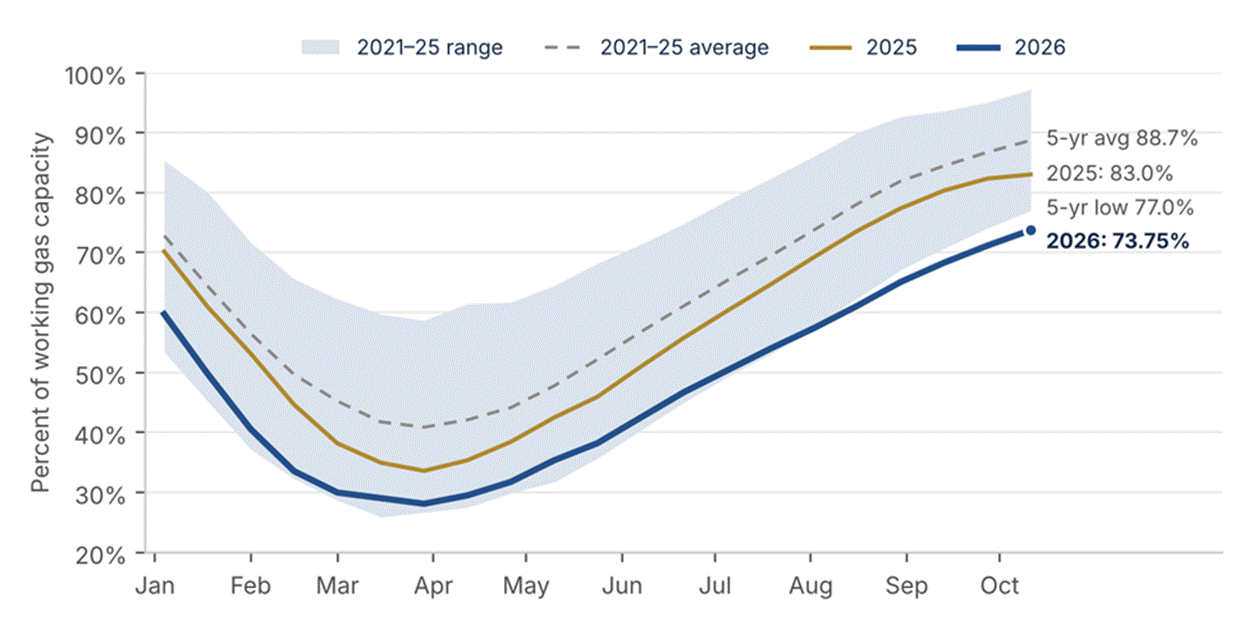
Observed data. Source: Gas Infrastructure Europe, AGSI+ (data to gas day October 11, 2026). Range and average are Meridian calculations from same-calendar-day values for 2021–25. Fortnightly sampling; AGSI+ data are subject to revision.
The shortfall is not evenly spread. Germany was 59.96% full, 11.3 points below its own 2021–25 minimum for the date, and the Netherlands, at 62.02%, sat on its five-year floor, with Belgium at 64.83%. France, at 87.22%, holds far more gas than Germany in absolute terms but is still below its own five-year low, because French storage normally fills almost completely by October. Italy, at 88.89%, is within its normal range, and Poland was 99% full. Every buyer pays the TTF price, but the physical exposure is heaviest in North-West Europe, where stocks are lowest, and in landlocked Central-Eastern and South-Eastern markets that ENTSOG says have more difficulty securing LNG landed elsewhere.
Exhibit 2. Germany and France sit below their own five-year lows; Italy and Austria do not
Storage on gas day October 11, 2026, against each market’s 2021–25 range for the same day, percent full
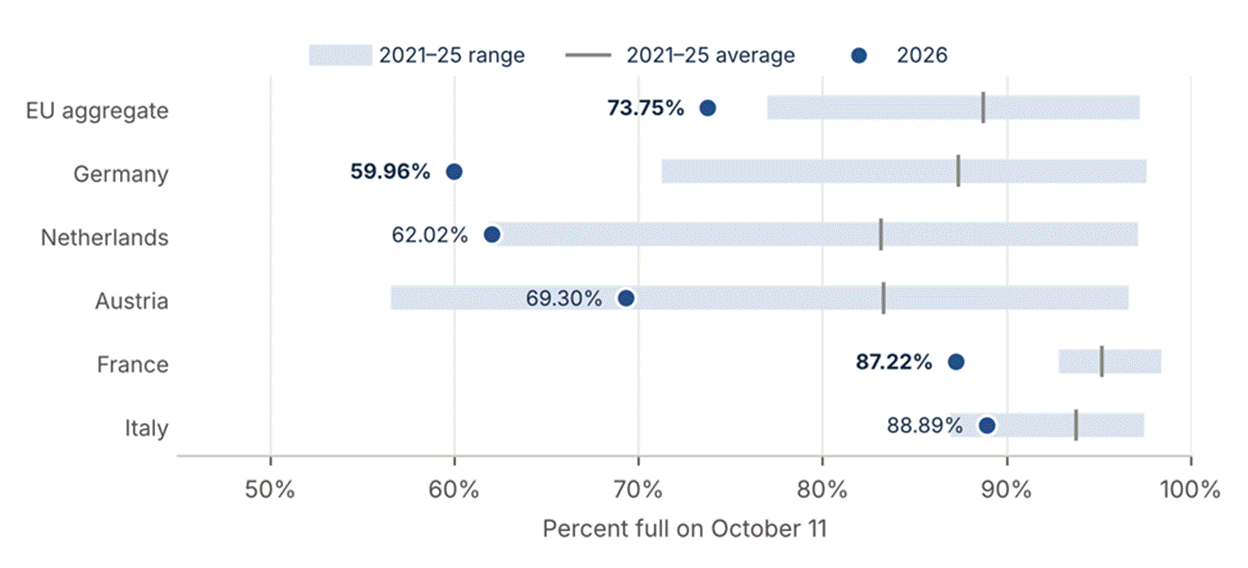
Observed data. Source: GIE AGSI+ country data. Ranges and averages are Meridian calculations from October 11 readings for 2021–25. Bold labels mark readings below the five-year minimum; the Netherlands sits 0.1 point above its minimum.
What the winter is likely to leave behind
ENTSOG’s Winter Supply Outlook models end-winter EU storage at 29% under its LNG Optimal reference case and 13% under LNG Tight. ENTSOG is explicit that these are preparedness scenarios, not forecasts. It also finds the infrastructure flexible enough to meet reference demand, while warning that a cold winter would require demand reductions of 7% to 12%.
The Meridian’s own cross-check applies each of the six observed winter withdrawals since 2020/21, measured from October 11 to March 31, to today’s inventory. The outcomes range from 7% to 39% full at the end of March 2027, and last winter’s withdrawal would leave 17.7%. These are historical analogues rather than weather forecasts, and each one carries its own year’s supply mix, including the Russian pipeline flows that were still running in 2020–22.
The refill arithmetic is what carries the problem into 2027. Reaching 90% of capacity by next autumn would take between 575 and 935 TWh of net injections across the six analogues, and 817 TWh under last winter’s pattern. Europe injected 520 TWh between March 31 and October 11 this year, 560 TWh in 2025 and 423 TWh in 2024. Even the mildest analogue requires more than Europe injected in any summer from 2023 through 2026, and four of the six exceed the 726 TWh it managed in 2022 under emergency rules. ENTSOG reaches the same conclusion by a different route: 90% by September 30, 2027 is attainable under LNG Optimal, while LNG Tight stops near 65%. EU rules allow the 90% target to be met at any point between October and December and permit derogations, so the figure works as a stress gauge rather than a legal cliff.
Exhibit 3. Historical withdrawal analogues: where EU storage would end March 2027, and what refilling would take
Each row applies one past winter’s observed EU net withdrawal (October 11 to March 31) to the 833.4 TWh held on October 11, 2026
|
Analogue
winter |
Net withdrawal, Oct 11–Mar 31 (TWh) |
Storage on Mar 31, 2027 (TWh) |
Percent full |
Injection to reach 90% (TWh) |
|
2022/23 |
391.6 |
441.8 |
39.1% |
575.3 |
|
2023/24 |
441.5 |
391.9 |
34.7% |
625.2 |
|
2021/22 |
565.8 |
267.6 |
23.7% |
749.5 |
|
2025/26 (last winter) |
633.7 |
199.7 |
17.7% |
817.4 |
|
2024/25 |
701.0 |
132.4 |
11.7% |
884.7 |
|
2020/21 |
751.4 |
82.0 |
7.3% |
935.1 |
Meridian calculations from observed data; historical analogues, not forecasts or weather scenarios. Each embeds that year’s supply mix, including Russian pipeline flows in 2020–22. Working gas capacity 1,130.1 TWh. For comparison, summer injections (March 31 to October 11) were 725.6 TWh in 2022, 479.9 in 2023, 422.5 in 2024, 559.9 in 2025 and 519.6 in 2026. Source: GIE AGSI+.
The forward curve does not pay for refill
Storage normally refills because summer gas is cheaper than the following winter’s. On September 30, Platts forwards published by ENTSOG put winter 2026/27 at €72.35/MWh, summer 2027 at €53.41 and winter 2027/28 at €49.03. Summer gas costs €4.38/MWh more than the winter it would be stored for, so a merchant operator buying next summer to sell the following winter would lose money before paying any storage fee. Argus flagged the inversion as early as March, when German storage capacity was only 64% booked, and it has persisted through the season.
When the spread will not pay for inventory, the state does. Germany has ordered SEFE to store 8 TWh by December 15, and the Netherlands has approved €993 million for EBN to inject gas, according to IEEFA. The European Commission says the system is prepared and “sufficiently flexible” despite low storage, and on volume that judgment is compatible with this analysis: Europe can very likely buy enough gas this winter. The open question is who carries the cost of doing so for a second consecutive year, and state-directed refill moves that cost from trading margins onto public budgets and regulated tariffs.
Volume at a price, paid partly by Asia
Qatar’s LNG exports were down about 96% through August, with 18 cargoes shipped against 509 a year earlier, according to ICIS data reported by Reuters. QatarEnergy has extended force majeure on deliveries to Edison into early December and to Asian buyers into November. Four Qatari carriers left the Gulf through Hormuz around October 2–3, but transits are not resumed contract deliveries. A reported claim that the March strike damaged about 17% of Ras Laffan’s capacity, with three to five years of repairs, has not been confirmed by QatarEnergy.
The United States is filling most of the gap. U.S. plants exported 10.9 Mt of LNG in September, 54% of it to Europe (LSEG data via Reuters), and U.S. cargoes supplied 60.7% of EU LNG imports in the first nine months of the year (S&P Global). Kpler expects European arrivals of about 10.5 Mt in October and 10.6 Mt in November, broadly in line with 2025. Europe is winning those cargoes by outbidding Asia. September TTF and JKM averaged within three cents of each other, and Kpler estimated Asian LNG imports in September at their weakest for the month since 2018. Pakistan, which counted on Qatar for 35 of its 36 winter cargoes, is preparing for shortages. Part of Europe’s security this winter is being purchased through demand destruction in China and South Asia.
The 2027 refill season adds a new constraint. From January 1, 2027, EU rules prohibit imports of Russian LNG under long-term contracts. Russian cargoes made up 16.1% of EU LNG imports in January–September, and Europe bought a record 12.18 Mt of Russian Arctic LNG over that period (Urgewald analysis of Kpler data). The global supply loss will be smaller than Europe’s import loss, because Russian cargoes can be redirected and free up other supply, but Europe still has to replace those volumes in its own portfolio just as next summer’s injections begin.
The bill lands on energy-intensive industry
TTF traded around €84/MWh on October 12, roughly $27.6/MMBtu at the ECB reference rate and its highest level since December 2022 on indicative quotes. Henry Hub’s November contract was near $3.13. That gap of about $24.5/MMBtu compares two wholesale benchmarks at slightly different times; it is not a delivered industrial-cost ratio. Even on the forward curve, summer-2027 gas sits about 70% above the pre-war level of roughly €31.5/MWh.
Company decisions show where the pressure is landing. Ineos has idled Europe’s last world-scale acetyls plant, at Hull, citing gas costs it puts at 12 times U.S. levels and eight times China’s; Ineos has not published the basis for those multiples. Agrofert has said it is considering ammonia curtailments, with imported product reportedly about $300 a ton cheaper than its own output. Destatis reported German energy-intensive production down 2.1% year on year in August even as total industrial output rose 2.0% from July, so the damage is sectoral rather than economy-wide, and gas prices are not the only cause of every closure. Current data cannot separate temporary curtailment from permanent closure. That split matters for 2027 in two directions: permanent closures would ease Europe’s gas balance at the expense of its industrial base, while curtailments that reverse would bring demand back just as refill begins.
Where this thesis could fail
The strongest competing reading is that the refill problem is smaller than the 90% arithmetic implies. The Commission has accepted fill levels of 75–80% for November 1, according to Brussels Signal, flexible deadlines and derogations could lower the 2027 target in practice, and the forward curve already prices winter 2027/28 about 42% below October spot. A mild winter of the 2022/23 type would leave storage near 39% at the end of March, and the April ceasefire showed how quickly prices can fall on de-escalation, with TTF dropping to about €43/MWh within days. The thesis would be wrong if end-March storage exceeds roughly 35%, if summer 2027 moves to a discount to the following winter without government intervention, or if Qatari loadings return to their pre-war pace of about 6.5 Mt a month before the second quarter of 2027. Its relevant horizon runs through the third quarter of 2027.
Editorial II. Diesel: Product Scarcity Has Outrun Crude Scarcity
A correction to our October 6 framing
The Meridian’s October 6 edition ran under the headline “Gulf Crude Has Nearly Recovered, but Diesel Has Not.” The diesel half of that headline holds; the crude half overstated the recovery. Measured by total Middle East crude shipments, which Kpler puts about 10% below pre-war levels, the description was defensible. Measured by flows through Hormuz, down roughly 40% at about 8.5 million b/d, it was not, and the EIA’s October Short-Term Energy Outlook estimates that roughly 4.5 million b/d of Middle Eastern crude production remains shut in during the fourth quarter, with global inventories drawing. The International Maritime Organization counted 11 attacks on tankers in the week to October 4, and two more tankers were hit by October 11. The more accurate statement is that diesel scarcity has run ahead of crude scarcity while both persist.
The evidence for a product squeeze
U.S. distillate stocks were 105.1 million barrels in the week to October 2, below the 2021–25 low for that week of 106.1 million and about 11% below the period average. Commercial crude stocks, at 424.1 million barrels, were within 1% of their five-year average, and the EIA reported East Coast distillate inventories 32% below their five-year average in September. On EIA spot prices, the New York Harbor diesel premium over Brent averaged $93.51 a barrel in September, against $34.16 in February before the war and a 2025 peak month of $42.21. Between February and September, Brent rose about 60% while the diesel premium nearly tripled. The premium eased in the first trading days of October to an average near $72, and retail diesel was $6.20 a gallon on October 5.
Exhibit 4. U.S. distillate stocks have been below the 2021–25 range every week since late July
Total U.S. distillate fuel oil stocks, million barrels; weekly, to the week ending October 2, 2026
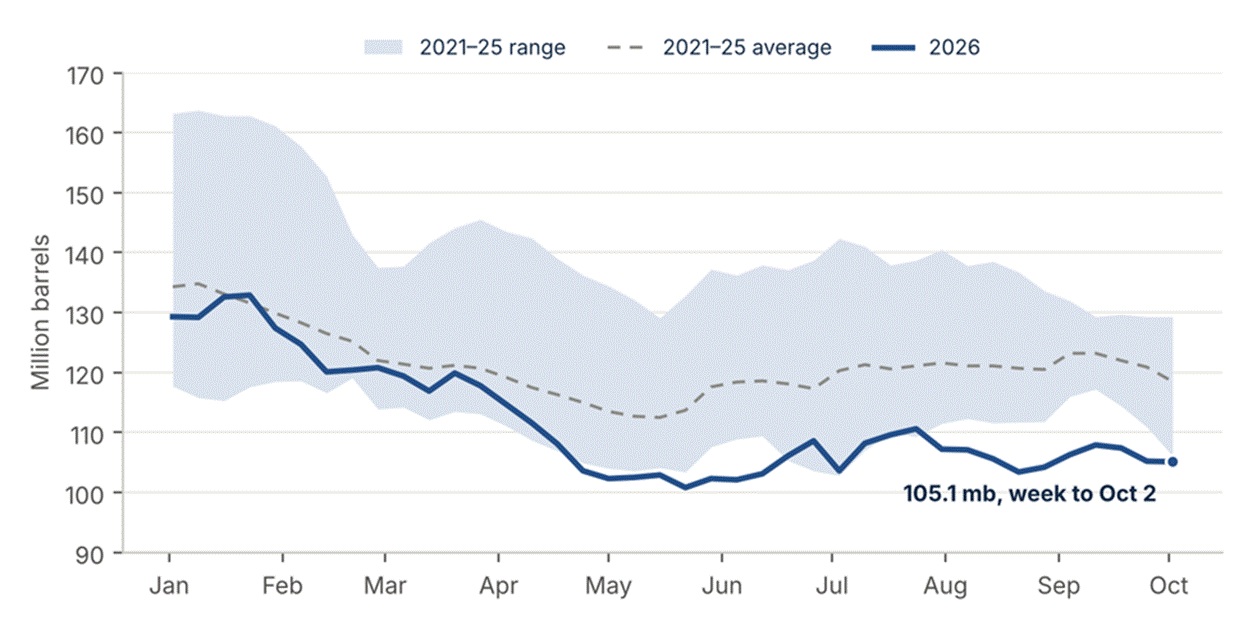
Observed data. Source: U.S. Energy Information Administration, Weekly Petroleum Status Report (series WDISTUS1). Range and average computed by The Meridian from 2021–25 values aligned by ISO week; they may differ slightly from EIA’s published five-year range.
The barrels missing from the product market come mainly from damaged or restricted refining rather than from a lack of crude. S&P Global estimated that about half of Russia’s refining capacity was offline by the end of August, as reported by The Washington Post, and Russia’s ban on diesel exports by producers runs to October 31. Goldman Sachs estimated in August that Gulf refined-product exports were at about 40% of pre-war levels and that global refinery outages were running about 60% above seasonal norms. China resumed product exports in October, but at a lower quota of about 3.7 Mt against more than 4 Mt in September, and quotas are not shipments. Crude can be rerouted through pipelines and longer voyages, but damaged distillation units cannot be replaced quickly, and the systems hit hardest were export-oriented diesel suppliers. Within the United States, the East Coast is most exposed because it relies on Gulf Coast pipeline supply and imports for roughly a tenth of its distillate demand, rising toward 15% in winter.
Bridges, not repairs
Public stocks are carrying much of the load. The IEA reported that about 325 million of the 400 million barrels committed in March had been released by October 2. G7 leaders then called for a coordinated 100 million-barrel release, with diesel front-loaded, “taking into account” commitments already fulfilled, and France and Germany have said their share will not require new barrels. The official statements do not establish how much of the 100 million barrels is additional, so The Meridian does not treat it as new supply. The IEA Governing Board meets on October 14–15 to settle details. Whatever the answer, importing countries will enter 2027 with thinner public cover than they held a year ago.
The second bridge runs through Moscow. On October 9, the U.S. Treasury’s Office of Foreign Assets Control issued General License 135, running to April 7, 2027, in connection with a U.S.–Russia diesel arrangement whose announced tranches total up to 4.8 Mt, or about 36 million barrels at a standard conversion. That figure is an announced maximum: counterparties, loadings and payment channels have not been verified. The market took the announcement seriously, and S&P Global reported a $6.45 one-day drop in the U.S. diesel crack on October 9. Deputy Prime Minister Alexander Novak has been reported as saying Russia’s export restrictions will be lifted early. Against that, Ukrainian drones struck a Russian fuel-export terminal at Rostov-on-Don on October 10, according to Ukrainian media, and further strikes on refineries could cancel out much of what the arrangement adds.
Where this thesis could fail
The principal competing interpretation treats the U.S. shortfall as an inventory cycle rather than a capacity problem. U.S. distillate exports were still running at 1.76 million b/d in the week to October 2, chasing overseas margins, and four-week U.S. distillate demand was 1.6% lower than a year earlier; if the export arbitrage narrows, U.S. stocks could rebuild faster than refining repairs alone would allow. Persistence into 2027 is forecast rather than established. The EIA expects U.S. distillate inventories to stay below their 2021–25 average through 2027, with East Coast stocks 20–30% below average this winter, and Goldman Sachs projects 2027 diesel margins of $63 a barrel in the United States and $49 in Europe. Yet the capacity losses behind those forecasts stem from war damage, sanctions and export restrictions, which can reverse faster than refineries can be built. The thesis would be wrong if U.S. distillate stocks return inside their seasonal range before December, if the New York Harbor premium over Brent holds below about $40 a barrel, or if Russian product exports are restored alongside a pause in strikes on refineries. Two evidence gaps limit the analysis: no current European middle-distillate inventory series was available, so the inventory case is made for the United States only, and neither new refining capacity due in 2026–27 nor refiners’ ability to raise diesel yields has been assessed.
Editorial III. PJM: The Shortfall Is Physical. The Fight Is Over Who Pays.
Two short auctions and a capped price
PJM’s 2028/29 Base Residual Auction, held in July, procured 149,182 MW including fixed-resource-requirement capacity, against a reliability requirement of 156,013 MW. The 6,831 MW gap followed a shortfall of about 6,500 MW for 2027/28, and these are the first two auctions in PJM’s history in which the whole RTO fell short. Prices cleared at the collar cap, $325/MW-day for 2028/29 and $333.44 for 2027/28, and only 525 MW of new or uprated capacity cleared. The resulting reserve margin for 2028/29 is 14.7% against a 20% target. The auction cost $16.4 billion, and PJM’s Independent Market Monitor has estimated, as relayed by DC Market Insights, that data-center load accounted for about $6.3 billion of that, or 38%. That figure is an estimate, not an audited assignment of cost.
Two orders in two weeks
On September 29, FERC accepted PJM’s Reliability Backstop Procurement, suspended it for five months and set a paper hearing on cost allocation. It upheld the program’s eligibility rules, selection process and $555/MW-day price cap, but found that PJM had not shown its proposed allocation followed cost causation, and it encouraged PJM to refile. PJM said it would not proceed at this time and plans to refile by October 29, after a special Members Committee meeting on October 22.
On October 9, FERC accepted PJM’s definition of a large load as 50 MW or more at one site, together with a registry of such loads. It rejected the Interim Resource Adequacy Service and the “bring your own new capacity” rules; according to published summaries of the order, FERC found that they would have reached into matters reserved to the states, including obligations on retail customers, the choice of which retail customers are curtailed, and retail rates. Commissioner David Rosner wrote in a concurrence that the Commission’s guidance would allow PJM to assign backstop costs to zones with data-center growth. That is one commissioner’s reading rather than a Commission ruling. The accurate summary is that FERC rejected the allocation method PJM had put forward, gave guidance favoring cost causation, and left the final allocation unresolved. The Department of Energy has filed in support of large loads paying for the generation and infrastructure they require.
Divided authority, and a bill nobody has accepted
Wholesale capacity procurement and transmission service remain with PJM and FERC, while retail tariffs, cost recovery and much of the curtailment order belong to the states. A federal attempt to set national rules, the Ratepayer Protection Act, passed the House 417–3 but fell short of cloture in the Senate, 57–43. States are moving at different speeds: California created a separate large-load rate class with upfront payments on September 22, and Virginia launched a data-center accountability framework on September 18. For developers, the cost of connecting in PJM will depend on the refiled backstop and on state terms for collateral, minimum bills and curtailment priority. Those terms are becoming siting variables alongside the price of power itself, although the evidence that they already decide site selection is not yet in.
Private contracting offers a partial way around the backstop. Google and Constellation announced a 20-year agreement on October 6 supporting 890 MW of planned uprates at 11 reactors in Illinois, Pennsylvania and New Jersey, alongside a 15-year supply agreement for 2,700 MW. The uprates are contracted rather than operating, and no in-service dates have been published. If deals like it are counted against the shortfall, the backstop target shrinks.
Where this thesis could fail
Commissioner Rosner has argued that PJM must return to market fundamentals, with hedging and self-procurement doing more of the work; on that view the allocation question resolves through bilateral contracting rather than a socialized backstop. The procurement itself is delayed rather than dead, since FERC upheld most of its design, and PJM cautions that an auction shortfall does not necessarily mean it will be unable to serve load in the delivery year. The thesis that costs will move toward the customers and zones driving large-load growth would be wrong if FERC accepts a broadly socialized, RTO-wide allocation, if states decline to set curtailment priority, or if PJM’s 2027 load forecast materially cuts the large-load additions now expected. The registry tool is due on February 1, 2027, with aggregated zonal data in March, and the 2029/30 auction will show whether new supply is arriving at scale.
ENERGY — FIXED INTELLIGENCE COVERAGE
01. Crude Oil Markets & Production
Seven OPEC+ participants kept November required production at September levels on October 4 rather than adding another increase, with further meetings set for November 1 and November 29, according to World Oil. Quota policy and physical disruption are operating at the same time: Gulf output is held below quota by shipping risk as much as by policy, which means some spare capacity is trapped rather than absent and could return quickly if Hormuz traffic normalizes. That is a Meridian inference, and the research did not quantify the trapped volume.
Security conditions deteriorated in the first half of October. Kpler data show Hormuz crude flows around 8.5 million b/d, roughly 40% below pre-war, while total Middle East shipments are down about 10%; Kpler’s counts exclude vessels sailing with transponders off, so both figures may understate traffic. The IMO counted 11 tanker attacks in the week to October 4, two more tankers were struck by October 11, and an attack on Riyadh’s airport killed 12. President Trump has said there will be no attack on Iran before the November 3 U.S. election, according to Argus; that is a statement of intent rather than a measure.
The EIA’s October Short-Term Energy Outlook raised its fourth-quarter Brent forecast by $14 to $105 a barrel and expects $96 for 2026 as a whole and $84 in 2027; the outlook does not incorporate the G7 stock action. The same outlook projects record U.S. crude output of 13.9 million b/d in 2026 and 14.3 million b/d in 2027, and weekly production was running at 13.98 million b/d. U.S. commercial crude stocks of 424.1 million barrels sit 0.6% below their five-year average, and the Strategic Petroleum Reserve held 283.0 million barrels in the week to October 2; a 40 million-barrel exchange was announced on September 29. Comfortable U.S. crude stocks do not establish global adequacy, given the Middle Eastern shut-ins described in Editorial II.
Hurricane Isaias made landfall near Destin, Florida, on October 9 with 105 mph winds. About 1.2 million b/d of Gulf of Mexico output was shut in on October 11, and 604,503 b/d, roughly 30%, remained offline on October 12 along with 531 MMcf/d of gas, according to BSEE estimates reported by Argus. The loss is temporary; its duration depends on restart pace.
Readers comparing crude prices should note a data issue. The EIA’s spot Brent assessment was $125.44 on October 6, while front-month Brent futures traded around $105–107 on October 12–13. The dates differ, and whether the gap reflects a prompt physical premium or a methodological difference is unresolved. The Meridian therefore computes refining margins against EIA spot Brent throughout, which produces lower margins than futures-based calculations.
02. Refined Products, Refining Margins & Fuel Markets
Editorial II sets out the diesel squeeze and the bridges supporting it. The wider product picture shows how specific the scarcity is to middle distillates. On EIA spot prices, the U.S. Gulf Coast jet fuel premium over Brent averaged $69.69 a barrel in September against $24.13 in February, while New York Harbor gasoline’s premium was $29.61, up from $16.51 but far less elevated, and it fell to about $17 in the first days of October. The futures-based 3:2:1 crack was $61.05 on October 13 on indicative delayed quotes. Refiners with distillate-heavy configurations are earning the widest margins, and airlines face jet premiums near $70.
Exhibit 5. The diesel premium nearly tripled while crude rose about 60%
Monthly averages of EIA daily spot prices, U.S. dollars per barrel, January 2025 to October 2026
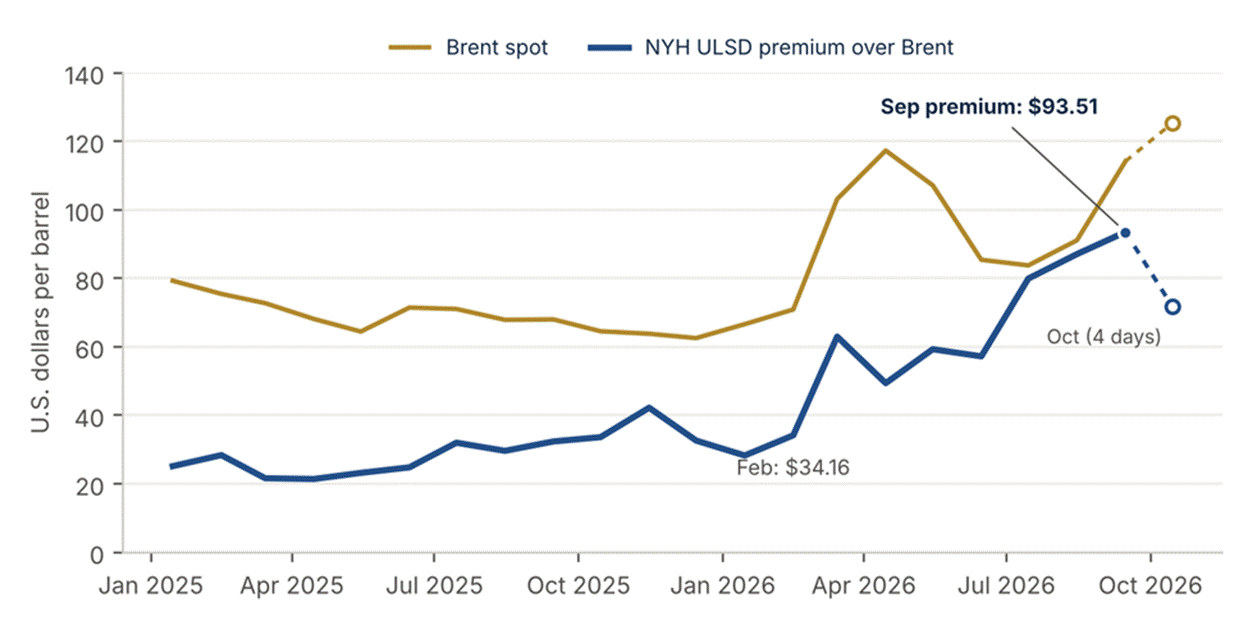
Observed data; premium is a Meridian calculation (New York Harbor ULSD in $/gal × 42, minus Brent). Source: U.S. EIA via FRED (DDFUELNYH, DCOILBRENTEU). October 2026 covers the first four trading days only (dashed). EIA spot Brent differs from front-month futures; futures-based margins are higher.
U.S. refinery utilization fell from 96.8% in the week of September 11 to 92.7% in the week of October 2 as autumn maintenance began, which removes product supply just as heating demand approaches. Four-week U.S. distillate product supplied was 3.77 million b/d, 1.6% lower than a year earlier, while jet demand was up 6%, and distillate exports of 1.76 million b/d continued despite low stocks. In Asia, Singapore’s middle-distillate inventories averaged 8.47 million barrels in September, up 3% from August according to Enterprise Singapore data, even as China held exports below last year’s pace: its Jan–Aug product exports were 19 Mt, down 21%. Inside Russia, retail diesel and gasoline prices are up about 20% since January, according to S&P Global data reported by The Washington Post, a domestic squeeze that bears on how quickly Moscow can ease export restrictions.
U.S. retail diesel averaged $6.29 a gallon in September and was $6.20 on October 5. The EIA forecasts a 2026 average of $5.19 and $4.49 in 2027, which keeps diesel above $4 through next year in its outlook.
03. Natural Gas & Liquefied Natural Gas (LNG)
Editorial I covers European storage, refill economics and the Qatari outage. On the other side of the Atlantic, U.S. working gas stood at 3,500 Bcf on October 2, 68 Bcf above the EIA’s five-year average but 130 Bcf below a year earlier. The latest weekly build of 85 Bcf was smaller than the 96 Bcf five-year norm, and the EIA expects end-October inventories near 3,850 Bcf, about 2% above average. Lower 48 output fell from a record 113.3 bcfd to about 110.7–111.2 bcfd in October because of Isaias shut-ins and pipeline force majeure in Kentucky, Texas and West Virginia, according to LSEG data. Henry Hub’s November contract traded near $3.13, and the NGSA puts the November–March strip at $3.43, 23.9% lower than a year ago. Speculators held their largest net short position since February 2024 (LSEG). The EIA forecasts Henry Hub at $3.16 for 2027, so the transatlantic price divide looks durable on official forecasts even if European prices ease.
Inside the United States, pipeline constraints are setting regional prices. Next-day gas at the Enbridge South pricing point in southwestern Pennsylvania fell to about $0.61/MMBtu on October 12, its lowest since November 2020 (LSEG), and Eastern Gas South traded at $1.005 on October 5. On October 7, Marcellus–Utica pricing was 88.5 cents against Henry Hub at $3.155, according to price assessments relayed by Marcellus Drilling News, and some producers are curtailing. These are basis outcomes driven by mild weather and limited takeaway capacity, and winter demand normally narrows them.
In Asia, JKM was about $26.09/MMBtu on October 12 on indicative quotes. Asian LNG arrivals of 20.09 Mt in September were the lowest for the month since 2018, with China at 4.32 Mt, as spot prices ran at roughly twice China’s import breakeven (Kpler data via Reuters). Buyers affected by the Qatari force majeure are covering on the spot market: Edison had replaced 23 of 35 cancelled cargoes, and QatarEnergy itself bought 33 U.S. spot cargoes earlier in the year to meet commitments. In Britain, NBP traded at 208.82 pence per therm on October 12, and UK storage was 48% full on October 1 according to ENTSOG, although UK storage capacity is small relative to demand. Norway’s Gassco reports its system ready for winter after maintenance; Norwegian pipeline gas provides roughly 27% of European winter supply under ENTSOG’s reference case and is already running at high utilization.
04. Coal Markets & Coal-Fired Generation
The IEA’s Coal Mid-Year Update now forecasts record global coal demand of 8.94 billion tons in 2026, up 1.2%, reversing its December 2025 expectation of a decline. Gas prices and El Niño drove the revision. China’s demand is forecast at about 5 billion tons (up 1%), India’s at 1,353 Mt (up 4.2%), and Korea’s at 119 Mt (up 6%), where coal-fired generation rose about 30% in the first quarter as LNG became unaffordable. Japan is forecast at 161 Mt and the EU at 276 Mt, where higher gas prices have slowed the structural decline in Germany and Poland. U.S. demand is forecast to fall 7%, and global production about 2%.
Trade flows are shifting at the same time. The IEA expects seaborne thermal coal trade to edge down to 1,062 Mt from 1,074 Mt. Chinese seaborne imports fall to 310 Mt from 325 Mt as Mongolian rail supply displaces them, and India’s fall to 160 Mt from 167 Mt. Southeast Asia, at 164 Mt against 156 Mt with Viet Nam rising to 62 Mt, is the only region with sustained import growth, while Korean imports rise more than 10%. Indonesian exports are forecast to fall to 485 Mt from 517 Mt. All of these figures are forecasts published before the current research window. The IEA expects demand to slip 0.4% in 2027 if LNG supply recovers, which supports reading the 2026 rise as cyclical fuel switching rather than a reversal of the trend away from coal.
05. Nuclear Energy & Uranium Supply Chains
Holtec’s Palisades restart in Michigan is delayed. During fuel loading, which began on August 30, fuel assembly DD41 tilted about 30 degrees at core location H-1. Holtec filed an emergency license amendment request on September 30 for a one-time recovery procedure, and the NRC issued a preliminary finding of no significant hazards and closed public comment on October 8. The NRC has said the fuel rods are intact. The 805 MWe plant is not operating, and no revised restart date has been given, so off-takers counting on its firm supply face an open-ended delay.
Holtec has also submitted the second part of its construction-permit application, the preliminary safety analysis report, for two SMR-300 units totaling 680 MWe at the same site. The project remains proposed, with operation targeted for the early 2030s and a draft safety evaluation for limited work authorization expected in December 2026.
The Google–Constellation agreement covered in Editorial III supports 890 MW of planned uprates at 11 PJM reactors, which Constellation describes as a program of more than $4.3 billion, plus a 2,700 MW supply contract. It is evidence of commercial demand for firm, low-carbon capacity rather than a resolution of PJM’s near-term shortfall.
06. Renewable Energy & Energy Storage
Monitoring continues. The IEA’s Electricity Mid-Year Update, published in July, forecasts renewable generation growing more than 8% in 2026 and overtaking coal globally, with solar adding about 600 TWh a year and overtaking wind; renewables’ share of generation rises from 33% in 2025 to 37% in 2027, with gas-fired output roughly flat. Record coal demand and renewables overtaking coal in generation are compatible because they measure different things. In PJM’s 2028/29 auction, accredited solar capacity rose by 651 MW. ERCOT’s generation interconnection queue is led by batteries at 166 GW, followed by solar at 158 GW, gas at 80 GW and wind at 49 GW; queue megawatts are applications, not expected operating capacity.
07. Electricity Markets, Grid Reliability & Power Pricing
Editorial III covers PJM’s capacity shortfall and FERC’s orders. In current operations, PJM issued Maximum Generation and Load Management Alerts for October 13 because of unseasonable warmth during the autumn maintenance season and extended a Capacity Advisory to October 14. These were precautionary operating alerts tied to present weather and outages; they are not evidence of the 2028/29 shortfall, which concerns a future delivery year.
Price pressure in PJM is locational. DC Market Insights estimates that the ComEd zone would have cleared around $777/MW-day without the price collar, against about $555 RTO-wide. A Pennsylvania Public Utility Commission study modeled 2030 loss-of-load expectation at 0.59 in its reference case and 13.2 in its worst case, against a 0.1 criterion; these are modeled scenarios. Jefferies expects capacity prices to stay higher for longer after the rejection of the interim service, which it sees as positive for independent generators such as Constellation, NRG, Talen and Vistra.
Beyond PJM, ERCOT has issued a request for information on data-center loads of 25 MW or more, with responses due October 12 and a report expected by December 10, and it reports about 474 GW of large loads seeking interconnection, roughly 90% of them data centers. Those are requests, not committed demand. Globally, the IEA forecasts electricity demand growth of 3.6% in 2026 and 3.8% in 2027, led by India at about 7% and China at 5.5%, with the United States and the EU near 2%. In Europe, where gas sets the marginal power price in much of the market, pre-war wholesale power averaged about $95/MWh in 2025, energy-intensive industry was paying more than twice U.S. levels (IEA), and energy and supply costs made up about 63% of those users’ bills (ECB).
08. Energy Infrastructure, Pipelines & Capacity Expansion
U.S. LNG capacity is growing on paper faster than it is delivering reliably. Corpus Christi Stage 3 was completed on August 31, adding about 1.3 Bcf/d by one advisory estimate. Venture Global has asked federal regulators to place Plaquemines Phase 1 (13.33 Mtpa initial phase) in service, targeting October 31; the plant is shipping commissioning cargoes, and the request is not an approval. Golden Pass Train 1 has operated since April 23, running about 600 of 790 MMcf/d in June, while Trains 2 and 3 are not yet operating and their timing is uncertain, so the project’s full 18 Mtpa is not available. Freeport’s Train 2 went offline after a compressor outage on October 2, with feedgas recovering to about 1.9 of the plant’s 2.4 bcfd, Cove Point was in planned maintenance from September 18 to October 13, and New Fortress Energy’s Fast LNG unit in Altamira, Mexico, is offline with a return expected in the fourth quarter, according to its October 5 filing. Feedgas to U.S. export plants averaged 17.1 bcfd so far in October, down from 18.0 bcfd in September and a record 18.8 bcfd in April, although LSEG reported a five-month daily high on October 12. LNG Canada shipped about 1 Mt in September into the Pacific market.
In power, PJM accepted the first three projects into its expedited interconnection track on October 8, and its Phase I study includes 617 projects totaling about 169 GW. That queue cannot be compared directly with the 525 MW of new capacity that cleared the last auction, because many queued projects withdraw before construction, accredited capacity is a fraction of nameplate for intermittent resources, and delivery takes years. PJM has lost about 15 GW to retirements since 2022, and the IEA counts more than 2,500 GW of generation, storage and large-load projects stalled in grid queues worldwide.
Two damage claims remain unconfirmed: the reported 17% loss of Ras Laffan’s capacity, and the extent of damage to the Rostov-on-Don fuel terminal, which comes from a partisan outlet and is not quantified here.
09. Energy Policy, Security & Investment
Energy-security policy in Europe has shifted from targets to interventions. Beyond the German and Dutch storage directives in Editorial I, the Commission has accepted lower fill levels for November 1, and Commission President von der Leyen has cited an extra €100 billion in energy import costs since February, as reported by Euronews. The Commission maintains that there is no immediate security-of-supply risk. The ban on Russian LNG under long-term contracts takes effect on January 1, 2027, and enforcement and any waivers will determine how much of the 16.1% Russian share must be replaced.
In oil, emergency stocks are the main policy instrument. IEA members hold about 1.1 billion barrels of public stocks, including more than 200 million barrels of diesel, according to Reuters. National release pace varies: Germany had released 0.6 Mt out of 2.65 Mt, while France has about 8 million barrels left and may add 2 million barrels of diesel, according to Politico. Russia extended its producer diesel-export ban to October 31 on September 30, and the U.S. license for Russian diesel supply runs to April 7, 2027. Policy risk also runs the other way: U.S. officials have raised the possibility of restricting diesel exports, and any such measure would redirect the shortage toward Latin America and Europe.
In U.S. power, the federal Ratepayer Protection Act stalled in the Senate, leaving large-load cost allocation to FERC, PJM and the states, and the Department of Energy has filed its first statement of position at FERC in at least five years. On investment, the clearest new commitment in the research window is private: the Google–Constellation agreement. The research did not capture broader energy capital-expenditure data for the period.
10. Cross-Layer Energy Implications
European gas costs, Chemicals and Commodities. The origin is a gas price several times U.S. levels; the transmission runs through feedstock and fuel costs at European plants until imports undercut domestic production. The intermediate variable is import parity, which Agrofert’s comparison suggests has already been crossed for ammonia. If it holds, the effects reach Chemicals and fertilizer supply within Commodities, shifting market share toward U.S., Middle Eastern and Asian producers. The evidence so far is company-specific (Ineos, Agrofert), and the research found no verified rise in EU chemical or fertilizer import volumes, so a broad relocation wave is not yet established.
Diesel, Freight Rates & Trends, and agriculture. Diesel near $6.20 a gallon feeds trucking, rail, farm and construction costs through fuel surcharges, which typically adjust with a lag set by contract terms. The research did not quantify surcharge pass-through, so the timing of the effect on Freight Rates & Trends is an open question rather than a measured outcome.
Power connection rules, Technology, AI & Digital Trade, and Manufacturing & Industrial Development. In PJM, the price of power is no longer the only cost of a large connection; collateral, minimum bills and curtailment priority under state tariffs are becoming part of the siting calculation for data centers and large manufacturers. Whether those terms are already redirecting projects will show in the PJM registry and state filings over the next six months.
Grid and LNG buildout, Manufacturing & Industrial Development and Commodities. Confirmed buildouts would support demand for transformers, turbines, cable, steel and copper. Queue totals alone do not establish procurement, and the research has no verified equipment-delivery data, so this remains an inference.
Sanctions and bans, Trade Policy & Geopolitics. The EU’s Russian LNG ban and the U.S. license for Russian diesel change sourcing, compliance and routing. Gross volumes displaced from one market do not equal net global supply losses, because redirected cargoes free up other supply.
Gas-to-coal switching, Commodities and dry-bulk freight. High LNG prices have supported coal burn in Korea and slowed the EU’s decline, while seaborne coal demand tilts toward Southeast Asia. These effects are tied to the LNG shock and should fade if LNG supply recovers, as the IEA’s 2027 forecast assumes.
The Meridian Outlook
Base case
Europe remains the premium buyer of flexible Atlantic LNG through much of the 2027 injection season, and refill is paid for substantially by governments, through mandates, subsidies and flexible deadlines, rather than by storage spreads. In oil products, middle-distillate margins stay above pre-conflict norms through the winter but below September’s peak, and U.S. distillate inventories remain below their seasonal range. In PJM, the refiled backstop moves toward allocating costs to the zones and customers whose load growth creates the need, retail recovery is left to state commissions, and procurement slips into 2027. The horizon is the third quarter of 2027 for gas, the first quarter of 2027 for diesel, and 2027–2030 for PJM.
Alternative case
A Gulf settlement and a mild winter would leave EU storage at 35–39% at the end of March and push TTF back toward the low-€40s level it reached within days of the April ceasefire. Faster stock releases and verified Russian product deliveries would pull the New York Harbor diesel premium back toward $35–45 a barrel. Bilateral supply, self-procurement and attrition in the large-load forecast would shrink PJM’s backstop target. Even in this case, capacity already closed in European chemicals and fertilizers would not return quickly, so the competitiveness damage would outlast the security risk.
Upside and downside exposures
In the base case, European energy-intensive producers carry a second year of input costs well above pre-war levels, utilities and storage operators depend on state support to meet fill obligations, and U.S. LNG exporters and destination-flexible portfolio players capture the margin. East Coast diesel buyers, fleets and farms absorb costs that surcharges recover only with a lag, while refiners with distillate-heavy configurations benefit. In PJM, existing generators benefit from capped but high capacity prices, and data-center developers face uncertain connection terms until PJM refiles and states set curtailment rules. In the alternative case, the exposures reverse fastest for spot buyers and slowest for those who hedged at current forward levels.
Conditions and invalidators
The base case assumes that Qatari contract deliveries do not resume at scale before spring, that Russian and Gulf refining capacity is not substantially restored over the winter, and that FERC does not approve a socialized backstop. It would be materially weakened by EU storage above 35% at the end of March, by summer-2027 gas moving to a discount to the following winter without intervention, by a New York Harbor diesel premium sustained below about $40 a barrel, by U.S. and European distillate stocks back inside their seasonal ranges before winter ends, or by a PJM load forecast that removes most of the projected shortfall.
Confidence
Confidence is moderate overall. It is highest on the direction of European refill costs, which rests on observed storage levels and forward prices, and lowest on the persistence of diesel tightness beyond the winter, which depends on war damage and policy decisions the research cannot anticipate. On PJM, the direction of cost allocation is better supported than its timing.
Decision implications
For European industrial gas buyers, budgets for 2027 should assume summer gas near the €53/MWh forward level rather than a return to pre-war prices, treating the alternative case as upside rather than as the planning case. For diesel-intensive operators in the eastern United States, the case for holding more fuel inventory and reviewing surcharge mechanisms through the winter is stronger than in a normal year. For data-center and industrial developers in PJM, connection budgets should allow for collateral, minimum-bill and curtailment terms that are not yet written, and site comparisons should include state tariff clarity alongside power prices.
Changes to prior Meridian views
Our October 6 headline overstated the recovery of Gulf crude, as Editorial II explains; the error lay in the measure rather than the direction, and the diesel half of that thesis stands. Our open call that Russia will extend its producer diesel-export ban beyond October 31 (ENE-20261006-02) now faces contrary evidence in General License 135 and Deputy Prime Minister Novak’s reported statement that restrictions will be lifted early. The call stands as published and will be evaluated on November 1 on its original terms. Our call that EU storage will be below 80% on gas day November 1 (ENE-20261006-03) remains consistent with the data: storage rose 2.6 points in the two weeks to October 11, and at that pace it would reach about 77.6% by November 1, with injections usually slowing in late October (Meridian calculation). Our call that U.S. distillate stocks stay below their 2021–25 seasonal minimum through November (ENE-20260929-01) still holds, but the margin narrowed to about 1.0 million barrels in the week to October 2 on The Meridian’s alignment of EIA data, so it is at risk. The TTF–Henry Hub gap, near $24.5/MMBtu on October 12 prices, remains far above the $8.40 threshold in our September 29 call (ENE-20260929-03), and Henry Hub’s early-October spot average near $2.97 is consistent with our call for a fourth-quarter average below $4.00 (ENE-20261006-05). No Energy forecast reached its evaluation date in the research window.
Signals to Watch
▪ EU storage on gas day November 1, then withdrawal rates in the first cold spell (GIE AGSI+). This tests whether the refill problem carries into 2027. A reading below 80% on November 1 confirms the low starting point, and withdrawals faster than last winter’s pace through November would push the end-March outcome toward the lower analogues. November 1 data publish on November 2. If withdrawals run fast, buyers should revisit how much summer-2027 gas to contract early.
▪ TTF summer-2027 minus winter-2027/28 spread (ICE Endex settlements). This tests whether refill depends on state intervention. A spread that stays positive keeps refill in government hands; a move to a discount, with summer cheaper than the following winter, would mean the market is again paying to store gas and would weaken the base case. Review weekly through year-end; storage operators and utilities would reprice capacity bookings if it turns.
▪ Qatari LNG loadings and force-majeure notices (QatarEnergy and buyer statements; ship-tracking data). Resumed contract deliveries, not vessel transits, are the test of recovery. Pakistan’s notices run to November 5 and Edison’s to early December; further extensions strengthen the 2027 refill case, while resumed loadings would argue for less aggressive summer hedging.
▪ U.S. distillate stocks against the EIA’s five-year range, and the New York Harbor diesel premium over Brent on EIA spot prices. This tests whether product scarcity persists through winter. Stocks back inside the range before December, or a premium below about $40 a barrel, would mark a faster recovery than the base case assumes. Weekly, on the EIA’s Wednesday releases; fleet operators would then have less reason to carry extra fuel inventory.
▪ Russia’s diesel-export decision for November and verified loadings under General License 135. This tests whether the Russian arrangement adds real supply. A lapse or early lifting of the producer ban, together with verified tanker loadings, would ease Atlantic diesel and count against our October 6 call. Watch through October 31, then monthly loadings.
▪ PJM’s refiled backstop procurement, due by October 29, and FERC’s response. This tests the cost-allocation thesis. Allocation to the zones or customers driving large-load growth supports the base case; an RTO-wide socialization of costs contradicts it. State large-load tariffs, especially collateral and curtailment terms, are the second-order signal, and developers would reassess PJM sites against other regions if the terms tighten.
Sources
Official, regulatory and intergovernmental
• Gas Infrastructure Europe. AGSI+ Aggregated Gas Storage Inventory, EU and country data (data to gas day October 11, 2026). https://agsi.gie.eu/
• ENTSOG. Winter Supply Outlook 2026/27 (SO0072-26), October 2026. https://www.entsog.eu/sites/default/files/2026-10/SO0072-26_Winter%20Supply%20Outlook%202026-27.pdf
• European Commission, DG Energy. “EU gas system prepared for winter despite lower storage levels,” October 8, 2026. https://energy.ec.europa.eu/news/eu-gas-system-prepared-winter-despite-lower-storage-levels-2026-10-08_en
• European Commission, DG Energy. “Gas Coordination Group: no immediate security of supply risk,” September 3, 2026. https://energy.ec.europa.eu/news/gas-coordination-group-no-immediate-security-supply-risk-2026-09-03_en
• EUR-Lex. Regulation (EU) 2026/261, summary. https://eur-lex.europa.eu/legal-content/EN/LSU/?uri=CELEX%3A32026R0261
• European Central Bank. Euro foreign exchange reference rates, October 12, 2026. https://www.ecb.europa.eu/stats/policy_and_exchange_rates/euro_reference_exchange_rates/html/index.en.html
• European Central Bank. Economic Bulletin box on energy costs and energy-intensive industry, February 2026. https://www.ecb.europa.eu/press/economic-bulletin/focus/2026/html/ecb.ebbox202601_02~a552b71378.en.html
• Destatis. “Production in August 2026: +2.0% on the previous month,” Press release 355, October 7, 2026. https://www.destatis.de/EN/Press/2026/10/PE26_355_421.html
• U.S. Energy Information Administration. Short-Term Energy Outlook, October 2026. https://www.eia.gov/outlooks/steo/archives/oct26.pdf
• U.S. Energy Information Administration. Short-Term Energy Outlook, petroleum products and natural gas chapters, October 6, 2026. https://www.eia.gov/outlooks/steo/report/petro_prod.php
• U.S. Energy Information Administration. Weekly Petroleum Status Report, distillate and crude stocks (data to week ending October 2, 2026). https://www.eia.gov/dnav/pet/pet_sum_sndw_dcus_nus_w.htm
• U.S. Energy Information Administration via FRED, Federal Reserve Bank of St. Louis. Daily spot prices: New York Harbor ULSD (DDFUELNYH), Brent (DCOILBRENTEU), U.S. Gulf Coast jet fuel, New York Harbor gasoline (data to October 6, 2026). https://fred.stlouisfed.org/series/DDFUELNYH
• U.S. Energy Information Administration. Weekly Lower 48 working gas in underground storage (data to October 2, 2026). https://www.eia.gov/dnav/ng/hist/nw2_epg0_swo_r48_bcfw.htm
• International Energy Agency. “Executive Director participates in G7 Leaders’ meeting on energy security and markets,” October 2026. https://www.iea.org/news/executive-director-participates-in-g7-leaders-meeting-on-energy-security-and-markets
• UK Government. “G7 Leaders’ statement on global energy security and market stability,” October 2026. https://www.gov.uk/government/news/g7-leaders-statement-on-global-energy-security-and-market-stability
• International Energy Agency. Coal Mid-Year Update 2026: Demand, Overview and Trade. https://www.iea.org/reports/coal-mid-year-update-2026/demand
• International Energy Agency. Electricity Mid-Year Update 2026, Executive summary, July 2026. https://www.iea.org/reports/electricity-mid-year-update-2026/executive-summary
• International Energy Agency. Electricity 2026: Prices, and Executive summary, January–February 2026. https://www.iea.org/reports/electricity-2026/prices
• U.S. Treasury, Office of Foreign Assets Control. Recent actions, October 9, 2026 (General License 135). https://ofac.treasury.gov/recent-actions/20261009_33
• National Hurricane Center. Hurricane Isaias advisory archive, October 2026. https://www.nhc.noaa.gov/archive/2026/al09/al092026.update.10100129.shtml
• Federal Energy Regulatory Commission. “Commissioner Rosner’s concurrence on PJM’s Reliability Backstop Procurement (ER26-3380).” https://www.ferc.gov/news-events/news/commissioner-rosners-concurrence-pjms-reliability-backstop-procurement-er26-3380
• U.S. Department of Energy. “Energy Department supports FERC’s call for PJM to protect ratepayers and build more reliable power,” October 9, 2026. https://www.energy.gov/articles/energy-department-supports-fercs-call-pjm-protect-ratepayers-and-build-more-reliable-power
• PJM Inside Lines. “PJM capacity auction procures 138,318 MW of generation resources as work continues to address growing electricity demand,” July 14, 2026. https://insidelines.pjm.com/pjm-capacity-auction-procures-138318-mw-of-generation-resources-as-work-continues-to-address-growing-electricity-demand/
• PJM Inside Lines. “PJM Board directs action on resource adequacy, affordability and large loads,” July 27, 2026. https://insidelines.pjm.com/pjm-board-directs-action-on-resource-adequacy-affordability-and-large-loads/
• PJM Inside Lines. News archive, October 9–12, 2026. https://insidelines.pjm.com/archives/
• PJM. Large Load (accessed October 13, 2026). https://www.pjm.com/markets-and-operations/large-load
• ERCOT. Data center impact RFI, September 2026. https://www.ercot.com/about/legal/data-center-impact-rfi
• ERCOT. Senate panel: Assessing the grid, July 29, 2026. https://www.ercot.com/files/docs/2026/07/29/ERCOT-Senate-July-29-Panel-1-Assessing-The-Grid.pdf
• ERCOT. Interconnection and Grid Analysis Update, September 2026. https://www.ercot.com/files/docs/2026/09/07/10-Interconnection-and-Grid-Analysis-Update.pdf
• U.S. Nuclear Regulatory Commission. “NRC reviewing Palisades license amendment request; public comment opportunity open,” October 6, 2026. https://www.nrc.gov/about-nrc/news-releases/2026/nrc-reviewing-palisades-license-amendment-request-public-comment-opportunity-open
• Palisades Energy / Holtec. Emergency license amendment request for recovery of fuel assembly DD41 (NRC ADAMS ML26273A469), September 30, 2026. https://www.nrc.gov/docs/ML2627/ML26273A469.pdf
Company and operator disclosures
• Constellation Energy. “Google and Constellation announce agreement to bring 890 MW of new nuclear capacity to PJM grid,” October 6, 2026. https://www.constellationenergy.com/news/2026/10/google-and-constellation-announce-landmark-agreement-to-bring-890-mw-of-new-nuclear-capacity-to-pjm-grid.html
• New Fortress Energy. Form 8-K, October 5, 2026. https://www.sec.gov/Archives/edgar/data/1749723/000174972326000166/nfe-20261005.htm
• Venture Global Plaquemines LNG. Semi-annual status report to DOE, Docket 16-28-LNG, October 1, 2026. https://www.energy.gov/sites/default/files/2026-10/VG%20Plaquemines%20October%202026%20DOE%20Progress%20Report.pdf
• Gassco. “Strong demand for Norwegian gas as Europe enters the winter season,” October 1, 2026. https://kommunikasjon.ntb.no/pressemelding/19087109/strong-demand-for-norwegian-gas-as-europe-enters-the-winter-season?publisherId=17846748&lang=en
• Holtec International. “Major regulatory developments in the Palisades Pioneer project,” September 30, 2026. https://holtecinternational.com/hh-41-23/
Market data, research and specialist reporting
• Euronews (IEEFA analysis). “EU may need to cut winter gas demand by 7% as storage hits record low, IEEFA warns,” October 9, 2026. https://www.euronews.com/2026/10/09/eu-may-need-to-cut-winter-gas-demand-by-7-as-storage-hits-record-low-ieefa-warns
• Brussels Signal. “Gas network operators warn of 15 per cent EU shortfall in a severe winter,” October 9, 2026. https://brusselssignal.eu/2026/10/gas-network-operators-warn-of-15-per-cent-eu-shortfall-in-a-severe-winter/
• Brussels Signal. “EU buys record volumes of Russian Arctic LNG in final year before import ban,” October 2026. https://brusselssignal.eu/2026/10/eu-buys-record-volumes-of-russian-arctic-lng-in-final-year-before-import-ban/
• Argus Media. “TTF gas price spike spills into 2027 and beyond,” March 19, 2026. https://www.argusmedia.com/en/news-and-insights/latest-market-news/2803352-ttf-gas-price-spike-spills-into-2027-and-beyond
• Argus Media. “TTF front-month drops on ceasefire, holds above winter,” April 8, 2026. https://www.argusmedia.com/en/news-and-insights/latest-market-news/2811416-ttf-front-month-drops-on-ceasefire-holds-above-winter
• Argus Media. “Two tankers hit near Strait of Hormuz: Indian minister,” October 11, 2026. https://www.argusmedia.com/en/news-and-insights/latest-market-news/2889395-two-tankers-hit-near-strait-of-hormuz-indian-minister
• Argus Media. “About 30pc of Gulf of Mexico oil output still shut in,” October 12, 2026. https://www.argusmedia.com/en/news-and-insights/latest-market-news/2889851-about-30pc-of-gulf-of-mexico-oil-output-still-shut-in
• Reuters (via TBS News). “Qatar extends force majeure notices on LNG supply to Edison, Asian clients,” September 28, 2026. https://www.tbsnews.net/worldbiz/asia/qatar-extends-force-majeure-notices-lng-supply-edison-asian-clients-including
• Reuters (via TBS News). “QatarEnergy buys 33 US LNG cargoes to offset Hormuz disruption,” July 30, 2026. https://www.tbsnews.net/worldbiz/middle-east/qatarenergy-buys-33-us-lng-cargoes-offset-hormuz-disruption-sources-1501856
• Reuters (via Economic Times Energy). “More Qatari LNG cargoes transit Strait of Hormuz despite ongoing risks,” October 5, 2026. https://energy.economictimes.indiatimes.com/amp/news/oil-and-gas/more-qatari-lng-cargoes-transit-strait-of-hormuz-despite-ongoing-risks/134699869
• Arab News Pakistan. “Pakistan seeks alternative LNG supplies, braces for winter shortages amid Qatar force majeure,” October 7, 2026. https://www.arabnews.pk/pakistan/pakistan-seeks-alternative-lng-supplies-braces-for-winter-shortages-amid-qatar-force-majeure-3003474
• Reuters. “US LNG exports rise in September; Europe outbids Asia for cargoes,” October 1, 2026. https://www.reuters.com/business/energy/us-lng-exports-rise-september-europe-outbids-asia-cargoes-lseg-data-show-2026-10-01/
• Reuters (Clyde Russell). “LNG spot price surge deters Asian buyers, but saves Europe,” September 17, 2026. https://www.reuters.com/commentary/reuters-open-interest/lng-spot-price-surge-deters-asian-buyers-saves-europe-2026-09-17/
• S&P Global Energy. “Commodity Tracker: 5 charts to watch this week,” October 6, 2026. https://www.spglobal.com/energy/en/news-research/blog/lng/100626-ctracker-eu-imports-gas-jkm-shipping-fossil-fuels-india-china-methanol-australia-beef-tallow-argentine-brazil-soybean
• LNG Industry (ENTSOG). “Europe enters winter with historically low storage levels,” October 12, 2026. https://www.lngindustry.com/special-reports/12102026/europe-enters-winter-with-historically-low-storage-levels-reinforcing-the-need-for-lng-imports-an
• European Coatings Journal. “Ineos idles Europe’s last world-scale acetyls plant,” September 29, 2026. https://www.european-coatings.com/news/markets-companies/ineos-idles-europes-last-world-scale-acetyls-plant/
• Profercy. “Agrofert considering ammonia capacity curtailments on volatile natgas prices,” September 2, 2026. https://www.profercy.com/insights/european-fertilizer-giant-agrofert-considering-ammonia-capacity-curtailments-on-volatile-natgas-prices
• Trading Economics. EU Natural Gas TTF and JKM (indicative quotes), October 12, 2026. https://tradingeconomics.com/commodity/eu-natural-gas
• Fuel Data Portal. Fuel prices, inventories and refining (delayed futures quotes), October 13, 2026. https://fueldataportal.com/data
• Maritime Professional (Reuters/LSEG). “Natural gas prices steady on storage build,” October 8, 2026. https://www.maritimeprofessional.com/news/natural-prices-steady-storage-build-423525
• Business Recorder (Reuters/LSEG). “US natgas futures fall on lower demand forecast,” October 12–13, 2026. https://www.brecorder.com/news/40443856
• Marcellus Drilling News. Commodity price coverage and NGSA Winter Outlook, October 5–9, 2026. https://marcellusdrilling.com/category/industrywide-issues/commodity-price/
• OilPrice.com. “Freeport LNG ramps up gas intake after Train 2 shutdown,” October 5, 2026. https://oilprice.com/Latest-Energy-News/World-News/Freeport-LNG-Ramps-Up-Gas-Intake-After-Train-2-Shutdown.html
• Reuters. “Venture Global asks federal regulators to place in service its Plaquemines LNG plant,” October 1, 2026. https://www.reuters.com/business/energy/venture-global-asks-federal-regulators-place-service-its-plaquemines-lng-plant-2026-10-01/
• AEGIS Hedging. LNG insights, October 12, 2026. https://aegis-hedging.com/insights/lng
• World Oil. “OPEC+ holds November oil production targets steady as supply remains constrained,” October 4, 2026. https://www.worldoil.com/news/2026/10/4/opec-holds-november-oil-production-targets-steady-as-supply-remains-constrained/
• CNBC. “Iran war: Strait of Hormuz tanker attacks,” October 9, 2026. https://www.cnbc.com/2026/10/09/iran-war-strait-hormuz-tanker-attack-oil.html
• CNBC. “Oil prices today,” October 12, 2026. https://www.cnbc.com/2026/10/12/oil-prics-today-iran-us-saudi-arabia-crude-.html
• Politico Europe. “France and Germany say diesel promise to Trump won’t require new stock release,” October 7, 2026. https://www.politico.eu/article/france-and-germany-say-diesel-promise-to-trump-wont-require-new-stock-release/
• Reuters. “IEA to meet Wednesday over proposed release of reserves, say two EU diplomats,” October 7, 2026. https://www.reuters.com/business/energy/iea-meet-wednesday-over-proposed-release-reserves-say-two-eu-diplomats-2026-10-07/
• Reuters. “IEA to decide details of G7 diesel, oil stocks release on October 14–15,” October 6, 2026. https://www.reuters.com/business/energy/iea-decide-details-g7-diesel-oil-stocks-release-october-14-15-sources-say-2026-10-06/
• Admiral Markets. “Russian diesel: the Trump–Putin deal,” October 10, 2026. https://admiralmarkets.com/analytics/traders-blog/russian-diesel-trump-putin-deal
• EBC Financial Group. “US–Russia diesel deal 2026: fuel prices,” October 12, 2026. https://www.ebc.com/forex/us-russia-diesel-deal-2026-fuel-prices
• Interfax. “Russia extends diesel export ban for producers,” September 30, 2026. https://interfax.com/newsroom/top-stories/119335/
• The Washington Post. “How Ukraine uses precision drone strikes to hobble Russian oil refineries,” October 11, 2026. https://www.washingtonpost.com/investigations/interactive/2026/10/11/how-ukraine-uses-precision-drone-strikes-hobble-russian-oil-refineries/
• Ground News (relaying Goldman Sachs). “Goldman Sachs sees diesel refining margins soaring to $63 a barrel,” August 31, 2026. https://ground.news/article/goldman-sachs-sees-diesel-refining-margins-soaring-to-63-a-barrel_7e79ce
• Reuters (via Yahoo Finance). “China to resume October fuel exports,” October 9, 2026. https://finance.yahoo.com/energy/articles/china-resume-october-fuel-exports-032753419.html
• Engine (Enterprise Singapore data). “Singapore fuel oil stocks rose by 4% in September,” October 1, 2026. https://www.engine.online/news/singapore-fuel-oil-stocks-rose-by-4-pc-in-september-8220
• Troutman Pepper Locke, Washington Energy Report. “FERC accepts and suspends PJM’s Reliability Backstop Procurement proposal, establishes paper hearing procedures,” October 6, 2026. https://www.troutmanenergyreport.com/2026/10/ferc-accepts-and-suspends-pjms-reliability-backstop-procurement-proposal-establishes-paper-hearing-procedures-and-encourages-a-new-section-205-filing/
• EnergyChoiceMatters. “PJM won’t proceed with Reliability Backstop Procurement at this time,” September 30, 2026. http://www.energychoicematters.com/stories/20260930d.html
• Utility Dive. “FERC rejects most of PJM’s large load interconnection plan,” October 12, 2026. https://www.utilitydive.com/news/ferc-pjm-large-load-interconnection-iras-byonc/832716/
• Utility Dive. “DOE presses PJM on ratepayer protections from large load costs,” October 8, 2026. https://www.utilitydive.com/news/doe-pjm-ferc-ratepayer-protection-large-load-data-center/832479/
• Utility Dive. “PJM faces 2030 reliability crisis if data center load growth continues: report,” September 15, 2026. https://www.utilitydive.com/news/pjms-reliability-could-start-failing-by-2030-if-data-center-growth-continu/830405/
• DC Market Insights. “PJM is 6.8 GW short and its backstop is stalled. The 29 October filing decides who pays,” October 12, 2026. https://www.dcmarketinsights.com/news/pjm-is-6-8-gw-short-and-its-backstop-is-stalled-the-29-october-filing-decides-who-pays
• Environment+Energy Leader. “Ratepayer Protection Act falls three votes short in Senate,” October 2, 2026. https://www.environmentenergyleader.com/stories/ratepayer-protection-act-falls-three-votes-short-in-senate,142202
• American Nuclear Society, Nuclear Newswire. “NRC reviews LAR on Palisades fuel loading incident, as Pioneer SMR application advances,” October 8, 2026. https://www.ans.org/news/article-8474/nrc-reviews-lar-on-palisades-fuel-loading-incident-as-pioneer-smr-application-advances/
• World Nuclear News. “Second part of construction permit application submitted for SMRs at Palisades,” October 2, 2026. https://www.world-nuclear-news.org/articles/second-part-of-construction-permit-application-submitted-for-pioneer-smrs