
Watch the Water, Not the Wire
Crude Fell a Second Straight Session on the Iran Deal. Natural Gas Rose. Urea Is Cracking While Sulfur Hits an All-Time High. The Chemical Chain Is Repricing in Two Completely Different Speeds at Once.

Global Trade Framework | Layer 3 | Chemicals
Editorial: The Peace Dividend Is Real, But It Arrives Molecule by Molecule
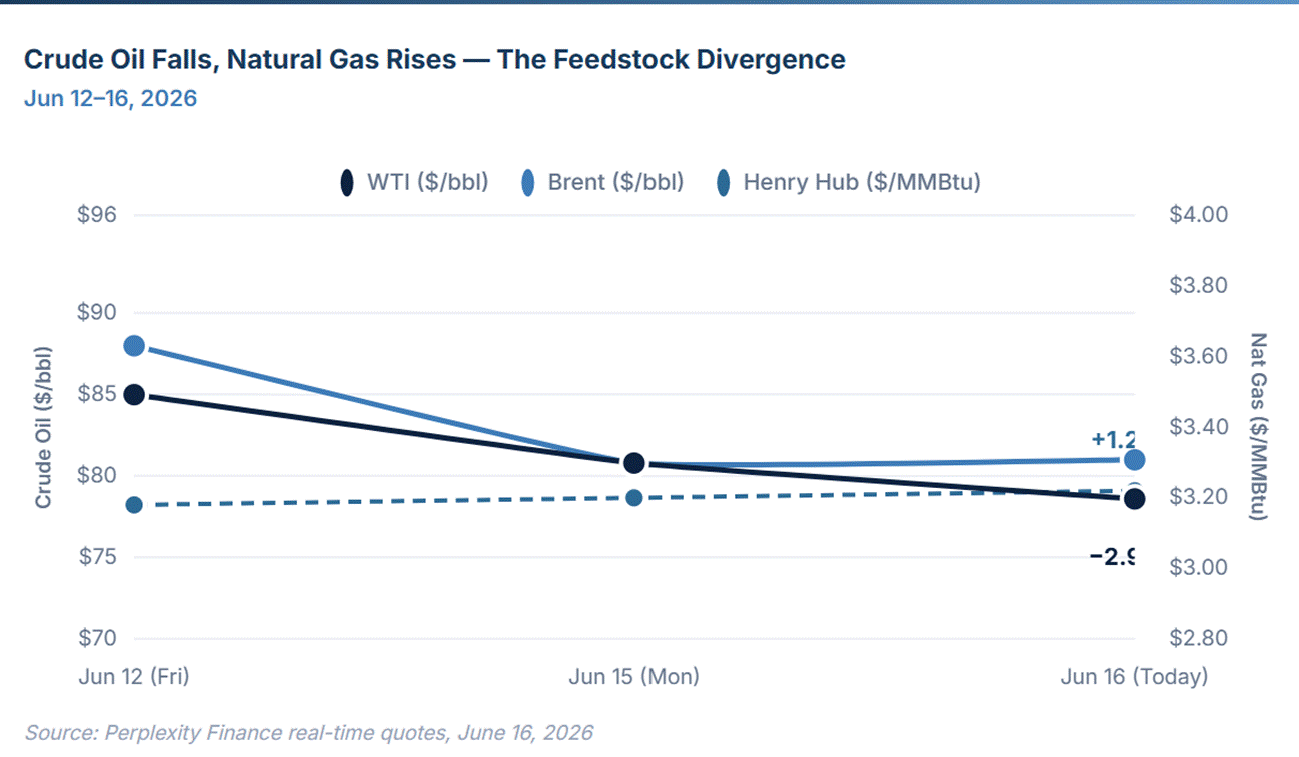
Last week, the question for this publication was whether the war's bifurcation of the global chemical cost curve was a windfall to harvest or a new floor to defend. This week, the question changed because the war itself may be ending. The U.S. and Iran announced a deal on June 14 and 15. Trump declared it complete, with a formal signing scheduled for June 19 in Geneva that authorizes the toll-free reopening of the Strait of Hormuz.[1] Crude is voting with conviction. WTI sits at $78.34, down 2.98 percent on the session. Brent is at $81.05, off 2.55 percent — a second consecutive collapse that takes Brent to its lowest level since early March, more than $40 per barrel below the early May peak.[2] The risk premium that defined the last four months is unwinding in real time.
Here is the call for readers, and it is deliberately contrarian. The market is pricing the peace faster than the physical world can deliver it, and that gap is the entire trade for the next quarter. A signed MOU does not de-mine a strait. As of this week, Hormuz traffic remains roughly 95 percent below pre-war levels, and the people who model this for a living, ClearView Energy, put de-mining and the resumption of tanker traffic at weeks to months, with facility repair and output restoration at multiple quarters to years.[3] QatarEnergy says it can reach 50 percent of LNG capacity one month after safe passage is restored and 80 percent within two.[4] But the phrasing "after safe passage is restored" is doing enormous work in that sentence. And the roughly 85 percent of Iranian petrochemical capacity that was physically destroyed at Mahshahr and South Pars does not come back on a diplomatic signature at all. That is a multi year reconstruction.[5]
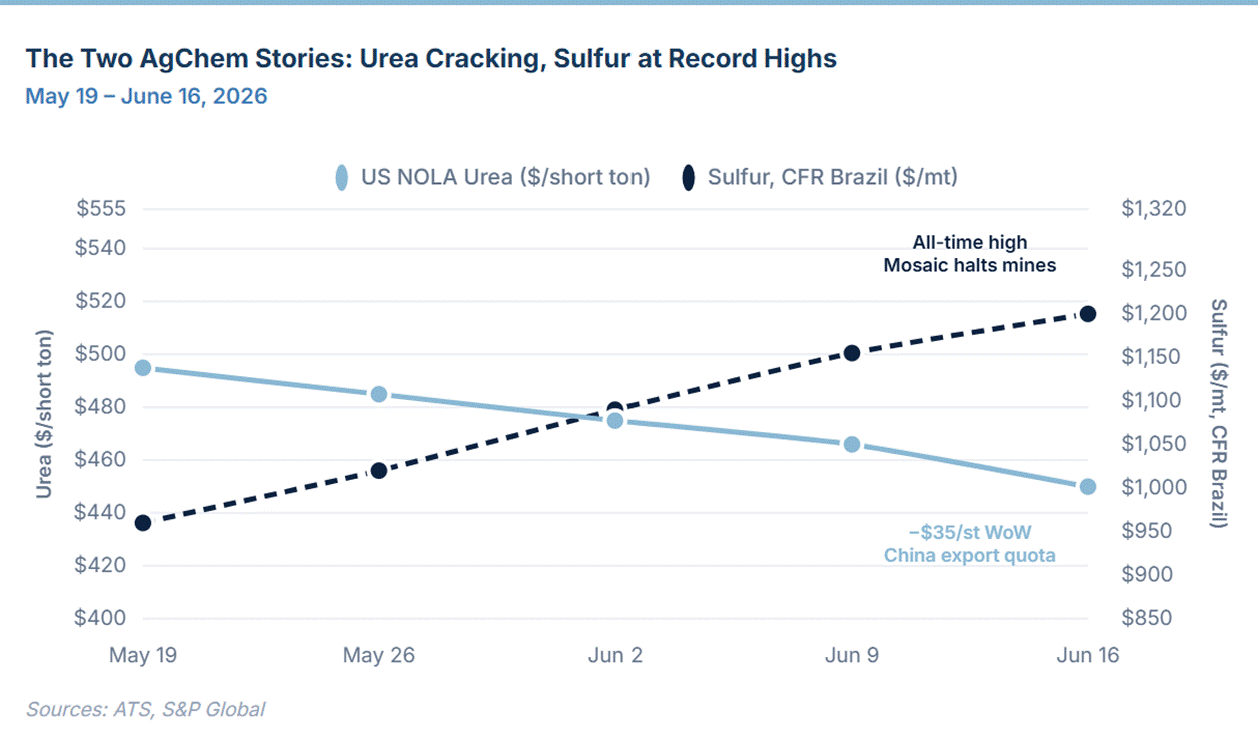
This is why the response across the chemical chain is, correctly, uneven and why the businesses this publication serves should resist the temptation to treat peace as a single trade. Feedstock-linked commodities are repricing immediately. U.S. spot petrochemical prices began retreating the moment the deal hit the tape.[6] U.S. urea fell $35 per short ton week on week as the same crude logic and, also factoring in a fresh Chinese export quota, flipped sentiment from tight to ample.[7] But the physical supply squeezes are still tightening. Seaborne sulfur, half of which transits Hormuz, hit an all time high near $1,200 per metric ton CFR Brazil, forcing Mosaic to halt two Brazilian phosphate mines effective June 1.[8] BASF's CEO used June 9 to warn that sulfur, helium, and specialty gas stockouts remain a genuine downside risk into the second half.[9] The molecules that are priced off a screen are falling today. The molecules that must physically move through a mined waterway will not.
The strategic implication fans out by audience. For U.S. producers and the energy companies feeding them, the ethane advantage that drove Dow's 10 percent Q2 guidance raise is narrowing at the margin but not disappearing. Natural gas actually ticked up to $3.19, up 1.24 percent, even as crude fell,[10] and PE suppliers still expect roughly half the global supply disruption to persist through year end. The danger is the June PE price increase: a $0.20 per pound hike that looked easy at $94 crude looks shaky at $78, and this publication expects it to land only partially.
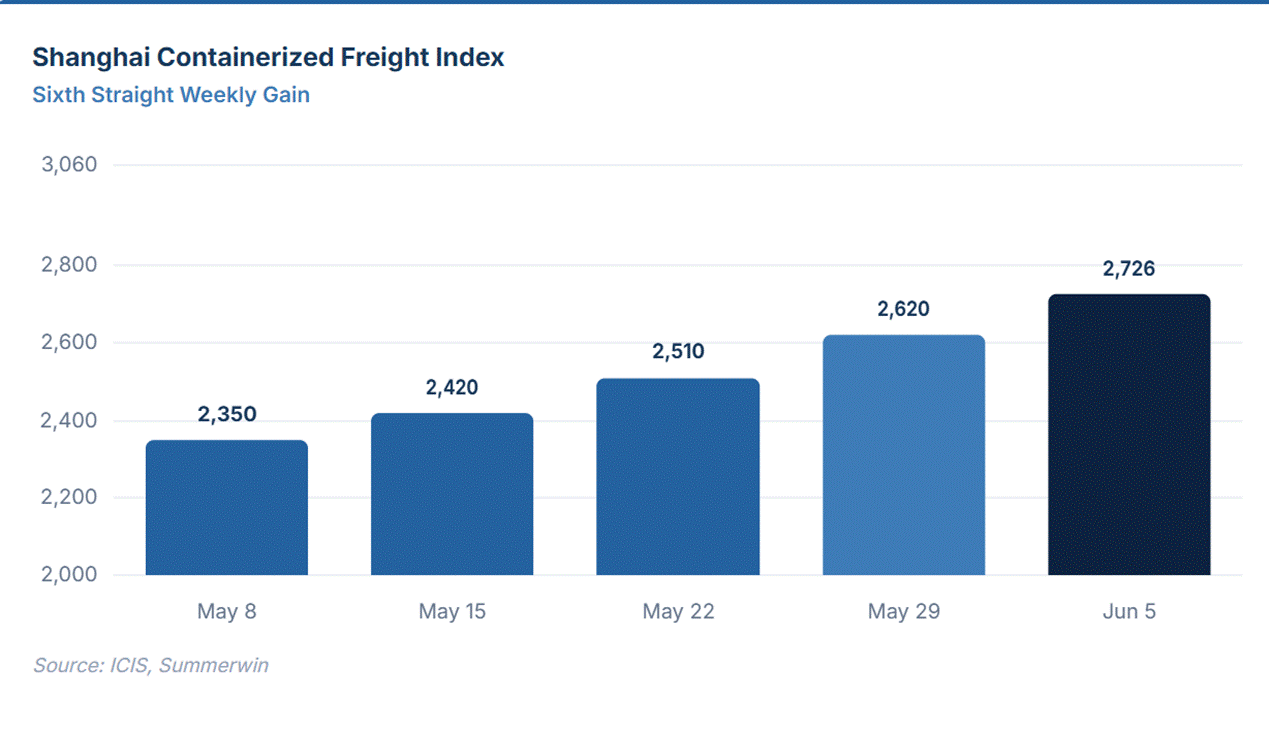
For manufacturers and distributors, the lesson of the last month holds. Input risk has migrated into the freight lane, where the Shanghai index just notched its sixth straight weekly gain to 2,726, and Maersk's $1,000 per TEU peak surcharge takes effect tomorrow, June 17.[11] For traders and analysts, the cleanest expression of this thesis is the basis between paper and physical: short the war premium in crude linked benzene and naphtha, but respect the physical floor under sulfur, helium, and Middle East ammonia until the first commercial tanker actually clears Hormuz. That transit, not the Geneva signature, is the signal that turns the peace dividend from a forecast into a fact.
We lean cautious on the speed, constructive on the direction. The deal could still fracture on the unresolved pieces including Israel's refusal to leave Lebanon, Iran's enriched uranium stockpile, and the 60 day nuclear timeline.[1] But even a clean signing buys you only a calendar, not a cargo. Watch the water, not the wire.
Petrochemicals and Commodity Chemicals
The Premium Is Unwinding
U.S. spot petrochemical prices began retreating the week of June 15 as the Iran deal and falling feedstock costs flowed through.[6] Prior week reference points: U.S. spot ethylene ran 13.75 to 16.50 cents per pound, and PGP sat near 31.77 cents per pound, both set to compress as Brent and ethane normalize.
Cracker Restarts Signal Confidence
Taiwan's Formosa Petrochemical lifted its force majeure on olefins effective June 3 after a near three month outage. Its No. 3 cracker, with 1.2 million tonnes per year of capacity, is scheduled for an end of June or early July turnaround specifically to reconfigure for ethane feedstock.[12] That reconfiguration decision is a direct vote for the U.S. ethane advantage thesis from a major Asian producer that would not make this switch unless it expected the economics to hold for years, not weeks.
Benzene at the Turn
European benzene held near a four year high, around $1,550 per tonne offers, the widest spread since July 2022, on Hormuz driven naphtha costs and a reopened transatlantic arbitrage. With crude breaking lower, this is the most exposed aromatic to a fast repricing lower among the major commodity chemicals tracked this week.
Methanol: A Structural Prop That Crude Cannot Touch
Methanex June contract prices: North America $1,480 per metric ton, Europe €850 per metric ton, Asia Pacific $740 per metric ton, China $610 per metric ton.[13] Iran, the world's second largest methanol exporter before the war, stays offline for the foreseeable future. That is a structural prop under global methanol even as crude falls, and it is the clearest example in the entire chemicals complex of a price floor that a diplomatic signature cannot lower, because the capacity itself, not just the shipping route, needs to be rebuilt.
Projection:
Crude linked olefins and aromatics reprice lower over the next two to four weeks. The swing factor flips from last week. Instead of "will the premium hold", the question is "how fast naphtha falls and revives idle Asian crackers". Expect the U.S. ethane lead to narrow but persist. Gas at $3.19 is not following crude down.
Specialty and Fine Chemicals
Carlyle and BASF Coatings: Cleared, With a Remedy
The EU approved Carlyle's acquisition of BASF's coatings business on June 2 and 3, conditioned on divesting Nouryon's global polysulfides business specifically to preserve competition in aerospace sealants.[14] For adhesives and sealants buyers, this is a clean read through: aerospace grade polysulfide supply stays competitive even after the deal closes.
BASF's Strategic Pivot Comes Into Focus
BASF's June 8 and 9 investor deep dive detailed the now inaugurated Zhanjiang Verbund site in China, an $8.7 billion investment, completed below budget, targeting €4 to 5 billion in sales by 2030, with slightly negative EBITDA in 2026 turning positive in 2027.[15] The coatings sale to Carlyle funds this pivot to China core chemistry directly, making the two transactions two halves of the same strategic decision.
Footprint Rationalization Continues
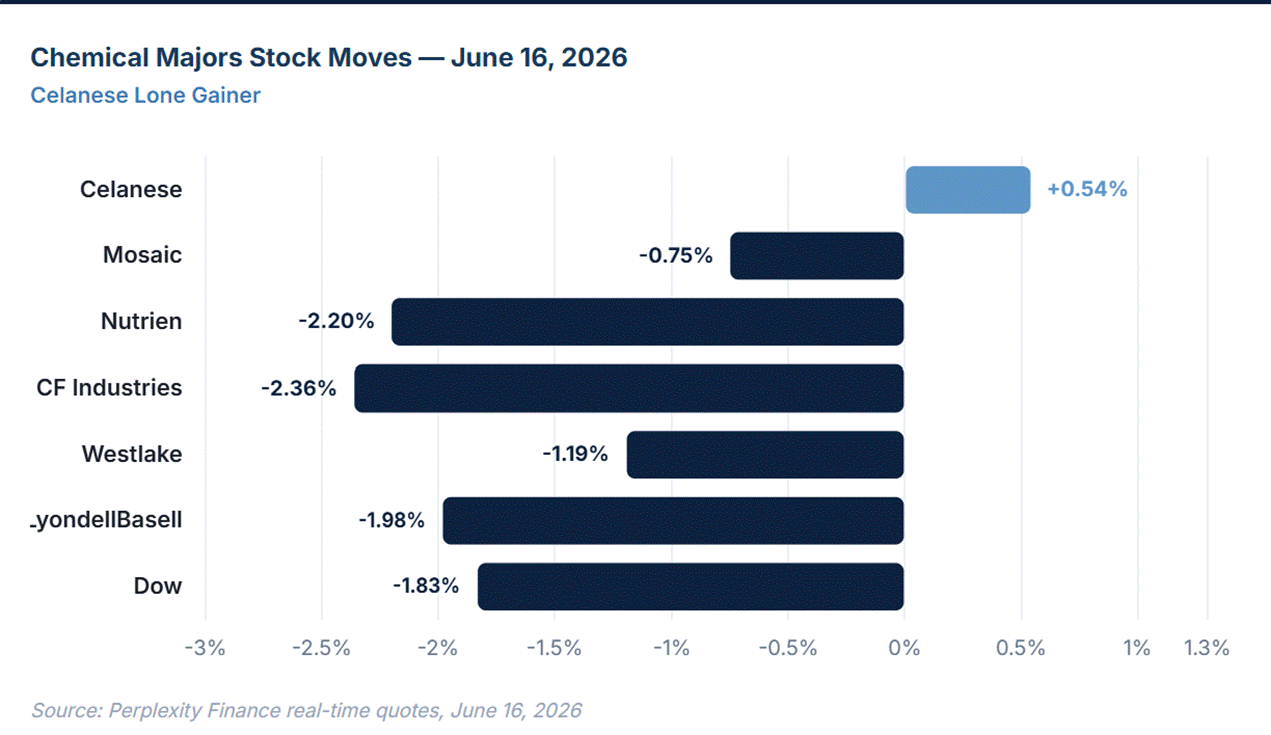
Celanese closed its Ulsan, South Korea engineered materials plant on June 4 and 5, shifting volume to China and India.[16] Celanese trades at $53.77 today, up 0.54 percent, the lone gainer among the chemical majors tracked this week. Eastman pushed an esters price increase in the Americas effective June 1.[17]
API Relief Is Coming, Slowly
BASF's up to 20 percent excipient and API price increase, effective April, and India's doubled paracetamol input costs were both war driven. The deal should ease these over the next 60 to 90 days, but that relief lags the crude move significantly, which is the pattern across specialty chemicals more broadly this week.
Projection:
Specialty margins lag feedstock by four to eight weeks, so the relief from falling crude shows up in late Q3. M&A remains the structural story. Expect more European asset divestiture as the majors concentrate capital toward Asia.
Agricultural Chemicals
Urea Is Cracking
U.S. NOLA urea fell $35 per short ton week on week to $440-467 per short ton FOB range.[7] Three drivers stack up: spring top dress demand is ending, China's second 2026 export quota of 750,000 metric tons through September is flipping sentiment to ample, and India's large May tender is already covered. This is the clearest peace dividend print anywhere in agricultural chemicals this week.
But Sulfur Is Still at the Top
Seaborne sulfur hit all time highs, approximately $815 to $820 per metric ton FOB Middle East and roughly $1,200 per metric ton CFR Brazil, with roughly half of global seaborne sulfur transiting Hormuz.[8] This forced Mosaic to halt the Catalão mine for 45 days and the Tapira mine for 30 days effective June 1, and prompted Egypt's EFIC to idle three SSP plants. Mosaic trades at $22.52 today, down 0.75 percent. This is the physical floor side of the thesis expressed in a single commodity.
Phosphate Firm, Nitrogen Names Soft on the Deal
NOLA DAP sits near $790 per short ton, MAP near $800 to $805 per short ton, both elevated but illiquid as buyers sit out.[18] CF Industries, which posted Q1 adjusted EBITDA of $983 million, up 53 percent year over year,[19] fell to $106.90 today, down 2.36 percent, and Nutrien fell to $66.13, down 2.20 percent, as the ceasefire pressures the nitrogen premium specifically.
Projection:
Nitrogen eases faster than phosphate. China export curbs and the sulfur squeeze keep DAP and MAP firmer for longer. Watch Mosaic's mine restart timing closely. With Hormuz still mined, sulfur relief is weeks away, not days.
Polymers and Plastics
Dow's Dual Signal
Dow raised its Q2 EBITDA guidance approximately 10 percent to $2.2 billion on PE and PU strength on June 9, while simultaneously confirming 605 Dutch job cuts on June 4, citing high energy costs.[20] Dow trades at $33.23 today, down 1.83 percent. That is the bifurcation in one company: harvest U.S. margins, shrink the European footprint. There is no cleaner illustration anywhere in this week's chemicals coverage of the regional split this publication has been tracking since the disruption began.
The June PE Increase Is the Week's Tell
Suppliers are pushing roughly a 20 cent per pound June PE increase, but Plastics Technology calls it very fluid and crude dependent.[21] At $78 WTI, this publication expects only partial implementation. Reliance Industries did raise Indian domestic PE prices effective June 10, suggesting at least some regional markets are willing to test the increase even as the broader crude backdrop weakens.
Europe Keeps Rationalizing
LyondellBasell confirmed closure of its last Brindisi, Italy PP plant, with 260,000 tonnes per year of capacity, by year end, and completed the sale of four European olefins and polymers assets, now operating as Velogy, at an estimated $700 to $800 million loss.[22] LYB trades at $63.30 today, down 1.98 percent. Westlake trades at $87.45, down 1.19 percent.
Projection:
PE stays better supported than PP. Roughly half the global ethylene and PE disruption is expected to persist through 2026, while China's new PP capacity caps polypropylene. The risk to U.S. PE margins is now demand, whether the June increase sticks, not feedstock.
Industrial Biotechnology and Bio-Based Chemicals
EIA Holds the Line
The June 9 EIA Short Term Energy Outlook kept 2026 renewable diesel at 240,000 barrels per day, up from 190,000 in 2025, and SAF at 40,000 barrels per day.[23] The 2026 Renewable Fuel Standard volume of 24.02 billion gallons took effect June 15.[24]
Policy Mix Shifting
Colorado signed a SAF purchase tax credit on June 3, pivoting from supply side to demand side support.[23] On the downside, SunGas Renewables halted its Louisiana wood to methanol biorefinery, a reminder that not every bio based project is finding a viable path forward even with policy support building.
Projection:
Falling crude erodes the relative economics of bio based routes. The war had quietly narrowed the green premium, and peace widens it back. Watch renewable diesel and SAF margins compress if crude keeps sliding. Policy, including the RFS and state credits, becomes the marginal support rather than feedstock arbitrage.
Cross-Cutting: Supply Chain, Sustainability, and Regulation
Freight at the Inflection
The Shanghai Containerized Freight Index hit 2,726 on June 5, a sixth straight weekly gain, with Asia to U.S. West Coast at $4,552 per FEU, the highest since July 2025, and East Coast at $5,741 per FEU.[11] Maersk's $1,000 per TEU peak season surcharge takes effect tomorrow, June 17. But U.S. liquid chemical tanker rates are already softening as buyers anticipate the deal, the leading edge of the turn that this entire editorial has been built around.
PFAS Rollback Advancing
EPA's May 18 to 20 proposals would rescind drinking water limits for four PFAS compounds, PFHxS, PFNA, HFPO DA, plus a hazard index, while keeping PFOA and PFOS at 4 parts per trillion, and would offer compliance extensions to 2031.[25] States are expanding consumer product restrictions independently, a widening federal and state split that complicates supply chain traceability for any manufacturer selling across multiple state regulatory regimes.
TSCA Cliff Approaching
TSCA Title I fee authority expires September 30. Without reauthorization, EPA's chemical review program reverts to discretionary appropriations amid staffing cuts, with no Congressional action yet.[26] EU REACH continues with targeted updates rather than a fundamental revision. ECHA released its five year operation report June 5.
Projection:
Container rates should roll over within two to four weeks if Hormuz reopening lets carriers shift cargo off the Cape route, a potential $1,000 to $2,000 per FEU unwind. The U.S. Section 122 tariff window expiring July 24 removes a front loading demand prop. This is the pivot into the Freight Rates and Trends stage of the Framework.
Executive Takeaway
- The peace dividend is real but arrives at different speeds for different molecules. Crude linked olefins and aromatics are repricing within days. Sulfur, helium, and Middle East ammonia stay tight until a commercial tanker actually clears Hormuz, not when the MOU is signed.
- Natural gas rising while crude falls is the single most important data point this week for U.S. producers. Dow's ethane advantage narrows at the margin but persists. PE suppliers still expect roughly half the global supply disruption to last through year end.
- The June PE price increase is the week's clearest test of demand versus feedstock logic. A 20 cent per pound hike made sense at $94 crude. At $78, expect only partial implementation, with regional exceptions like Reliance's Indian increase.
- Urea and sulfur are telling opposite stories inside the same agricultural chemicals complex. Urea fell $35 per short ton on a Chinese export quota and ending demand. Sulfur hit an all time high because half of it physically transits a still mined waterway. Nitrogen eases faster than phosphate.
- Specialty chemical margin relief lags feedstock by four to eight weeks. API and excipient cost relief from the deal will not show up until late Q3 even if crude keeps falling today.
- Container freight rates are at cycle highs precisely as the catalyst for their reversal comes into view. A potential $1,000 to $2,000 per FEU unwind is in play over the next month if Hormuz reopening proceeds and carriers shift cargo off the Cape route.
Signals to Watch
Signal 1: First Commercial Tanker Transit Through Hormuz
This is the signal that turns the peace dividend from forecast to fact, more important than the Geneva signing itself. Watch Kpler and Vortexa vessel tracking data daily.
Signal 2: Whether the June PE Price Increase Lands Full, Partial, or Not at All
The cleanest real time test of whether buyers believe the crude decline is durable. Watch ICIS and Plastics Technology pricing updates over the next two weeks.
Signal 3: Mosaic's Catalão and Tapira Mine Restart Timing
The physical floor under phosphate. A restart announcement ahead of the 45 day and 30 day windows would signal sulfur relief is arriving faster than expected. A delay would confirm the Hormuz mining situation is the binding constraint, not just caution.
Signal 4: QatarEnergy LNG Capacity Restoration Milestones
The 50 percent at one month, 80 percent at two month framework QatarEnergy has laid out is contingent on safe passage being restored. Watch for QatarEnergy's own confirmation that safe passage has been achieved, which would start that clock.
Signal 5: Shanghai Containerized Freight Index Weekly Reading
Currently at a sixth consecutive weekly gain. Any reversal would be the first sign that carriers are repositioning capacity off the Cape route in anticipation of Hormuz normalization.
Effect on the Framework
Level 1: Trade Policy and Geopolitics — A Calendar, Not Yet a Cargo
The June 19 Geneva signing is the next formal milestone, but the deal could still fracture on unresolved pieces: Israel's refusal to leave Lebanon, Iran's enriched uranium stockpile, and the 60 day nuclear negotiation timeline.[1] The U.S. Section 122 tariff window expiring July 24 is a separate trade policy variable that removes a front loading demand prop from freight markets regardless of how the Iran situation resolves, and the two calendars, Geneva and the Section 122 expiry, are worth tracking as parallel rather than connected events.
Level 2: Energy — The Master Switch Flipped This Week
Crude fell a second straight session, WTI $78.34 down 2.98 percent, Brent $81.05 down 2.55 percent, on the U.S. Iran deal, while U.S. natural gas rose to $3.19, up 1.24 percent.[2][10] That divergence is the whole story for energy this week: crude linked naphtha and aromatics reprice lower immediately, while gas linked ethane keeps U.S. crackers structurally advantaged. The energy stage's narrative, Hormuz reopening, is being priced ahead of the physical reality, and chemicals are transmitting that gap directly into commodity and specialty pricing.
Level 4: Commodities — The Peace Dividend Reaches the Planted Acre, Unevenly
Urea falling to $440 to $467 per short ton, down $35 week on week, eases nitrogen input costs into grain models. Sulfur at all time highs, near $1,200 per metric ton CFR Brazil, is forcing phosphate mine curtailments that will keep DAP and MAP firm.[7][8] Net effect for the commodities layer: nitrogen intensive crops see cost relief first, phosphate intensive ones lag. The corn fertilizer affordability picture improves on the margin but not uniformly, and this should be read alongside the grain market's own decoupling from crude that has been the dominant commodities theme since early June.
Level 6: Freight Rates and Trends — The Molecule Cheapens This Week, the Freight Unwinds Next
Container rates are at cycle highs, SCFI 2,726, a sixth straight weekly gain, precisely as the catalyst for their reversal, Hormuz reopening, comes into view.[11] The softening in U.S. liquid chemical tanker rates is the leading indicator: tanker owners who captured crisis pricing are seeing demand pull back first. If the June 19 signing holds and de mining proceeds, expect carriers to shift cargo off the 10 to 14 day Cape route, collapsing transpacific and Asia to Europe box rates over the coming month. A $1,000 to $2,000 per FEU unwind is a realistic range for that move.
Citations
[1] NPR / PBS NewsHour. 2026. 'U.S. and Iran Announce Deal, Formal Signing Set for Geneva June 19.' NPR.org / PBS.org. June 14-15, 2026.
[2] Perplexity Finance. 2026. 'Real Time Crude Oil Quotes: WTI $78.34 (-2.98%), Brent $81.05 (-2.55%).' June 16, 2026, approximately 6:18 AM CDT.
[3] ClearView Energy / Global Energy Flow. 2026. 'Hormuz De-Mining and Tanker Traffic Resumption Timeline Estimates.' June 2026.
[4] Bloomberg. 2026. 'QatarEnergy: LNG Capacity Restoration at 50% One Month, 80% Two Months After Safe Passage Restored.' Bloomberg.com. June 2026.
[5] New York Times. 2026. 'Iranian Petrochemical Capacity at Mahshahr and South Pars: 85% Physically Destroyed, Multi-Year Reconstruction.' NYTimes.com. June 2026.
[6] Bloomberg. 2026. 'U.S. Spot Petrochemical Prices Begin Retreating as Iran Deal Hits Tape.' Bloomberg.com. June 15-16, 2026.
[7] ATS / IFDC. 2026. 'U.S. NOLA Urea Falls $35/Short Ton Week-on-Week on China Export Quota.' AgriculturalTradeServices.com. June 2026.
[8] S&P Global. 2026. 'Seaborne Sulfur Hits All-Time High Near $1,200/mt CFR Brazil; Mosaic Halts Catalão and Tapira Mines.' SPGlobal.com. June 2026.
[9] Chemnet. 2026. 'BASF CEO Warns Sulfur, Helium, Specialty Gas Stockouts Remain Downside Risk.' Chemnet.com. June 9, 2026.
[10] Perplexity Finance. 2026. 'Real Time Natural Gas Quote: Henry Hub $3.19 (+1.24%).' June 16, 2026.
[11] ICIS / Summerwin. 2026. 'Shanghai Containerized Freight Index Hits 2,726, Sixth Straight Weekly Gain; Maersk $1,000/TEU Peak Surcharge Effective June 17.' June 2026.
[12] ICIS. 2026. 'Formosa Petrochemical Lifts Force Majeure on Olefins; No. 3 Cracker Turnaround for Ethane Feedstock Conversion.' ICIS.com. June 3, 2026.
[13] Methanex. 2026. 'June Contract Prices: North America $1,480/MT, Europe €850/MT, Asia Pacific $740/MT, China $610/MT.' Methanex.com. June 2026.
[14] ChemAnalyst. 2026. 'EU Approves Carlyle Acquisition of BASF Coatings, Conditioned on Nouryon Polysulfides Divestiture.' ChemAnalyst.com. June 2-3, 2026.
[15] Spray Foam Magazine. 2026. 'BASF Investor Deep Dive: Zhanjiang Verbund Site, $8.7B, Targeting €4-5B Sales by 2030.' SprayFoamMagazine.com. June 8-9, 2026.
[16] Polyestertime. 2026. 'Celanese Closes Ulsan, South Korea Engineered Materials Plant.' Polyestertime.com. June 4-5, 2026.
[17] Eastman. 2026. 'Esters Price Increase in the Americas Effective June 1.' Eastman.com. June 2026.
[18] ATS. 2026. 'NOLA DAP ~$790/st, MAP ~$800-805/st.' AgriculturalTradeServices.com. June 2026.
[19] CF Industries. 2026. 'Q1 2026 Adjusted EBITDA $983 Million, +53% Year-over-Year.' CFIndustries.com. 2026.
[20] ICIS / Dutch News. 2026. 'Dow Raises Q2 EBITDA Guidance ~10% to $2.2B; Confirms 605 Dutch Job Cuts Citing High Energy Costs.' June 4-9, 2026.
[21] Plastics Technology. 2026. 'June PE Price Increase Called Very Fluid and Crude-Dependent.' PlasticsTechnology.com. June 2026.
[22] Argus / Chemnet. 2026. 'LyondellBasell Confirms Brindisi, Italy PP Plant Closure; Completes Sale of Four European O&P Assets as Velogy at Estimated $700-800M Loss.' June 2026.
[23] Biomass Magazine. 2026. 'EIA June STEO: 2026 Renewable Diesel 240,000 b/d, SAF 40,000 b/d; Colorado SAF Purchase Tax Credit Signed.' BiomassMagazine.com. June 3-9, 2026.
[24] EPA. 2026. '2026 Renewable Fuel Standard Volume of 24.02 Billion Gallons Takes Effect.' EPA.gov. June 15, 2026.
[25] Morgan Lewis. 2026. 'EPA Proposes Rescinding Drinking Water Limits for Four PFAS Compounds, Compliance Extensions to 2031.' MorganLewis.com. May 18-20, 2026.
[26] Legis1 / DLA Piper / CIRS. 2026. 'TSCA Title I Fee Authority Expires September 30; EU REACH Five-Year Operation Report Released June 5.' June 2026.